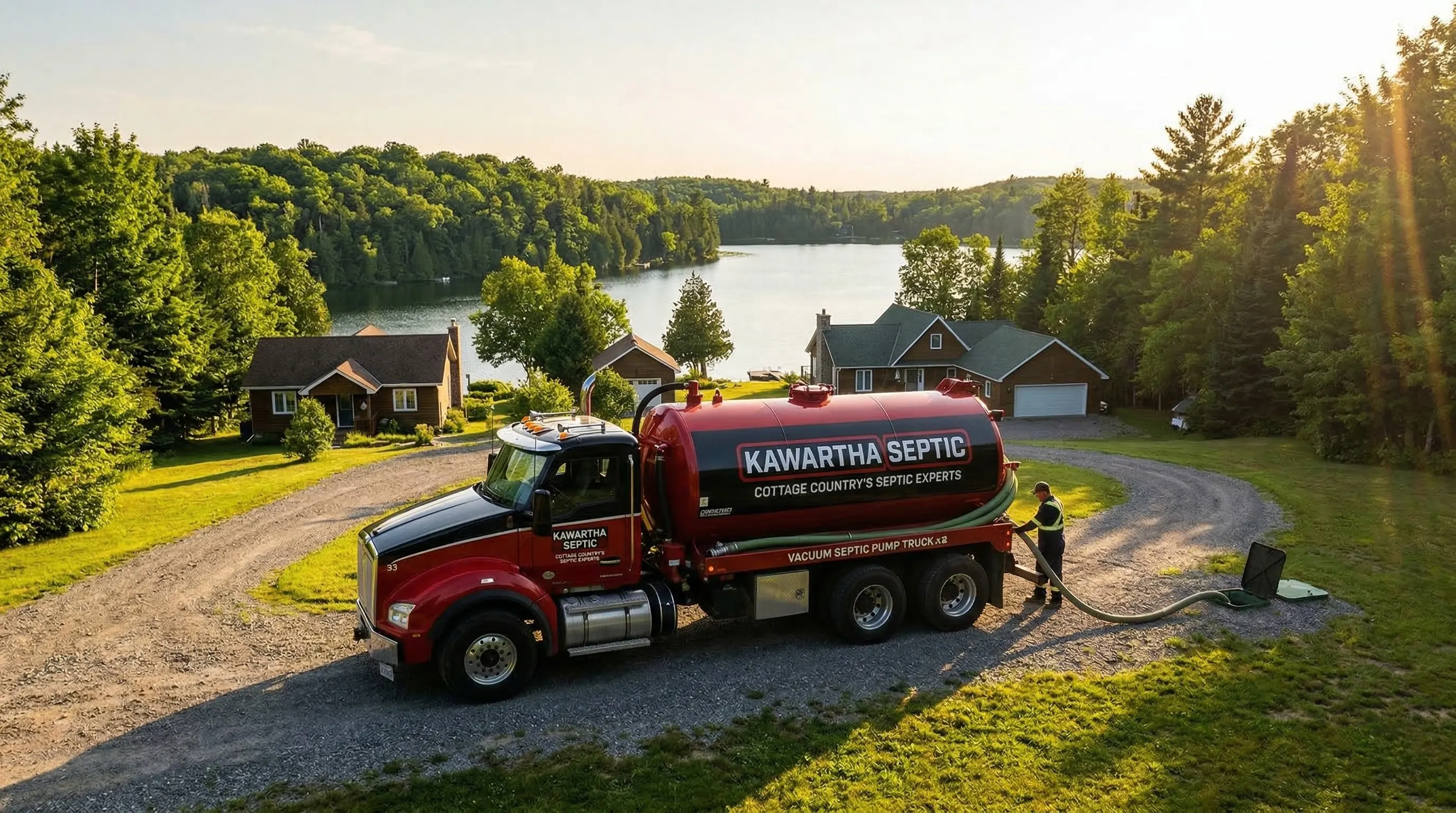
A homeowner in Fenelon Falls called us last year after her septic system failed. Sewage was pooling in the backyard. Drains were barely moving. The smell was bad enough that the neighbours noticed.
She’d been flushing Rid-X down her toilet every single month for eight years. Never missed once. She had receipts to prove it. She’d spent over $600 on the stuff.
She hadn’t pumped the tank in a decade.
When we opened the lid, the tank was packed with sludge. The outlet baffle was completely blocked. The drain field was saturated with solids that should’ve been removed years ago. She needed a full system repair that cost her thousands.
“But I used the additives,” she said. “The box said it reduces the need for pumping.”
That’s the problem. It doesn’t. And this woman’s story isn’t unusual. We see some version of it multiple times a year across Kawartha Lakes.
So let’s settle this once and for all. Do septic tank additives work? Here’s the truth.
The Short Answer
No. Septic tank additives are not necessary, and they don’t replace proper maintenance. Your septic tank already has everything it needs to break down waste. The bacteria that do the work arrive with the waste itself. You don’t need to buy them in a box.
That might sound blunt, but it’s backed by decades of research. The U.S. Environmental Protection Agency doesn’t recommend septic additives. The Ontario government’s guidelines on septic systems don’t mention them as part of proper maintenance either.
If you’re wondering whether you should be flushing Rid-X, bacteria packets, or enzyme treatments into your system, the answer is: save your money. Spend it on regular pumping instead.
What Septic Additives Claim to Do
Walk down the plumbing aisle at any hardware store in Lindsay or Bobcaygeon and you’ll find a shelf full of septic tank additives. They all make similar promises:
- Break down solids faster so your tank doesn’t fill up as quickly
- Restore bacterial balance in your tank after using cleaning products
- Reduce or eliminate the need for pumping
- Prevent drain field clogs by dissolving buildup
- Keep your system running smoothly between service visits
Sounds great, right? The packaging is convincing. The testimonials are glowing. Some products even claim to be “recommended by septic professionals.”
Here’s the thing. Those claims aren’t supported by independent research. Not one of them.
What the Research Actually Shows
Multiple university and government studies have tested septic tank additives over the past 30 years. The results are consistent.
A widely cited study from Washington State found that septic tank additives provided no measurable benefit to system performance. Tanks treated with additives and untreated tanks performed the same.
Research from the University of Minnesota came to the same conclusion. Biological additives didn’t speed up the breakdown of solids in any meaningful way. The bacteria already present in human waste were doing the job just fine on their own.
The National Small Flows Clearinghouse reviewed the available science and concluded there was no evidence that additives helped, and some evidence that certain products could cause harm.
The bottom line from all this research: a healthy septic tank doesn’t need help. It’s a biological system that manages itself. Billions of anaerobic bacteria are already at work in your tank, breaking down organic matter 24 hours a day. Flushing a packet of freeze-dried bacteria into a tank that already contains trillions of live bacteria does essentially nothing.
Think of it like adding a cup of water to a swimming pool. The pool doesn’t notice.
Can Additives Cause Harm?
Some of them can. And that’s the part most people don’t hear about.
Chemical additives are the worst offenders. Products that contain strong acids, alkalis, or organic solvents can kill the bacteria in your tank. That’s the opposite of what you want. These products are marketed as drain cleaners or “system rejuvenators,” but they can wipe out the biological activity your tank depends on.
Some chemical additives have been shown to break up the sludge layer in the tank. That also sounds like a good thing, but it’s not. The sludge layer is supposed to stay at the bottom. When chemical additives suspend those solids in the liquid, the particles get pushed out into your drain field. Your drain field isn’t designed to filter solids. Once those particles clog the soil, the damage is expensive and sometimes irreversible.
Biological additives are less harmful. Products like Rid-X that contain bacteria and enzymes won’t hurt your system in most cases. But they won’t help it either. You’re paying for something your tank already produces naturally.
The one situation where biological additives could theoretically help is after you’ve dumped a large amount of antibacterial chemicals into the system. Even then, the bacterial population in your tank will recover on its own within a few days. You don’t need to buy a product to speed that up.
What About Biological vs Chemical Additives?
Since this question comes up a lot, let’s break it down clearly.
Biological additives include products like Rid-X, Bio-Clean, and various “septic bacteria” packets. They contain strains of bacteria and enzymes that are supposed to help with decomposition. They’re not harmful to your system, but they’re redundant. Your tank already has a thriving colony of the exact bacteria these products provide. Independent testing shows no performance difference between treated and untreated tanks.
Chemical additives include products containing hydrogen peroxide, sulfuric acid, formaldehyde, quaternary ammonium, and zinc sulfate. Some are sold as “septic system cleaners.” Others are general drain cleaning products that people dump into septic systems without thinking about the consequences.
These products can:
- Kill beneficial bacteria in the tank
- Break up the sludge layer and push solids into the drain field
- Corrode concrete tanks and metal components
- Contaminate groundwater (a real concern in the Kawartha Lakes region where many homes rely on wells)
If someone is selling you a chemical septic additive, walk away. If someone tells you biological additives are the best septic tank treatment, they’re selling you something you don’t need.
What Actually Keeps Your System Healthy (Spoiler: Pumping)
Here’s what actually works. None of it comes in a box.
Regular Pumping
This is the single most important thing you can do for your septic system. Your tank accumulates sludge that bacteria can’t fully break down. That sludge has to be physically removed. No additive changes this fact.
Most homes in the Kawartha Lakes area need pumping every 3 to 5 years. The exact schedule depends on your tank size, household size, and water usage. The cost of septic pumping in Ontario is a fraction of what you’ll pay if the system fails.
A homeowner in Coboconk told us last spring that he’d been buying Rid-X for five years at about $8 a month. That’s roughly $480 spent on a product that did nothing. He could’ve had two full pumpings for less than that, and his tank would’ve actually been maintained.
Don’t guess at your pumping schedule. Book a pumping appointment or call us at (705) 242-0330.
Watch What Goes Down the Drain
Your septic system can handle human waste and toilet paper. That’s about it. Things that cause real problems include:
- Cooking grease and fats
- Wet wipes (even “flushable” ones aren’t septic-safe)
- Feminine hygiene products
- Coffee grounds
- Paints, solvents, and chemicals
- Antibacterial soaps and cleaners in large amounts
These items either don’t break down or they kill the bacteria that are supposed to do the breaking down. Check out our full list in our septic tank maintenance tips guide.
Protect Your Drain Field
Don’t park vehicles on it. Don’t plant trees near it. Don’t direct roof drainage or sump pump discharge onto it. The drain field needs to absorb effluent from the tank, and it can’t do that if the soil is compacted or waterlogged.
Spread Out Water Use
Running the dishwasher, washing machine, and showers all at the same time floods the tank faster than it can process. Spread out heavy water use across the day and week.
Get Regular Inspections
An inspection catches problems early. A cracked baffle, a rising sludge level, a wet spot over the drain field. These are all signs your septic system might be failing that a trained eye can spot before they become emergencies.
Want to get your system checked? Call (705) 242-0330 to schedule an inspection or pumping in Kawartha Lakes.
FAQ
Is Rid-X bad for septic systems?
Rid-X isn’t harmful to your septic system. It just doesn’t do anything useful. The bacteria and enzymes in Rid-X are the same types already living in your tank. Adding more doesn’t speed up decomposition or reduce the need for pumping. It’s not dangerous, but it’s not the best septic tank treatment either. Regular pumping is.
Are septic additives necessary?
No. Septic additives are not necessary. Your tank naturally produces the bacteria it needs from the waste that enters it. No government agency or independent research body recommends septic additives as part of routine maintenance. Proper pumping, mindful water use, and keeping the wrong things out of your drains are what keep your system working.
What is the best thing to put in your septic tank?
Nothing except what’s supposed to go there: human waste and toilet paper. That’s it. Your septic system was designed to process those materials using naturally occurring bacteria. The best thing you can do for your system is pump it on schedule and avoid flushing anything that doesn’t belong.
Can septic tank bacteria additives restart a dead system?
If your system has failed, no additive will bring it back. A failed drain field, a cracked tank, or a blocked outlet needs professional repair. Dumping bacteria packets into a system that’s already showing failure signs is like putting a bandage on a broken bone. Call a professional instead.
How often should I pump my septic tank instead of using additives?
Most households need pumping every 3 to 5 years. A two-person household with a large tank might stretch to 5 years. A family of five with a smaller tank might need it every 2 to 3 years. We cover all the details in our guide on how often to pump your septic tank. The money you’d spend on monthly additives is better put toward staying on a regular pumping schedule.
The Bottom Line
Septic tank additives are one of the most successful marketing stories in the plumbing industry. They’ve convinced millions of homeowners to spend money on a product that independent research consistently shows doesn’t work.
Your septic system doesn’t need additives. It needs pumping. It needs careful use. It needs the occasional professional inspection.
If you’re in Kawartha Lakes, Lindsay, Bobcaygeon, Fenelon Falls, or Coboconk and you’re not sure when your tank was last serviced, don’t buy a box of Rid-X. Call us instead. We’ll check the tank, pump it if it’s due, and make sure your system is actually maintained.
Book your appointment online or call (705) 242-0330.