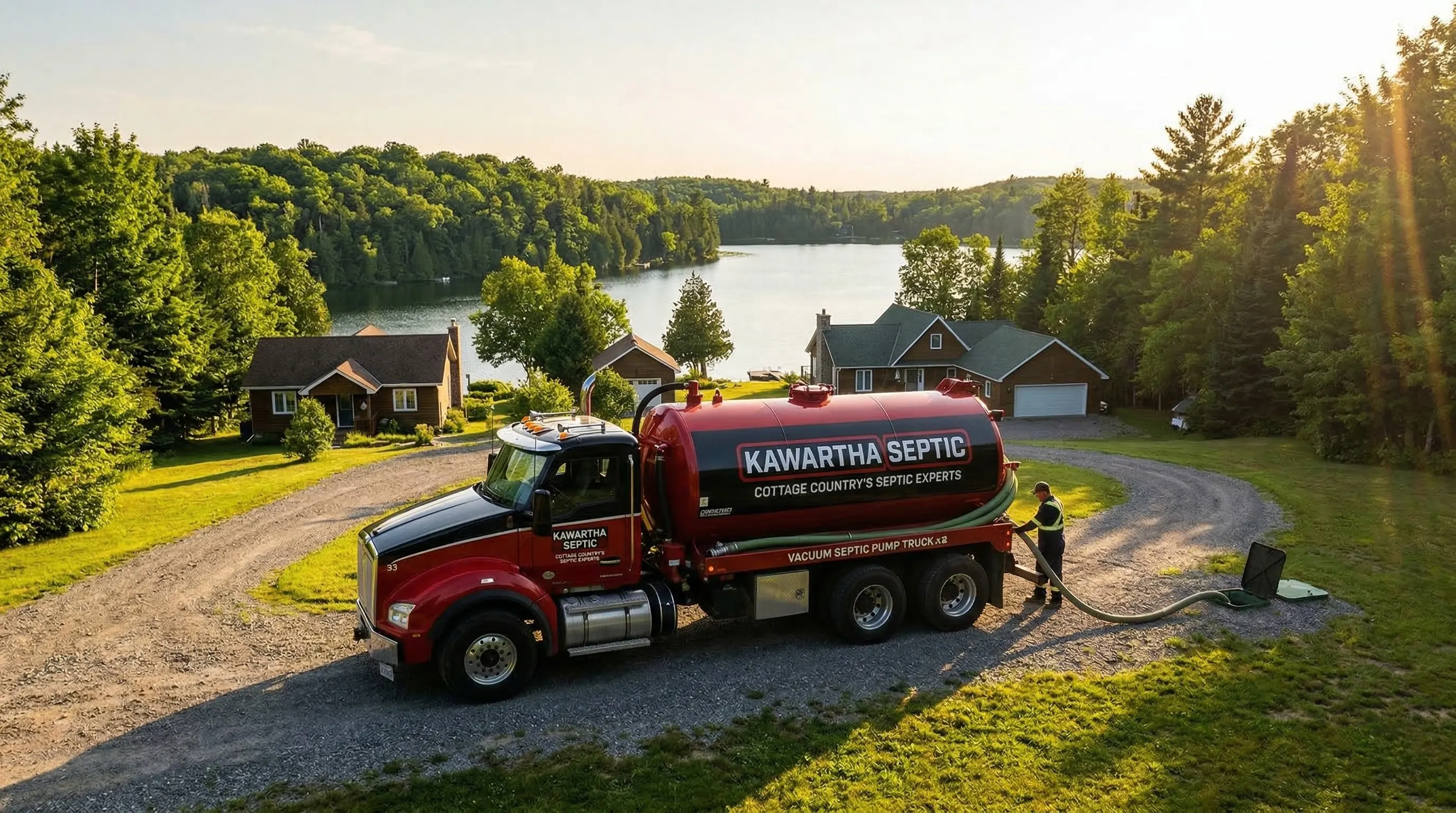
A family in Fenelon Falls called us last summer with a problem. Their toilets were backing up every few months. The tank looked fine. The drain field was in good shape. Turns out, they’d converted their cottage into a year-round home, added a bedroom and a bathroom, and never upgraded the septic tank. The tank was too small for the amount of wastewater they were producing.
This is more common than you’d think. If you’re building a new home, buying a property, or renovating in Kawartha Lakes, you need to know what size septic tank your property requires. It’s not a guess. Ontario has specific rules, and getting it wrong causes real problems.
Here’s your complete septic tank size guide for Ontario properties.
Quick Answer: Septic Tank Size by Number of Bedrooms
Ontario’s Building Code sets minimum septic tank sizes based on bedrooms. Not bathrooms. Not square footage. Bedrooms. The logic is simple: more bedrooms means more potential occupants, which means more wastewater.
Here’s the septic tank size chart for Ontario:
| Bedrooms | Minimum Tank Size (Litres) | Minimum Tank Size (Gallons) |
|---|---|---|
| 1-2 | 3,600 L | 800 gal |
| 3 | 3,600 L | 800 gal |
| 4 | 4,500 L | 1,000 gal |
| 5 | 5,700 L | 1,250 gal |
| 6+ | 5,700 L + additional | 1,250 gal + additional |
For properties with 6 or more bedrooms, you’ll need to add roughly 1,100 litres (250 gallons) for each additional bedroom.
Important: These are minimums. Many installers in the Kawartha Lakes area recommend going one size up, especially if you have a garbage disposal, a hot tub, or extra water fixtures. Bigger is almost always better when it comes to septic tank capacity.
If you’re not sure what size tank you currently have, give us a call at (705) 806-0800. We can check during a routine pumping.
How Ontario Determines Septic Tank Size
So why bedrooms and not bathrooms or people? The Ontario Building Code uses bedrooms because they’re a fixed number that doesn’t change with occupants. A 4-bedroom house might have two people living in it today, but it could have eight tomorrow. The system needs to handle the maximum potential load.
Here’s how the calculation works in practice.
Daily Design Flow
Ontario assumes each bedroom generates roughly 750 litres of wastewater per day for the first two bedrooms, then adds about 350 litres per additional bedroom. This daily design flow determines both the tank size and the drain field size.
The tank needs to hold at least 48 hours of wastewater. That’s the minimum retention time for solids to settle and bacteria to start breaking down waste. If the tank is too small, wastewater moves through too fast. Solids don’t settle properly. They push out into the drain field. And that’s where things get expensive.
The Bedroom Count Isn’t Always Obvious
Here’s where people get tripped up. The Ontario Building Code counts any room that could be used as a bedroom, not just rooms you’re currently using as bedrooms. That home office with a closet? It counts. The “den” on the real estate listing that has a window and a door? It probably counts too.
When you apply for a septic permit in Ontario, the inspector will look at the floor plan and make the call. If they count more bedrooms than you expected, you’ll need a larger tank.
Soil Conditions Matter Too
Your soil type affects the drain field, but it can also influence tank sizing recommendations. Properties in the Lindsay and Bobcaygeon area often have clay-heavy soil, which drains slowly. In these conditions, some designers will recommend a larger tank to give the effluent more time to settle before it reaches the drain field.
A proper site evaluation tests the soil percolation rate, checks the water table depth, and maps the available space. All of this feeds into the final system design.
Cottage vs. Year-Round Sizing
This is a big one for property owners in Kawartha Lakes. Cottages and year-round homes have different sizing requirements, and understanding the difference can save you thousands.
Seasonal Use Properties
If your property is genuinely a seasonal cottage, meaning it’s only used for part of the year, you may be able to use a smaller system. Ontario allows reduced daily design flows for seasonal properties. A 3-bedroom cottage used only from May through October could qualify for a smaller tank and drain field than the same 3-bedroom house occupied year-round.
But there’s a catch. If you winterize that cottage and start using it in January, the system needs to handle full-year use. We’ve seen plenty of situations in Coboconk and Fenelon Falls where seasonal cottages became year-round homes without any changes to the septic system. That’s a recipe for early failure.
Converting Cottage to Year-Round
If you’re converting a cottage to a permanent residence, you’ll likely need a septic permit and possibly a larger tank. The municipality will want to see that your system can handle year-round flow.
This doesn’t always mean a full replacement. Sometimes the tank is already large enough, and only the drain field needs modifications. Other times, everything needs to go. The cost of a full septic system replacement in Ontario ranges from $15,000 to $40,000 or more depending on the system type and site conditions.
Weekend vs. Full-Time Use
There’s a grey area between “seasonal cottage” and “year-round home.” If you’re using a property every weekend year-round, that’s a different pattern than three months of full-time summer use. Talk to your local building department about how they classify your usage. It affects what size septic tank you need and how the system is designed.
When Your Tank Is Too Small
An undersized septic tank doesn’t just cause inconvenience. It causes damage that costs serious money to fix.
Signs Your Tank Is Too Small
Watch for these warning signs:
- Frequent pumping needs. If you’re pumping more than every 3-5 years, your tank might be too small for your household.
- Slow drains throughout the house. Not just one sink, but multiple fixtures draining slowly at the same time.
- Sewage odours in the yard. Especially near the drain field. This means effluent isn’t being properly treated in the tank before reaching the field.
- Wet spots or standing water over the drain field. The drain field is getting overloaded.
- Sewage backup into the house. The worst-case scenario. The tank can’t accept more wastewater.
A couple near Lindsay called us after noticing their grass was unusually green and lush over the drain field. Sounds nice, but that’s actually a bad sign. It means nutrient-rich effluent is surfacing, which happens when the tank sends partially treated waste to the field. Their 3-bedroom home had a tank sized for a 2-bedroom cottage. It was the original system from when the property was built 30 years ago, before the addition went on.
What Happens to an Overloaded Tank
When a septic tank is too small, wastewater doesn’t stay in the tank long enough. Here’s the chain of events:
- Solids don’t fully settle. They flow out with the effluent.
- Those solids clog the drain field pipes and the surrounding gravel.
- The drain field loses its ability to absorb and filter water.
- Effluent backs up, surfaces in your yard, or re-enters your home.
A clogged drain field often can’t be repaired. It needs to be replaced. And that’s the most expensive part of any septic system. Regular maintenance helps, but it can’t fully compensate for a tank that’s fundamentally too small.
Can You Upgrade Your Tank Size?
Yes. Tank upgrades are a real option, and they’re more straightforward than most people expect.
When Upgrading Makes Sense
You should consider a larger tank if:
- You’ve added bedrooms or bathrooms to your home.
- You’ve converted from seasonal to year-round use.
- You’ve installed high-water-use fixtures like a hot tub or extra washing machine.
- Your household has grown and you’re pumping more frequently than normal.
- You’re on the original system and the home has changed significantly since it was built.
What’s Involved
A tank upgrade typically involves:
- Permit application. You’ll need a septic permit from your municipality. The building department will review the proposed changes.
- Site evaluation. An inspector or designer assesses whether the existing drain field can handle the increased flow. If not, you’ll need drain field upgrades too.
- Excavation. The old tank is pumped, disconnected, and removed. The new, larger tank is installed in its place or in a new location.
- Connections and inspection. The new tank is connected to the house and drain field. A final inspection confirms everything meets code.
The cost for a tank-only upgrade typically runs $5,000 to $15,000 in the Kawartha Lakes area, depending on the tank size, material, and how accessible the site is. That’s significantly less than replacing a failed drain field.
Going Bigger Than Required
There’s no rule against installing a larger tank than the minimum. A bigger tank gives you a longer retention time, which means better settling, cleaner effluent, and less stress on the drain field. It also gives you a buffer for guests, holidays, or changes in household size.
If you’re installing a new system, going up one size is usually a modest cost increase for a significant long-term benefit. Call us at (705) 806-0800 to talk about what makes sense for your property.
Frequently Asked Questions
What size septic tank do I need for a 3-bedroom house?
In Ontario, a 3-bedroom home requires a minimum 3,600-litre (800-gallon) septic tank. This is the same minimum as a 1 or 2-bedroom home. Many installers recommend a 4,500-litre tank for a 3-bedroom house to provide extra capacity and reduce how often you need to pump.
How do I find out what size septic tank I have?
The easiest way is to check your property records at the municipal office. Your original building permit or septic permit should list the tank size. You can also have the tank measured during a pumping. The pump truck operator can estimate the volume based on the tank dimensions. If you’re in the Kawartha Lakes area, we can check this during your next service visit.
Can I use a smaller tank if only two people live in a 4-bedroom house?
No. Ontario’s Building Code bases the minimum tank size on the number of bedrooms, not the number of current occupants. A 4-bedroom home requires a minimum 4,500-litre tank regardless of how many people actually live there. The code accounts for the possibility that the home could be fully occupied in the future.
Does a septic tank need to be a certain distance from the house?
Yes. Ontario requires a minimum setback distance between the septic tank and your home’s foundation, well, property lines, and water bodies. Typical minimums are 5 feet from the foundation and 50 feet from a well, though local bylaws may require more. These setbacks can affect where a larger tank can be placed on your property, which is why a site evaluation is always part of the process.
Get the Right Size From the Start
Getting your septic tank size right isn’t glamorous, but it’s one of the most important decisions for any property on a private system. Too small and you’re looking at frequent pumping, drain field damage, and expensive repairs. Right-sized (or a little bigger) and your system runs quietly in the background for decades.
Whether you’re building new in Kawartha Lakes, converting a cottage in Bobcaygeon, or wondering if your current tank can handle the addition you’re planning, we can help you figure it out.
Call Kawartha Septic at (705) 806-0800 or book online. We’ll assess your current system, tell you exactly what you’re working with, and recommend the right path forward.