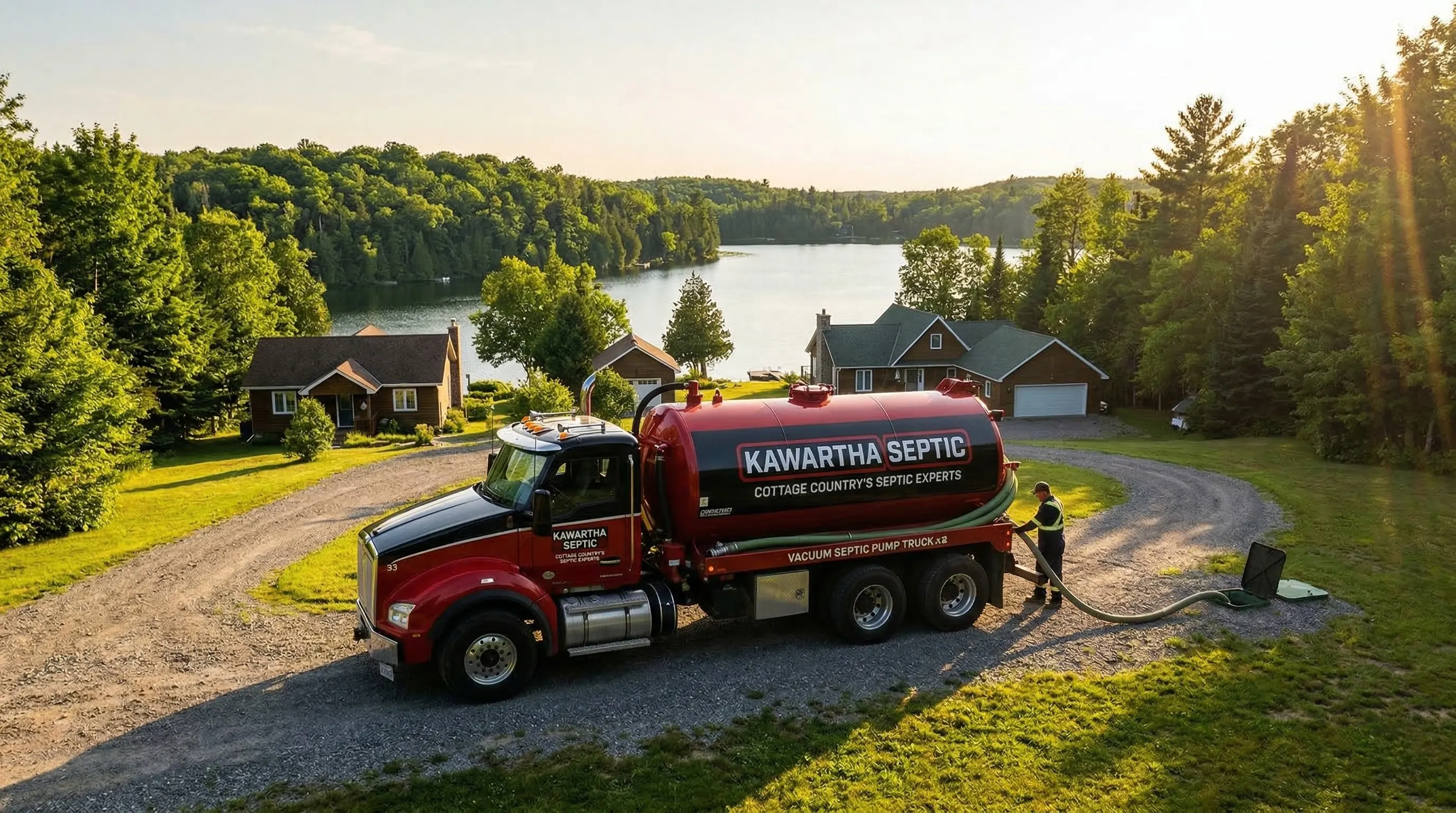
Last spring, a couple from Mississauga closed on a cottage near Bobcaygeon. They loved the lot, the lake view, the price. Three weeks into ownership, they got a call from a pumping company. Their holding tank was nearly full. They needed an emergency pump-out.
The problem? They thought they had a septic system. The home inspection report mentioned “septic,” and nobody clarified the difference. They had no idea their wastewater was sitting in a sealed box underground with absolutely nowhere to go. One tank. No drain field. No treatment. Just storage.
If you’re buying property in Kawartha Lakes, or if you already own one and aren’t sure what’s buried in your yard, this guide breaks down the difference between septic and holding tank systems so you know exactly what you’re dealing with.
Quick Answer: What’s the Difference?
A septic system collects, treats, and disperses wastewater on your property. It has a tank and a drain field (also called a leaching bed). Wastewater flows into the tank, solids settle, and the liquid drains out into the ground where soil bacteria finish the treatment process.
A holding tank just holds wastewater. That’s it. There’s no outlet, no drain field, no treatment. It’s a sealed container that stores everything until a pump truck comes to empty it.
The difference between septic and holding tank comes down to one thing: a septic system processes your waste on-site. A holding tank stores it for removal.
How a Septic System Works
A septic system has two main components: the tank and the drain field.
Wastewater from your house flows into the septic tank through an inlet pipe. Inside the tank, solids sink to the bottom (forming sludge) and grease floats to the top (forming scum). The liquid in the middle, called effluent, flows out through an outlet pipe into the drain field.
The drain field is a network of perforated pipes buried in gravel trenches. Effluent trickles out through the perforations and slowly filters through the soil. Naturally occurring bacteria in the soil break down the remaining contaminants before the water reaches the groundwater table.
It’s a passive system. No electricity needed for a conventional gravity-fed setup. Wastewater goes in, treated water goes out. The tank just needs to be pumped every 3 to 5 years to remove the accumulated solids.
For more on keeping a septic system running properly, check out our septic tank maintenance guide.
How a Holding Tank Works
A holding tank is about as simple as it gets. It’s a watertight container buried in your yard. All the wastewater from your house flows in. Nothing flows out.
When the tank gets close to full, an alarm goes off (if one is installed) or you notice drains slowing down. Then you call a pump truck to empty the entire thing. The contents get hauled away to a licensed treatment facility.
That’s the whole system. No drain field, no on-site treatment, no soil filtration. The holding tank in Ontario is regulated under the Ontario Building Code, and properties with holding tanks must maintain pump-out records to prove the system is being serviced. The Ontario government’s septic system page outlines the regulatory framework for both system types.
How often you pump depends entirely on the tank size and your water usage. A family of four in a year-round home with a 3,600-litre holding tank might need pumping every 2 to 4 weeks. That adds up fast.
Side-by-Side Comparison
Here’s a direct septic tank vs holding tank comparison across the categories that matter most:
| Category | Septic System | Holding Tank |
|---|---|---|
| How it works | Treats and disperses wastewater on-site | Stores wastewater for removal |
| Pumping frequency | Every 3-5 years | Every 2-6 weeks (year-round use) |
| Annual pumping cost | $300-$600 | $3,000-$8,000+ |
| Installation cost | $15,000-$30,000+ | $5,000-$12,000 |
| Requires drain field | Yes | No |
| Lot size needed | Larger (space for leaching bed) | Smaller (just the tank) |
| Environmental impact | Treats water and returns it to soil | No on-site treatment |
| Water use restrictions | Moderate (avoid overloading) | Strict (every drop costs money) |
| Resale value impact | Neutral to positive | Often negative |
| Best for | Year-round homes | Seasonal cottages, small lots |
The cost difference alone is a big deal. You can see a full breakdown of what pumping costs look like in our septic pumping cost guide for Ontario. For holding tank owners, those costs multiply quickly.
How to Tell Which One You Have
Not sure if you have a septic or holding tank? Here’s how to figure it out.
Check your property records. Your local municipal building department should have a file for your property that includes the original sewage system permit. In Kawartha Lakes, you can contact the City of Kawartha Lakes building division. The permit will tell you exactly what was installed.
Look for a drain field. Walk your yard. If you see a relatively flat area with lush, green grass (especially if the rest of the lawn isn’t as green), that’s likely your leaching bed. No drain field visible anywhere? You probably have a holding tank.
Check for an alarm. Holding tanks almost always have a high-level alarm because there’s no outlet. If you have an alarm panel in your basement or utility room labelled “holding tank” or “high water,” that’s a strong indicator.
Count the lids. Go outside and find your tank lids. A septic system typically has one or two lids on the tank, plus you might find an access port for the distribution box near the drain field. A holding tank usually has a single lid or access point with no other components in the yard.
Ask the pump truck. Next time your tank is pumped, ask the technician. They’ll know within seconds based on the tank configuration, the volume they’re removing, and whether there’s an outlet pipe.
If you’re buying a property, this is something that should be confirmed during the inspection. Our guide on septic inspections before buying a house in Ontario covers exactly what to look for and what to ask.
Which Is Better?
It depends on the property. There’s no universal winner in the holding tank vs septic system debate.
A septic system is better if:
- You live on the property year-round
- Your lot is large enough for a drain field
- Soil conditions allow for proper percolation
- You want lower long-term operating costs
- You’re concerned about resale value
A holding tank makes more sense if:
- The property is used seasonally (cottage, camp)
- The lot is too small for a leaching bed
- Soil conditions won’t support a drain field (high water table, bedrock)
- The property is close to a lake or waterway and regulations prohibit a drain field
- You need a temporary solution while planning a full septic install
For seasonal cottages around Fenelon Falls and Coboconk, holding tanks are common and practical. If you’re only there a few weekends in summer, pumping once or twice a season is manageable. But the moment a cottage becomes a year-round home, that holding tank turns into a money pit.
Can You Convert a Holding Tank to Septic?
Yes, in most cases. But it’s not a simple swap.
Converting from a holding tank to a septic system requires a new sewage system permit from your municipality. You’ll need a site evaluation that includes soil testing (usually a percolation test and sometimes test pits) to confirm your property can support a drain field.
If the lot passes, an engineer or licensed installer designs a system to meet Ontario Building Code requirements. Then comes the installation: excavation, tank modifications or replacement, a new drain field, and final inspection.
Typical conversion costs in the Kawartha Lakes area run $15,000 to $35,000 depending on the system type, soil conditions, and site access.
We worked with a homeowner on a back road outside Lindsay who’d been paying $5,500 a year in holding tank pump-outs. They converted to a conventional septic system for about $22,000. The system paid for itself in four years of saved pumping costs. They told us they wished they’d done it the year they moved in.
Not every property qualifies. If your lot has poor soil, a high water table, or sits too close to water, you may be stuck with a holding tank. But it’s worth investigating.
Holding Tanks and Cottages in Kawartha Lakes
If you own a cottage in Kawartha Lakes, there’s a good chance you have a holding tank. Waterfront properties, small lots, and strict environmental setbacks from lakes and rivers mean many cottage properties can’t support a conventional drain field.
Here’s what holding tank ownership looks like in cottage country:
Pumping costs scale with use. A cottage used for two weeks in July costs a lot less to manage than one that’s used every weekend from May to October. Monitor your usage and schedule pump-outs before the tank gets critical.
Alarms aren’t optional. If your holding tank doesn’t have a high-level alarm, get one installed. Running a holding tank to overflow is an environmental violation in Ontario, and the fines aren’t small. You’ll also end up with raw sewage on your lawn or, worse, running toward the lake.
Water conservation matters. Low-flow toilets, short showers, and spacing out laundry loads aren’t just nice ideas with a holding tank. They directly reduce how often you pay for pumping. A family that’s careful about water use can stretch pump-out intervals significantly.
Keep your records. Ontario requires holding tank owners to maintain pump-out receipts. If you sell the property, the buyer (or their inspector) will want to see a history of regular servicing. Keep every receipt.
If your cottage is in Lindsay, Bobcaygeon, Fenelon Falls, or Coboconk and you’re not sure what shape your system is in, we can take a look. Call (705) 806-0800 or book a service call.
Frequently Asked Questions
How do I know if I have a septic or holding tank?
Check your property’s sewage system permit at the municipal building department. You can also look for a drain field in your yard. If there’s no leaching bed and your tank has an alarm, it’s likely a holding tank. When in doubt, ask during your next pump-out. The technician can confirm it in minutes.
How often does a holding tank need to be pumped?
It depends on the tank size and how much water you use. A year-round household with a typical holding tank may need pumping every 2 to 6 weeks. A seasonal cottage might only need it once or twice a summer. Compare that to a septic system, which typically needs pumping every 3 to 5 years.
Is a holding tank bad for resale value?
It can be. Buyers often factor in the ongoing pumping costs when making an offer. A property with a holding tank that costs $5,000+ per year to maintain may sell for less than a comparable property with a functioning septic system. If you’re planning to sell, consider whether a conversion makes financial sense.
Are holding tanks legal in Ontario?
Yes. Holding tanks are a recognized sewage system under the Ontario Building Code. They must be properly permitted, installed by a licensed installer, and maintained with documented pump-out records. They’re common on properties where soil or lot conditions don’t allow for a conventional septic system.
What are the signs my septic system is failing?
Slow drains, sewage odours, wet spots over the drain field, and lush green patches in the yard can all signal trouble. If you notice any of these, don’t wait. Read our full guide on signs your septic system is failing and call a professional for an assessment.
The Bottom Line
Knowing whether you have a septic system or a holding tank isn’t trivia. It affects how much you spend every year, how you use water, and what your property is worth. If you’re buying, get it confirmed before you close. If you already own, make sure you’re maintaining the system you actually have.
Whether you need a pump-out for your holding tank, a routine septic service, or advice on converting from one system to the other, we’re here to help. We service Lindsay, Bobcaygeon, Fenelon Falls, Coboconk, and all of Kawartha Lakes.
Call (705) 806-0800 or book online to get started.