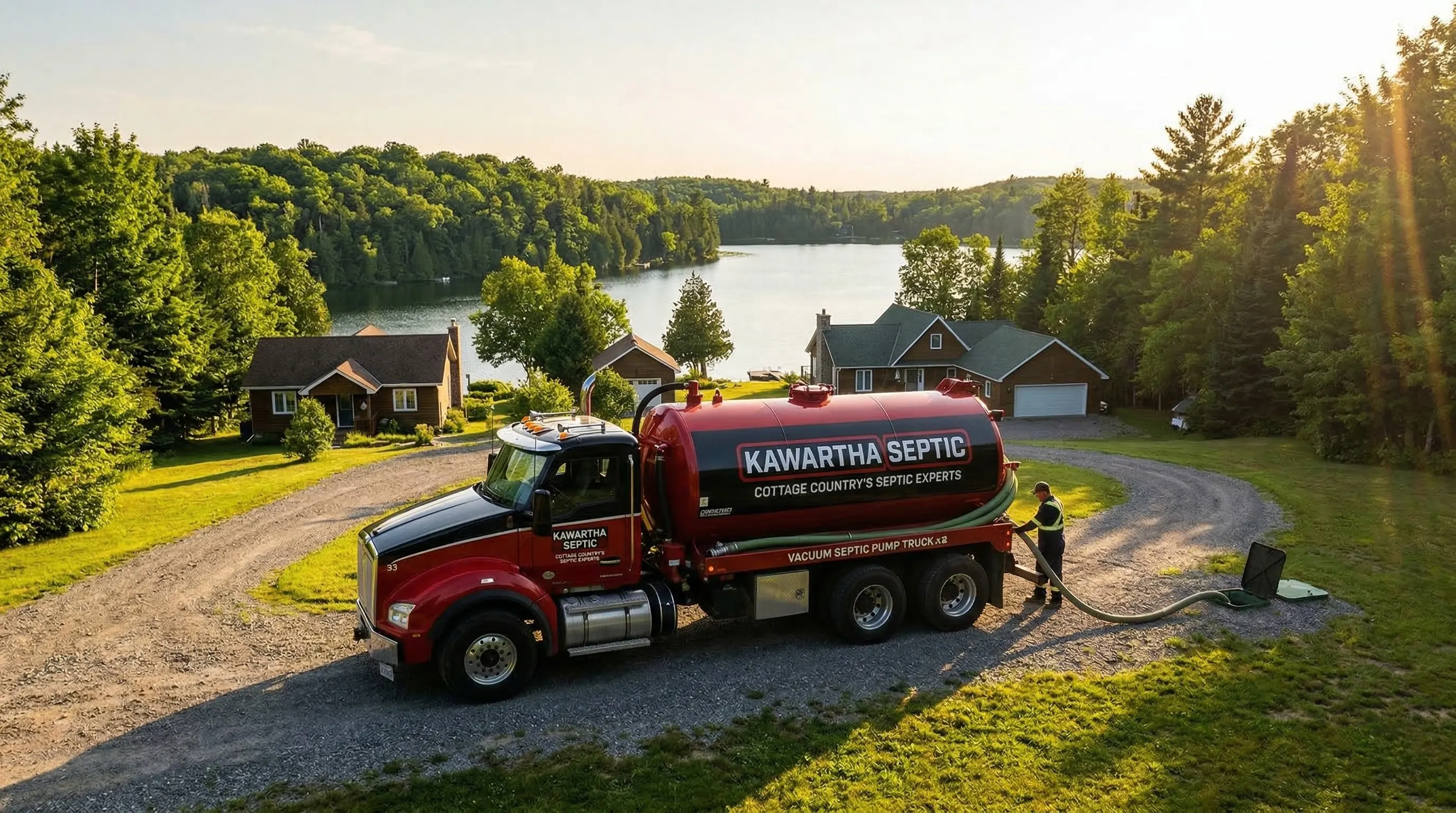
A cottage used twelve weekends a year sees roughly 24 to 30 days of load. Move in full time and that becomes 365. Even with the same number of people in the house, you have just multiplied the annual load on the leaching bed by ten or more, on a system that may have been sized and built for exactly the light seasonal use it was getting.
This is the single most commonly overlooked cost in a cottage conversion, and it tends to surface in year two or three, after the renovation budget is spent.
Here’s what to check before you commit, what triggers a permit, and what the fixes cost. If you want your system assessed against year-round occupancy before you sell the house in town, call (705) 702-5526.
The Quick Answer
| Check | Why it matters | Cost |
|---|---|---|
| Full inspection with tank open | Establishes tank condition and whether the bed has been coping | $300-$500 |
| Original permit and design flow | Tells you what the system was actually sized for | Free from the municipality |
| Bedroom count vs. design | Ontario sizes systems by bedrooms; conversions often add them | Free to check |
| Winterisation of tank and lines | Year-round use in a system built to be drained each fall | Varies |
| Water source and volume | Full-time use means full-time flow, including laundry | — |
| Bed expansion if undersized | The expensive outcome | $10,000-$25,000 |
| Full replacement if the bed is done | The worst outcome | $15,000-$35,000 |
The good news: many cottage systems handle the conversion fine, particularly newer ones built to current standards. The bad news: the ones that don’t tend to be the older ones, and older is the norm on lakefront properties in the Kawarthas.
Load Is About Days, Not Just People
The mental model most people carry is wrong in a specific way. They think “it’s still two of us, so the load is the same.” It isn’t.
A leaching bed’s design capacity is a daily flow figure. A seasonal cottage doesn’t stress that number, it just doesn’t hit it very often. The bed gets long recovery periods in which soil biology processes what it received and the structure dries and recovers.
Full-time occupancy removes the recovery. The same daily flow now arrives every single day, all year, including through the spring when the water table is high and the soil’s ability to accept water is at its worst. Our guide to how seasonal use affects your septic system covers the biology of it.
Then the other multipliers arrive with year-round living: laundry every week instead of once a visit, dishwasher daily, showers daily, and the water-using appliances that make a house liveable in February.
The result on the pumping side is straightforward. From our pumping frequency guide, a light-use seasonal cottage pumps every 4 to 5 years and a year-round home with 3 to 4 people pumps every 3 to 4 years. Expect your interval to shorten by roughly a third to a half.
Check One: What Was It Actually Built For?
Call the City of Kawartha Lakes Building and Septic Division with the address. You want the permit, the design drawings, and the design sewage flow.
That last number is the whole ball game. It tells you what daily volume the bed was engineered to accept. If the original design assumed a two-bedroom seasonal cottage and you’re converting to a four-bedroom year-round house, the system is undersized on paper before anyone flushes anything.
Under Ontario Regulation 163/24, systems are sized by bedroom count and fixture load. Adding bedrooms in a conversion is a design-flow change, and it typically triggers a permit whether or not you touch the septic system itself. Our guide on home addition and septic capacity walks through the assessment.
If there are no records, which is common on older lakefront lots, the physical inspection becomes your only source of truth.
Check Two: Has the Bed Been Coping Already?
A full inspection, $300 to $500, tells you what the paperwork can’t.
What the inspector is looking for on a conversion assessment:
- Sludge and scum depth in the tank, which reveals the real maintenance history rather than the reported one
- Baffle condition, particularly the outlet baffle and the effluent filter if there is one
- Evidence of past effluent surfacing at the bed, visible as staining, unusual growth, or soil discolouration
- Whether the bed area has been driven on, built over, or planted, all of which shorten its life
- Ponding in the distribution area
Signs the bed is already at its limit are covered in leaching bed failure signs. A bed that’s marginal under twelve weekends a year will not survive 365 days a year, and finding that out before you move is worth every dollar of the inspection.
Bundling the inspection with a pump-out is the efficient route: the tank is empty, everything is visible, and the add-on is $75 to $150 on top of a standard pump-out at $300 to $600.
Check Three: Winterisation and Freezing
A seasonal system is often built on the assumption that it gets drained and abandoned each fall. Year-round use changes what has to survive January.
Things that matter now and didn’t before:
Shallow lines. Cottage plumbing runs are frequently shallower than they’d be in a year-round build, because nobody expected water in them in winter. Shallow lines with daily flow are usually fine; shallow lines with intermittent flow in a cold snap are how you get a frozen septic line.
Pump chambers and control panels. If your system has an effluent pump, its chamber and controls need to survive winter with power on. Pumps last 7 to 10 years and a replacement runs $600 to $1,500.
Snow cover over the bed. Undisturbed snow is insulation. Once you’re living there, driveways get plowed and paths get shovelled, and the bed area can end up bare and compacted. Keep traffic and plowing off the bed.
Our cottage winterisation guide covers the seasonal version, and much of it inverts once you’re there full time.
What It Costs When the Answer Is No
If the assessment says the system can’t carry year-round occupancy, the options in ascending order:
Reduce the load. Low-flow fixtures, spread-out laundry, and disciplined water use can cut daily flow by 20 to 35%. On a system that’s marginal rather than failed, this is sometimes enough.
Expand the bed. Where soil and space allow, adding bed area increases capacity. This is a permitted alteration with design work attached, and the bed portion lands in the $10,000 to $25,000 range.
Replace the system. A full replacement in Ontario runs $15,000 to $35,000, most jobs between $15,000 and $30,000, plus $3,000 to $7,000 in permitting and design before digging starts.
A couple near Bobcaygeon moved to their cottage full time in 2024 after retiring. The 1996 system had been pumped exactly twice in their ownership. The inspection found a sound tank and a bed that had been quietly struggling for years, with staining that suggested seasonal surfacing nobody had been present to notice. They spent $19,000 on a new bed the following spring. Had they inspected before selling the house in town, that number would have been in the conversion budget rather than a surprise.
Frequently Asked Questions
Can a seasonal cottage septic system handle year-round use?
Sometimes, and it depends on what it was designed for and its current condition. A bed sized for a two-bedroom seasonal cottage is being asked to do something fundamentally different when occupancy goes from about 25 days a year to 365. Newer systems built to current standards often cope; older lakefront systems frequently don’t. A full inspection at $300 to $500 is the only way to know.
Do I need a permit to convert a cottage to full-time living?
For the septic side, it depends on whether the conversion changes the design sewage flow. Adding bedrooms almost always does, because Ontario sizes systems by bedroom count under Regulation 163/24. Interior finishing that doesn’t change occupancy usually doesn’t. Call the City of Kawartha Lakes Building and Septic Division with your specific plans before you start.
How much more often will I need to pump after moving in full time?
Expect the interval to shorten by roughly a third to a half. A light-use seasonal cottage typically pumps every 4 to 5 years; a year-round household of 3 to 4 people pumps every 3 to 4 years, and 5 or more people every 2 to 3 years. A standard pump-out on a 1,000 to 1,500-gallon tank runs $300 to $600.
What are the warning signs that the bed can’t take full-time use?
Soggy or unusually lush ground over the bed in dry weather, slow drains throughout the house rather than in one fixture, sewage odour outdoors near the bed, and gurgling in the plumbing after heavy water use. Any of these appearing in the first year of full-time occupancy means the bed is at or past capacity, and it needs assessment rather than monitoring.
Should I inspect before or after I move in?
Before, and ideally before you commit to selling your other property. An inspection tells you whether a $10,000 to $25,000 bed expansion or a $15,000 to $35,000 replacement belongs in the conversion budget. Finding that out in year two, after the renovation money is spent, is how a good plan becomes a financial problem.
Get the Assessment Before the Moving Truck
The septic question is answerable in an afternoon, and it’s much cheaper to answer it while you still have options.
Call (705) 702-5526 or book an inspection. Routine appointments within 48 hours, serving the whole City of Kawartha Lakes with no travel surcharge.
If the capacity math says the cottage needs a bigger system, that is a replacement job: septic system installation and replacement in Kawartha Lakes walks through the site visit, design, permit, and timeline.