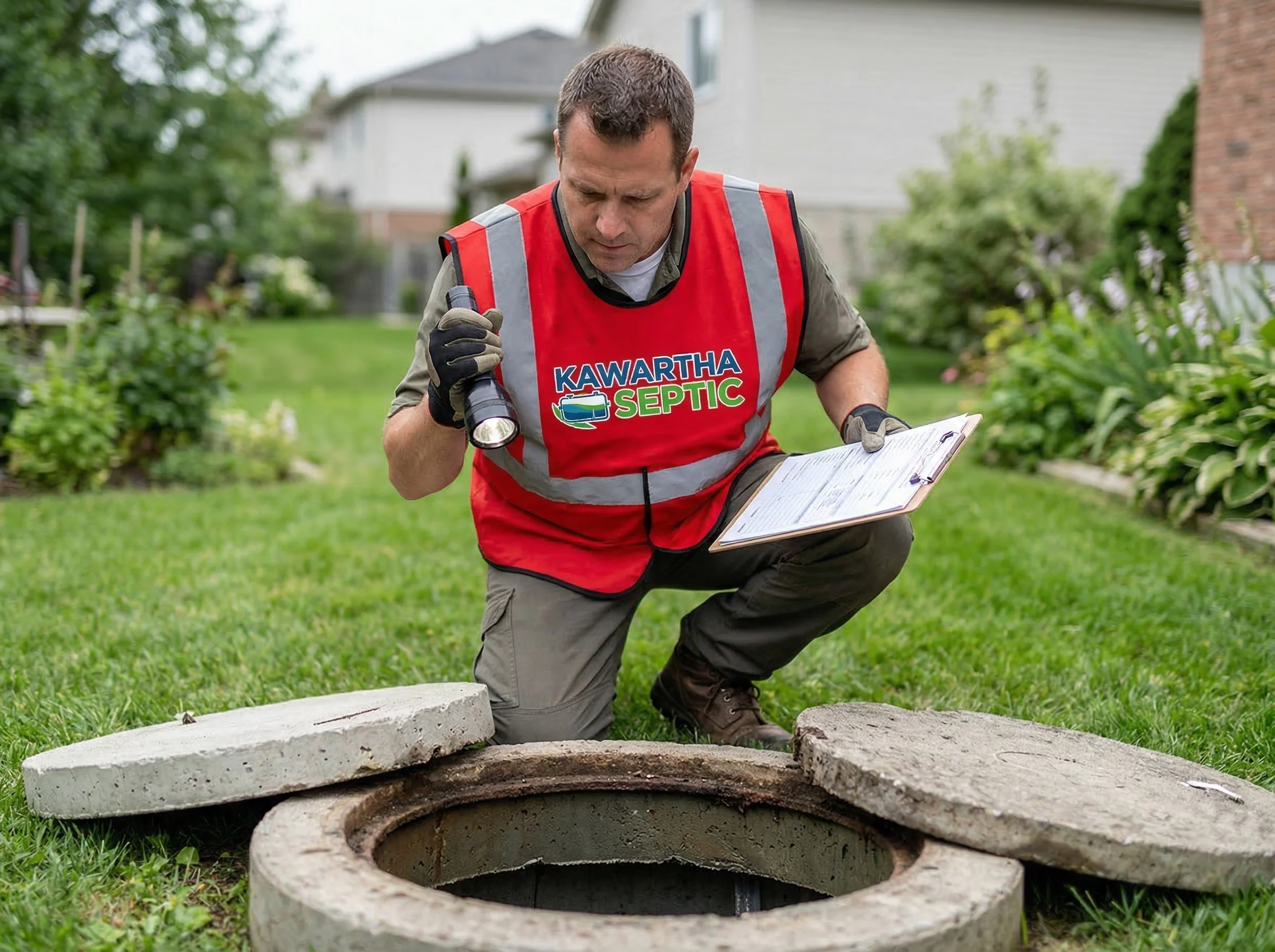
Most septic systems fail slowly and quietly. Nothing looks wrong until a wet patch appears over the leaching bed or a drain backs up, and by then the cheap fixes are behind you. An inspection is how you find out where the system stands while you still have options.
This page is for routine work: a checkup on a system you own, a cottage opening or closing, or a mandatory re-inspection letter from the municipality or the conservation authority. If you are buying or selling a property, you need a real estate septic inspection instead — same crew, but written to be handed to a lender, a lawyer, and the other side of a transaction, and scheduled against your condition deadline.
What We Check
- Tank condition — cracks, corrosion, root intrusion, and whether the tank is holding water where it should. Concrete tanks last 30 to 40 years, plastic and fibreglass 20 to 30, steel 15 to 20.
- Sludge and scum levels — measured, not guessed. This is what tells you whether your pumping interval is right for how you actually use the property.
- Inlet and outlet baffles — a deteriorated outlet baffle lets solids into the leaching bed, which is the single most expensive thing that can quietly go wrong.
- Effluent filter, if the system has one — clogged filters cause backups that look like a full tank.
- Leaching bed / tile bed — surface condition, ponding, soft ground, odour, and the strip of grass that is greener than the rest of the lawn.
- Pumps and alarms on systems that have them, including whether the alarm actually works.
- Distribution box — whether effluent is reaching the bed evenly or loading one run.
A visual inspection takes 30 to 60 minutes. A full inspection, where the tank is pumped so the interior can be seen properly, takes 2 to 3 hours. A camera inspection of the lines adds another 30 to 60 minutes when there is reason to run one.
What It Costs
| Inspection | Price |
|---|---|
| Visual inspection (basic) | $150–$250 |
| Full inspection (pump and assess) | $300–$500 |
| Camera inspection (add-on) | +$150–$300 |
| Full inspection with camera | $450–$700 |
| Added to a scheduled pump-out | +$75–$150 |
That last line is the one worth acting on. If your tank is due anyway, having it inspected while it is empty is the cheapest look inside you will ever get. Book a septic tank pump-out and ask for the inspection with it. Full breakdown in septic inspection cost in Ontario.
When to Book One
- Every 3 to 5 years as routine maintenance, regardless of pumping schedule.
- When you take over a property and have no maintenance history for it.
- Opening or closing a cottage, particularly the first season after a hard winter.
- After anything unusual — a season of heavy rain, a spring flood, a long power outage, a backup that cleared on its own.
- Before a change in how the property is used — a new bathroom, a family moving in full-time, or starting to rent the cottage out. A system sized for weekend use behaves differently under a full house.
- When you get a re-inspection letter.
- When you see early symptoms — slow drains, gurgling, odour outside, soft ground over the bed. See signs your septic system is failing.
Mandatory Re-Inspection Letters
Municipalities and conservation authorities across Ontario run mandatory septic re-inspection programs, often targeting properties near lakes and rivers — which in this region means a lot of properties. Getting one of these letters is not an accusation. It usually means your property falls inside a program area.
A few things worth knowing. Programs generally operate under authority that can compel access with proper notice, so ignoring the letter tends to escalate rather than resolve it. Some programs cover the inspection cost; others require you to book and pay for a qualified inspector yourself — the letter will say which. If you already have a recent inspection report, bring it, because it may satisfy the requirement or at least shorten the process. And if the letter itself looks off, verify it by calling the municipality or conservation authority on the number from their official website, not a number printed only on the letter. Full detail in mandatory septic re-inspection programs in Ontario.
What the Report Tells You
You get a written summary of what we found: system details, tank condition, baffle condition, measured sludge and liquid levels, leaching bed assessment, compliance notes against current Ontario requirements, and recommendations with what they are likely to cost.
Pass and fail is not really binary. Most systems come back somewhere in between — working now, with two or three things that will need attention on a timeline. That is the useful output: not a grade, but an order of operations and a rough budget. How to read a septic inspection report explains what each section means, and what is a septic inspection walks through the visit itself.
Cottages and Seasonal Properties
Seasonal properties need inspections for reasons a year-round home does not.
Five months of nothing, then a full house. A cottage system sits idle all winter and then takes a long weekend with twelve people on it. That pattern is hard on a bed and it hides problems: the system that struggled in August looks fine in May because nothing has used it yet.
Opening season. The best time to find winter damage — a heaved lid, a cracked line, a pump that did not survive an outage, a bed sitting in meltwater — is at opening, before the season loads the system. The best time to book it is before everyone on the lake opens at once.
Unknown-age systems. Plenty of systems here predate anyone's records. An inspection gives you a baseline: what it is, roughly how old, what condition, and how long you can reasonably expect it to keep working. That is worth having before you plan a renovation or an addition, not after.
Shoreline setbacks. On waterfront lots the tank, bed, and well are fitted around required separations from the water. Older systems often do not meet current separations, and in parts of the region Kawartha Conservation Authority rules apply alongside Ontario Building Code Part 8. Knowing where you stand matters most when you want to change something.
Book an Inspection
Call (705) 702-5526 or leave your number and the property location. If you are holding a re-inspection letter, say so and give us the deadline on it. If the system is actively backing up, do not book an inspection — go to emergency septic service and phone us.
Frequently Asked Questions
01 Is a septic inspection the same as a pump-out?
No. A pump-out removes the contents of the tank. An inspection evaluates the condition of the whole system. A full inspection usually involves pumping the tank so the interior can actually be seen, but pumping on its own does not tell you whether your baffles are intact, your tank is cracked, or your leaching bed is still absorbing.
02 Do I need an inspection if I just had the tank pumped?
It depends on when the last real inspection was. If the pump-out crew noticed anything unusual, follow it up. If the system has not been properly inspected in 3 to 5 years, it is due regardless of when it was last pumped. The cheapest time to do it is during a pump-out, while the tank is empty — bundled with pumping it adds $75 to $150.
03 How much does a septic inspection cost in Ontario?
A basic visual inspection is $150 to $250. A full inspection, where the tank is pumped and assessed, is $300 to $500. A camera inspection of the lines adds $150 to $300, and a full inspection with camera runs $450 to $700. Bundled onto a scheduled pump-out it is $75 to $150.
04 I got a mandatory re-inspection letter. Is it a scam?
Probably not — mandatory re-inspection programs are real and run by municipalities and conservation authorities. Scams that mimic official notices do exist, though. If you are unsure, call the municipality or conservation authority using the number on their official website, not a number printed only on the letter.
05 Do I have to let the inspector onto my property?
Programs vary, but most operate under municipal or conservation authority powers that can compel access with proper notice. Ignoring the letter rarely makes it go away and usually makes it worse. If you already have a recent inspection report — from a home sale, for instance — bring it to the program; it may satisfy or streamline the requirement, though acceptance is not guaranteed.
06 Can I inspect my septic system myself?
You can do a useful basic check: walk the leaching bed looking for wet or spongy ground, check for odour, and watch whether drains are flowing normally. What you cannot do without equipment is measure sludge levels, assess baffles under liquid, or evaluate the bed’s absorption rate. A DIY walk is worth doing between professional inspections. It does not replace one.
Where We Do This Work
Septic Inspection is available across the whole City of Kawartha Lakes — Lindsay, Bobcaygeon, Fenelon Falls, Coboconk, and every concession road and shoreline in between. There is no travel surcharge and no minimum distance anywhere in the municipality: a Coboconk cottage costs the same as a house in downtown Lindsay. See our full septic services in Kawartha Lakes, or check the town page nearest you.