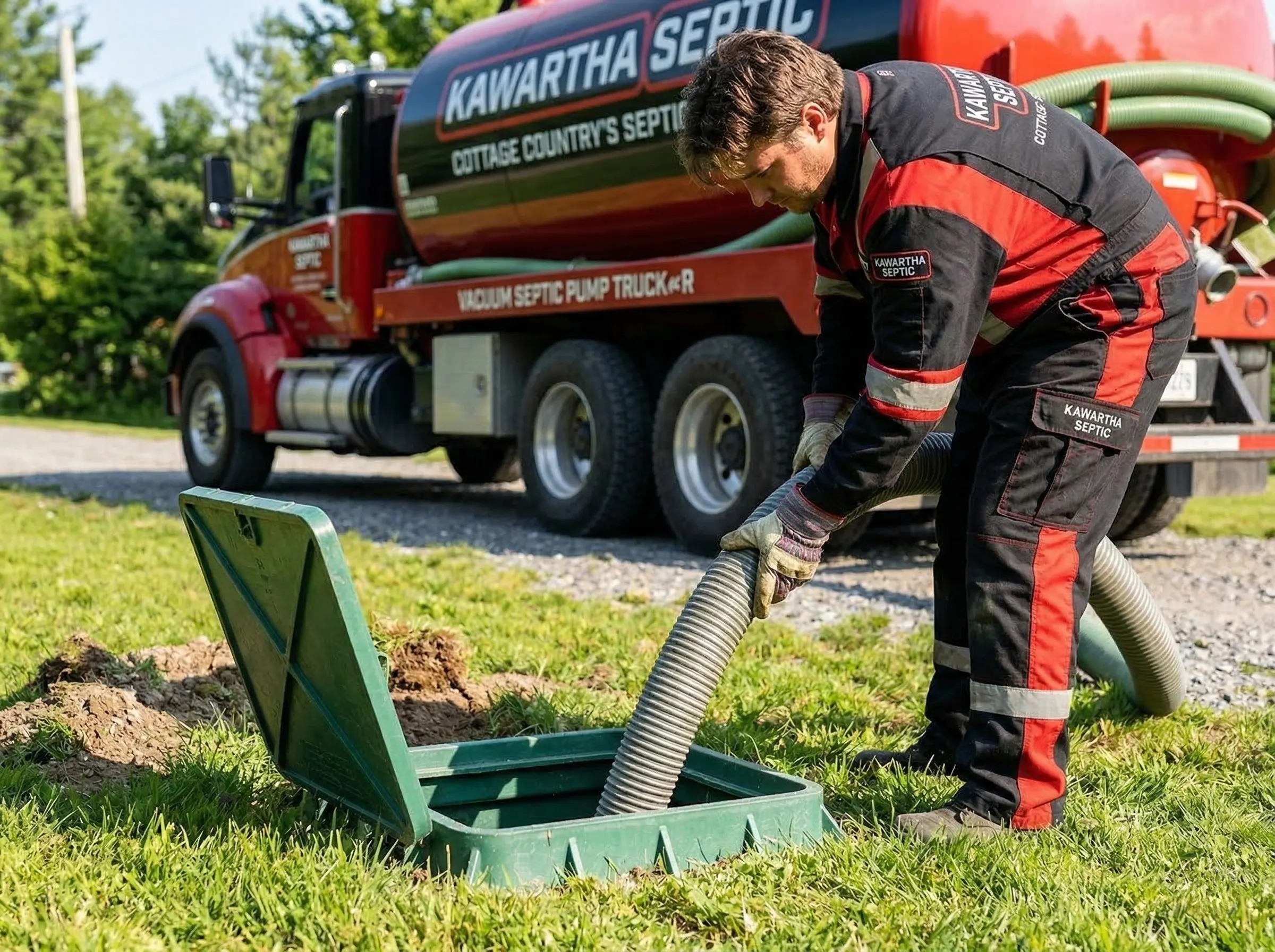
Pumping is the one piece of septic maintenance that is not optional. Solids settle in the bottom of your tank and build up whether you think about them or not. Once that sludge layer gets deep enough, solids start washing out into the leaching bed, and a bed that takes solids is a bed on its way to being replaced. A pump-out costs a few hundred dollars. A replacement bed costs five figures.
Kawartha Septic pumps residential and cottage tanks across the whole City of Kawartha Lakes, from 750-gallon systems in older village homes to 2,000-gallon tanks on rural and multi-family properties. Most routine pump-outs are scheduled within 48 hours.
What a Pump-Out Actually Includes
A pump-out is not just a hose and a truck. Every visit includes:
- Locating and opening the tank. If the lid is at grade or you have risers, this takes a minute. If it is buried, we dig down to it.
- Pumping the tank down completely — liquid, scum layer, and settled sludge, not just the easy liquid off the top.
- A visual inspection while the tank is empty. This is the only time anyone can actually see the inside of your system. We check the inlet and outlet baffles, look for cracks in the walls and lid, check the effluent filter if you have one, and look for signs that effluent is backing up from the bed.
- Telling you what we found. Tank size, condition, how full it was for the interval, and when you should book the next one.
A standard residential visit takes 30 to 60 minutes start to finish. Locating and accessing the tank is 5 to 15 minutes, the pumping itself is 15 to 25, and the inspection and close-up is another 5 to 10. Most people who take the morning off work are surprised by how quickly the truck is back down the driveway. Waste is hauled to a licensed receiving facility — it does not go anywhere near your property or your neighbour's.
Septic Tank Cleaning vs Pumping
These get advertised as two different services. In practice they are the same job with a different amount of effort on the sludge. Pumping removes the liquid and everything that will move under suction. A full cleaning also breaks up and removes compacted sludge welded to the bottom of the tank — sludge that pumping alone leaves behind.
If you are on a regular schedule, pumping is what you need. Cleaning earns its extra cost when a tank has gone many years without service, or when the technician looks in the empty tank and tells you the residual layer is getting thick. That last part matters: you should be told, not sold. Full tank cleaning runs $400 to $700. Our guide on septic tank cleaning vs pumping covers how to tell whether you are getting a real cleaning or a pump-out with a bigger invoice.
How Often You Should Pump
Every 3 to 5 years is the shorthand, but the number that matters is yours. In this area the pattern looks like this:
| Property | Use | Pump every |
|---|---|---|
| Year-round home | 1–2 people | 4–5 years |
| Year-round home | 3–4 people | 3–4 years |
| Year-round home | 5+ people | 2–3 years |
| Seasonal cottage | Light use, weekends | 4–5 years |
| Seasonal cottage | Heavy summer use | 2–3 years |
| Rental cottage | High guest turnover | 1–2 years |
| Rural / farm property | Variable | 2–4 years |
The trap in cottage country is the property that changes category without anyone noticing. A cottage built for two people on summer weekends gets winterized, the kids and grandkids start coming up year-round, and the tank is suddenly on a 5-year schedule doing 2-year work. If your use has changed, your interval should change with it. Full detail in how often to pump a septic tank, and if the property earns income, septic pumping for rental properties covers the shorter schedule guest turnover demands.
Tank Sizes and What They Cost
Price follows tank size first. These are our routine pump-out ranges:
| Tank size | Routine pump-out |
|---|---|
| 750 gallon | $250–$400 |
| 1,000 gallon | $300–$500 |
| 1,250 gallon | $350–$550 |
| 1,500 gallon | $400–$600 |
| 2,000+ gallon | $500–$800 |
Most homes and cottages here have a 1,000 to 1,500 gallon tank, which is why $300 to $600 is the answer to "what does a pump-out cost." If you do not know your tank size, check your septic permit at the municipal office or let us measure it on the next visit — see the septic tank size guide for what Ontario's Building Code requires by bedroom count. The septic pumping cost calculator will give you a number for your specific property in about thirty seconds.
What Changes the Price — and What Does Not
Distance does not. There is no travel surcharge and no minimum distance anywhere in the City of Kawartha Lakes. A cottage on the far side of Balsam Lake costs what a house in downtown Lindsay costs.
What does change the price is access and condition: a long or steep driveway, a gate the truck cannot fit through, a tank we have to dig for because there is no riser (add $100 to $200), a tank last pumped more than five years ago, or a tank nobody has ever pumped. All of it is quoted up front, before we start. Nothing gets added to the invoice after the job. Septic pumping cost in Ontario breaks down every line of that math.
Access: What We Need to Get to Your Tank
Our truck needs a route to within about 100 feet of the tank and enough room to turn around. That is easy on most properties and genuinely tight on some cottage lots. Before we arrive, it helps if you:
- Know roughly where the tank is, or have the lid marked
- Unlock gates and move vehicles, trailers, or boats off the driveway
- Tell us if the driveway is steep, soft, single-lane, or has a low branch clearance
- Tell us if the lid is buried and how deep, if you know
If your lid is buried, ask us about risers. They bring the access point up to ground level, and they pay for themselves by the second pump-out — no digging fee, no winter excavation, and a technician who can actually look inside the tank in two minutes instead of twenty.
Winter Pumping
We pump through the winter. The ground on top of the tank freezes; the contents do not. We cut through the frozen layer, get the lid up, and pump as usual. Expect $100 to $300 more than a summer visit depending on frost depth and how deep the lid sits — unless you have risers, in which case a February pump-out costs about what a July one does.
The better plan is not to need one. If your tank is due and winter is coming, book it in late fall. You avoid frozen ground, the short days, and the surcharge entirely. More in septic pumping in winter.
Cottages, Waterfront Lots, and Systems Nobody Has Records For
A large share of the tanks we pump belong to properties that are closed for five months of the year, sit on a shoreline, and were installed before anyone kept good records. That changes the job in ways a national franchise does not plan for.
Seasonal access. Private lanes that are not plowed, spring road bans, and driveways that are soft until May all affect when we can get a truck in. Fall is the best window for a cottage pump-out: you close for the winter with a clean tank, and you skip the May and June rush when the whole lake opens at once.
Waterfront setbacks. Shoreline lots often have the tank and bed squeezed into whatever space clears the required setbacks from the water and the well. That usually means a longer hose run and a tank in a spot you would not expect. It is worth knowing where yours is before you need us in a hurry.
Unknown-age systems. Plenty of cottages here run on tanks whose install date died with the previous owner. On a first visit to a system like that we will tell you what we can see: material, rough size, baffle condition, and whether the sludge level suggests it has been pumped in living memory. If the tank is steel, or if what we find looks like a cesspool rather than a tank, you need to know that before it fails, not after. Signs your septic system is failing covers the symptoms worth acting on.
Book a Pump-Out
Call (705) 702-5526, or leave your number and the property location in the form and we will call you back within 24 hours during business hours. Routine pump-outs are scheduled within 48 hours. If your system is backing up right now, that is not a routine pump-out — go to emergency septic service and call us instead of filling in a form.
Booking a pump-out and want the system looked at properly at the same time? Bundling a septic inspection with the pump-out adds $75 to $150, and it is the cheapest time to do it — the tank is empty and everything is visible. If you are buying or selling, you need a real estate septic inspection instead, which produces a written report.
Pumping is also where most other septic work gets found. If the empty tank shows a rotted baffle, a cracked lid or a failed effluent pump, that is septic tank repair, and most repairs run $200 to $800. If the symptoms are in the yard rather than the tank, drain field repair starts with working out whether it is the tank or the bed. A system that is past saving is handled under septic system installation and replacement. And a holding tank is a different service on a different schedule: holding tank pumping runs $300 to $500 per visit and comes around far more often.
Frequently Asked Questions
01 How often should I pump my septic tank?
Every 3 to 5 years for most households, but the honest answer depends on how the property is used. A year-round home with 1 or 2 people can go 4 to 5 years. A family of five is closer to every 2 to 3 years. A seasonal cottage used on weekends is 4 to 5 years, and one with heavy summer use is 2 to 3. A cottage rented out with high guest turnover needs it every 1 to 2 years.
02 How much does septic pumping cost in Kawartha Lakes?
A standard residential pump-out on a 1,000 to 1,500 gallon tank runs $300 to $600. Across every tank size we service, 750 to 2,000+ gallon, the range is $250 to $800. There is no travel surcharge and no minimum distance anywhere in the City of Kawartha Lakes — Coboconk costs the same as downtown Lindsay. What changes the price is access, not location.
03 Can you pump a septic tank when the ground is frozen?
Yes. The ground above the tank freezes but the contents stay liquid. We excavate through the frozen layer to reach the lid, then pump as normal. Expect $100 to $300 more than a summer pump-out depending on how deep the lid is buried and how hard the ground is. If you have risers installed, there is nothing to dig and the price is usually the same as any other visit.
04 Do I need to be home for the pump-out?
Not necessarily. If we can reach the tank without going through a locked gate and we know where it is, you do not need to be there. Being home for your first pump-out is worth it — you can show us the tank, ask questions, and hear what we found firsthand. After that, most people are happy to leave a note and let us come and go.
05 Is septic tank cleaning different from pumping, and do I need it?
They are the same service in most cases. Pumping removes the liquid and the sludge that will move; a full cleaning also breaks up and removes compacted sludge that pumping alone leaves behind. For anyone on a regular schedule, pumping is enough. Cleaning is worth it when the tank has not been serviced in many years or when our technician tells you the residual sludge is getting thick. Paying for a full cleaning every three years when a pump-out would do the job is not smart budgeting.
06 How do I find out what size septic tank I have?
Check your property records at the municipal office — the original building or septic permit should list the tank size. Otherwise we can estimate the volume from the tank dimensions during a service visit and write it down for you, so you never have to guess again.
Where We Do This Work
Septic Tank Pumping is available across the whole City of Kawartha Lakes — Lindsay, Bobcaygeon, Fenelon Falls, Coboconk, and every concession road and shoreline in between. There is no travel surcharge and no minimum distance anywhere in the municipality: a Coboconk cottage costs the same as a house in downtown Lindsay. See our full septic services in Kawartha Lakes, or check the town page nearest you.