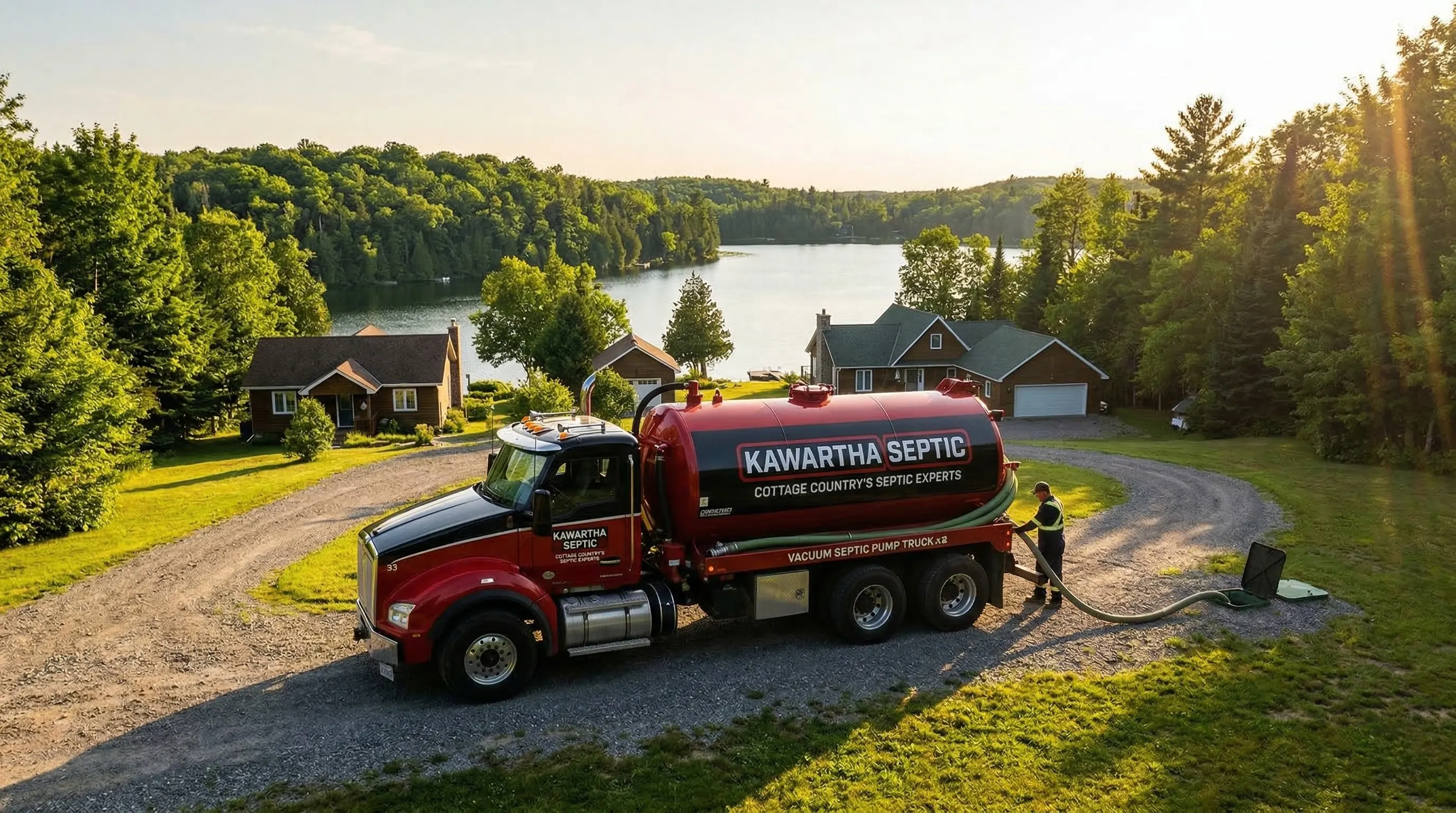
Last summer, a cottage owner on Balsam Lake had her tank pumped two years ahead of schedule. What came up the hose was a dense grey mat of “flushable” wipes, some of them two seasons old and still fully intact.
That’s the flushable wipes septic system problem in a single truckload. Flushable means the wipe will clear your toilet bowl. It says nothing about what happens in the tank, where that wipe will sit in cool, still water for years without breaking down.
If you’re on septic anywhere in the City of Kawartha Lakes, from Lindsay out to Coboconk, wipes do more quiet damage than almost anything else that goes down a toilet. Here’s why the label misleads, what the damage costs, and what to do if a few hundred of them are already down there.
The Quick Answer
| Detail | |
|---|---|
| Are flushable wipes septic safe? | No. Flushable means it clears the toilet, not that it breaks down |
| What toilet paper does | Falls apart in water within minutes |
| What wipes do | Stay intact in the tank for months or years |
| Where they cause trouble | Inlet baffle, effluent filter, pump, and the tank itself |
| Typical repair bills | $200-$800 for clogs and repairs, $600-$1,500 for a wrecked pump |
| The cheap fix | A lidded bin beside every toilet |
| Already flushed a lot? | Book a pump-out: $300-$600 for a standard 1,000-1,500 gallon tank |
The short version: no wipe belongs in a septic system. Not baby wipes, not cleaning wipes, and not the ones with “septic safe” printed on the package.
If your drains are already slow or gurgling, don’t wait for the full backup. Call (705) 702-5526 or book a pump-out. Routine visits are scheduled within 48 hours anywhere in Kawartha Lakes, and sewage backing up into the house gets same-day or next-morning emergency response.
Why Flushable Wipes Don’t Break Down in a Septic Tank
Toilet paper is engineered to fail. The moment it hits water, the fibres let go of each other, and by the time it reaches your tank it’s already dissolving into digestible mush.
Wipes are engineered to do the opposite. They’re a nonwoven fabric, usually plastic fibres like polyester or dense cellulose blends held together with binders, and their whole job is to stay strong while wet. A wipe that fell apart in your hand would be a useless wipe.
The “flushable” claim comes from industry tests that mostly measure whether a wipe will clear the toilet and travel down a drain line in moving water. A septic tank is the opposite environment: still, cool, and low on oxygen, with bacteria that work slowly on the easy stuff and not at all on synthetic fibre.
Cold makes it worse. A tank near Fenelon Falls or on Sturgeon Lake spends five months of the year barely above freezing, and bacterial digestion slows to a crawl. The wipes just sit there, layer on layer, until a pump truck removes them.
What Wipes Actually Do Inside a Septic System
Wipes cause failures at four different points, roughly in order of how fast they show up.
The inlet baffle. Wipes snag on the fitting where your home’s sewer pipe enters the tank. A few snagged wipes catch more, the mat grows, and eventually sewage backs up toward the house. If that’s happening right now, our guide on what to do when septic backs up covers the first hour.
The effluent filter. If your tank has one, it’s doing its job by catching wipe fragments before they escape. But a filter that should need cleaning about once a year starts clogging every few months, and every clog slows every drain in the house.
The pump. On systems that push effluent uphill to the bed, wipes are the classic killer. They wrap around the impeller until the motor stalls and burns out. Replacing an effluent pump runs $600 to $1,500.
The tank and the bed. Wipes add to the solids that only pumping removes, so the tank hits capacity early. Worst case, an overfull tank pushes solids out into the leaching bed, and a clogged bed is a $10,000 to $25,000 replacement.
The Repair Bill: What Wipes Cost Kawartha Lakes Owners
Here’s the damage ladder, using the same pricing we quote every day.
| What the wipes did | The fix | Typical cost |
|---|---|---|
| Filled the tank early | Pump-out, 1,000-1,500 gallon tank | $300-$600 |
| Clogged a baffle | Clearing and repair | $200-$800 |
| Broke the baffle | Baffle replacement | $200-$500 |
| Killed the effluent pump | Pump replacement | $600-$1,500 |
| Backed sewage into the house | Emergency pump-out, typical 1,000-1,500 gallon tank | $400-$800 |
| Did it on a Saturday night | After-hours or weekend call | $600-$1,200 |
| Pushed solids into the leaching bed | Bed replacement | $10,000-$25,000 |
For scale: on a normal schedule, routine pumping costs $300 to $600 for a standard 1,000 to 1,500 gallon tank, every 3 to 5 years for most households. A steady wipe habit can pull that schedule forward by a year or more, and the early pump-out is the cheapest thing on this list.
A bed replacement isn’t just a big bill, either. It’s an excavator in your yard and a permit under the Ontario Building Code, which is the regulation that governs septic systems in Ontario. Nobody gets there from one pack of wipes, but a decade of them on a cottage system is a real route.
Already Flushed Them? Here’s What to Do
Stop today. Put a small lidded bin beside every toilet and make it the only destination for wipes of any kind. If you rent your cottage out, a polite sign in the bathroom protects your system from guests who mean well.
If it’s been a few months, you probably haven’t done lasting harm. Mention it at your next pump-out so the technician checks the baffles and filter while the tank is open. Here’s what happens during a pumping visit if you’ve never watched one.
If it’s been years, book a pump-out ahead of schedule instead of waiting for symptoms. Wipes are removable as long as they’re still in the tank. Once they migrate into the pipes or the bed, the job changes completely.
If sewage is already backing up, stop running water and call now. That’s the emergency tier, and it gets same-day or next-morning response.
One safety rule worth repeating: never lean into a septic tank opening, and never climb inside, no matter what fell in or how shallow it looks. The gases in a tank can knock a person unconscious in seconds. Anything past a plunger and a look under the lid is a job for a crew with the right equipment.
Call (705) 702-5526 or book online and tell us what’s been going down the toilet. Honest answers get you a straight quote, and wipes surprise nobody in this business.
What’s Actually Safe to Flush on a Septic System
The rule fits on a sticky note: pee, poo, and toilet paper. Everything else goes in the bin.
That includes products marketed as flushable or natural: baby wipes, makeup wipes, “septic safe” cleaning wipes, paper towel, facial tissue, tampons, dental floss, cotton pads, and cat litter. None of them break down the way toilet paper does.
Regular toilet paper is fine. You don’t need a premium “septic safe” brand, though quicker-dissolving paper is easier on the tank. Our septic safe products guide covers what actually matters and what’s marketing, cleaners included.
And skip the additive shortcuts. No enzyme or bacteria product dissolves synthetic fibre, whatever the label hints. The Ontario Association of Onsite Wastewater Professionals keeps solid homeowner guidance on what a healthy system needs, and it’s a short list: sensible flushing and regular pumping.
Frequently Asked Questions
Are flushable wipes really septic safe?
No. Flushable means the wipe will clear your toilet and drain line, not that it will break down in the tank. Wipes are nonwoven fabric, often with plastic fibres, and septic bacteria can’t digest them. They accumulate until a pump truck removes them.
How long do flushable wipes take to break down in a septic tank?
Months to years, and many never fully break down at all. Pump technicians routinely remove wipes that are several years old and still recognizable. Toilet paper, by comparison, starts dissolving in minutes.
I’ve been flushing wipes for years. What should I do?
Book a pump-out ahead of your normal schedule and tell the technician, so they check the baffles, filter, and pump while the tank is open. A routine pump-out costs $300 to $600 for a standard 1,000 to 1,500 gallon tank, and most are scheduled within 48 hours. Catching wipes in the tank is cheap compared to chasing them into the pipes or the bed.
Can wipes ruin a leaching bed?
Indirectly, yes. Wipes speed up solids buildup in the tank, and an overfull tank lets solids escape into the bed, where they clog the pipes and the soil around them. A failed bed runs $10,000 to $25,000 to replace, which is why this habit is worth breaking early.
Got a Tank Full of Wipes? We’ll Take Care of It
Whether it’s a routine pump-out or a toilet that’s already burping, we’ll get a truck there and tell you plainly what we find.
Call (705) 702-5526 or book a pump-out. Serving the whole City of Kawartha Lakes with no travel surcharge and no minimum distance. Coboconk and Balsam Lake cost the same as downtown Lindsay.