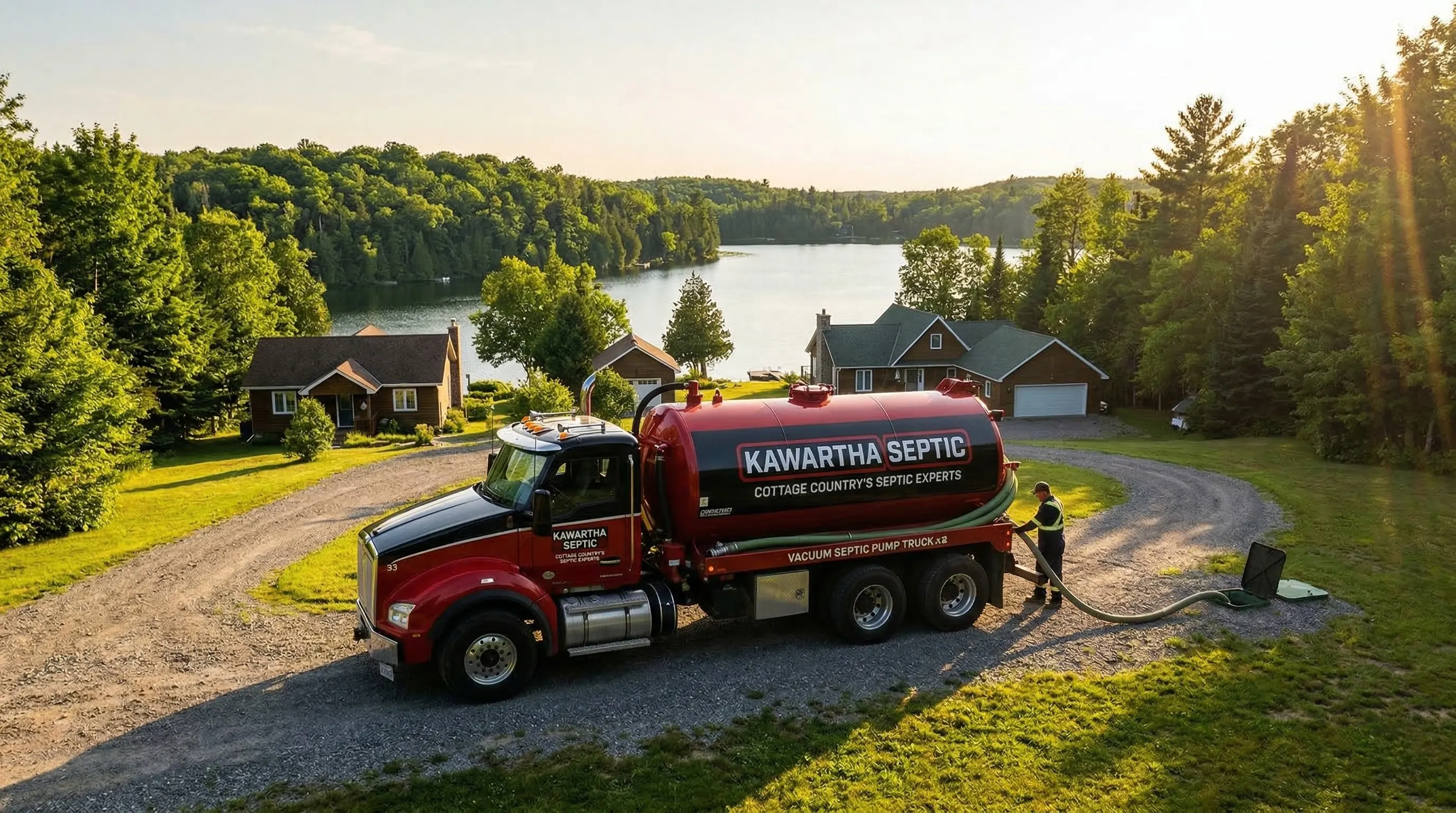
What’s actually buried in the yard of a century farmhouse outside Lindsay? Sometimes it’s a normal, if aging, concrete septic tank. Sometimes it’s a rusted-through steel tank installed in the 1960s. Sometimes it’s a cesspool, essentially a covered pit with no tank at all, dug back when nobody thought twice about it. And sometimes nobody, including the current owner, actually knows.
This is one of the more common surprises in Kawartha Lakes real estate. A gorgeous stone or brick farmhouse on five acres, decades of character, and an old septic system on the farmhouse property that predates most of the rules currently governing how these things get built, inspected, and replaced. If you’re buying, inheriting, or already living in one of these properties, here’s how to think about what’s actually down there.
The Quick Answer: What You Might Be Dealing With
| System type | Common era | Main concern |
|---|---|---|
| Concrete septic tank, aging | 1970s–1990s | Cracking, baffle failure, undersized by modern standards |
| Steel septic tank | 1950s–1970s | Corrosion and structural collapse, often past design life |
| Cesspool / cesspit | Pre-1970s, sometimes earlier | No real treatment, direct groundwater risk, often not legal to maintain as-is |
| Straight pipe (rare, illegal) | Very old, undocumented | Untreated discharge, a serious environmental and legal issue if found |
| No system found at all | Any era | Property may be relying on a system nobody can locate |
Steel Tanks: Why They’re a Ticking Clock
Steel septic tanks were common through the mid-20th century before concrete and fiberglass became standard. They work the same way a concrete tank does, solids settle, effluent flows out to the leaching bed, but steel corrodes. Decades of contact with wastewater and damp soil eventually eats through the tank walls and especially the top, which is the part most exposed to gas and moisture from above.
A steel tank that’s been in the ground for 50 or 60 years is well past any reasonable expectation of structural integrity. The real danger isn’t just that it stops treating wastewater properly. It’s that the lid or top surface can collapse under weight, which is a genuine safety hazard if anyone, a kid, a pet, a contractor walking the property, happens to be standing on it when it goes. If you know or suspect you have a steel tank, treat locating and assessing it as a priority, not a someday project.
If you’re already dealing with a farmhouse property and want a straight answer on what’s actually in your yard, that’s exactly the kind of assessment worth booking before another season goes by. Call (705) 702-5526 and we can talk through what to look for and get eyes on it.
Cesspools: The System That Predates the System
A cesspool is fundamentally different from a septic tank. There’s no tank at all in the traditional sense, just a covered pit or chamber, sometimes lined with stone or perforated concrete rings, that both collects and disperses wastewater directly into the surrounding soil with essentially no treatment first. It was a common approach on rural properties before Ontario’s modern sewage system rules existed.
Cesspools are a real concern for a few reasons. They provide little to no treatment before wastewater reaches groundwater, which is a direct risk to nearby wells. Many were never sized or sited with today’s setback rules in mind, so they may sit closer to a well or watercourse than would ever be approved now. And critically, an old cesspool discovered on a property today generally can’t be legally maintained as-is; a failed or non-compliant system triggers a requirement to upgrade to something that meets current Building Code standards under O. Reg. 163/24.
If a property inspection turns up a cesspool, or something that looks like one, that’s not a minor note in the report. It’s a significant, near-certain future expense, and worth factoring into your offer or your renovation budget immediately rather than treating it as a maybe.
Why Records Are Almost Never There
Modern septic installs come with permits, as-built drawings, and inspection records on file with the municipality. Systems installed before Ontario’s building code framework matured, often anything predating the 1980s, frequently have no paperwork at all. The original installer may be long retired or deceased, the municipality’s own archives may not go back that far, and any renovations done over the decades since may or may not have touched the system.
This is genuinely common on century farmhouses in this region, not an exception. Our guide on finding septic system records in Kawartha Lakes walks through where to actually look, the municipal building department, the health unit, old real estate listings, but for a property this old, be prepared for the search to come up empty. That’s not a dead end. It just means the next step is physical assessment rather than paperwork review.
A Real Assessment Starts With Finding the Thing
Before anyone can tell you whether your system is a steel tank, a cesspool, or something else entirely, it has to be physically located. On an old farmhouse property this can mean checking old survey drawings if any exist, looking for depressions or unusually lush grass patches in the yard, probing suspected areas, and sometimes just methodically working outward from the house’s plumbing stack.
Our guide on how to find your septic tank covers the general methods; on a century property, add patience to the list, because the original installer wasn’t following today’s conventions about placement relative to the house. Once it’s located, a pump-out and a physical inspection of the tank material, structure, and baffles will tell you far more than any records search would have anyway.
A Real Example: A Farmhouse Outside Lindsay
A family bought a stone farmhouse outside Lindsay a few years ago, drawn in by the property and the character of the house, with a septic system noted only as “functioning at time of sale” on the listing. During their first pump-out, the technician found a steel tank so corroded that part of the lid gave way slightly under the truck’s hose weight during the visit, nobody was hurt, but it was a clear sign the tank was near the end of any usable life. A proper assessment showed the leaching bed had also been compromised by decades of tree root intrusion nearby. The full replacement, tank and bed both, ran just over $27,000, a number the family hadn’t budgeted for in year one of ownership, but one that beat finding out about the collapse risk after a grandchild was playing in that part of the yard.
Don’t Try to Assess This Yourself
It can be tempting to lift the lid on an old tank and eyeball the situation, especially if money’s tight and you want to avoid a service call. Don’t. Corroded steel lids and old concrete covers can fail without warning under far less weight than you’d expect, and the gases inside an old tank are genuinely dangerous to breathe in an enclosed space. This is squarely a call-a-professional situation: a pumping company or septic inspector has the equipment and experience to open, assess, and photograph the tank’s actual condition safely. If you suspect a steel tank or cesspool on your property, that suspicion alone is reason enough to schedule a professional look rather than investigate it yourself.
What Assessment Actually Involves
| Step | What it tells you |
|---|---|
| Locate the tank/system | Confirms what’s actually on the property and where |
| Pump-out | Reveals tank material, structural condition, sludge/scum levels |
| Baffle and inlet/outlet check | Shows whether solids are escaping to the bed prematurely |
| Leaching bed condition check | Identifies whether the bed itself is still functioning or compromised |
| Soil and setback review | Confirms whether current placement would even meet today’s rules |
Planning for Replacement
If assessment confirms a steel tank near failure or a cesspool that needs to come out, replacement planning follows the same path as any other failing system, just often with more urgency given the safety and environmental factors involved. Our guide on what causes septic system failure and our breakdown of septic system replacement costs in Ontario both apply directly here; a conventional replacement on a straightforward rural lot typically runs $15,000 to $30,000 or more, with cost climbing if the leaching bed also needs full rehabilitation or if the site has unusual soil or access challenges.
On a farmhouse property, it’s also worth having a designer confirm the new system’s placement meets current setbacks relative to the well, since older wells on these properties were sometimes sited without today’s separation distances in mind either. Getting both right at the same time, rather than discovering a well problem after the septic work is done, saves a second round of digging. If you’re at this stage and want a ballpark before calling designers, the cost calculator is a reasonable place to start.
Buying an Old Farmhouse: What to Ask Before You Close
If you’re actively house-hunting in this category, our guide on septic red flags when house hunting covers the general warning signs, and our piece on septic inspections before buying a house in Ontario covers what a proper pre-purchase inspection involves. For a century property specifically, push for these two things beyond the standard inspection: a direct pump-out and physical tank inspection (not just a visual walk-around or dye test), and an explicit statement in the inspection report about tank material and estimated age, since “functioning at time of inspection” tells you almost nothing about a steel tank that’s one bad winter away from trouble.
Old Farmhouse Septic FAQ
How do I know if my old farmhouse has a steel tank or a cesspool? Age and construction era are a starting clue (steel tanks and cesspools both predate the 1970s-80s in most cases), but the only way to know for sure is to locate and physically inspect the system. Records are frequently missing on properties this old, so plan on physical assessment rather than a paper search.
Is it legal to keep using a cesspool if it’s still “working”? This depends on your specific situation and should be confirmed with the Kawartha Lakes building department or local health unit, but generally, a cesspool discovered today, especially one showing any signs of failure, is expected to be upgraded to meet current Building Code standards rather than maintained indefinitely as-is.
Can a steel tank be repaired instead of replaced? Rarely in any lasting way. Once corrosion has progressed to structural weakness, patching isn’t a safe long-term fix. Most steel tanks found in this condition are recommended for full replacement rather than repair.
What if I can’t find any records for my property’s septic system? That’s common on farmhouses this old. Start with a physical locate and pump-out rather than relying on a records search alone. Our guide on septic records in Kawartha Lakes covers where to check first, but be prepared for the trail to run cold on a genuinely old system.
Is a cesspool dangerous to have on my property? It carries real risk, mainly to groundwater and nearby wells given the lack of treatment, and structurally if the covering has deteriorated. It’s worth prioritizing assessment rather than leaving it as an unknown.
How much does it cost to replace a really old system like this? Conventional replacement on a typical rural lot generally runs $15,000 to $30,000 or more, similar to any other full septic replacement, though a compromised leaching bed or difficult site access can push costs higher. Get a site-specific quote once assessment is complete.
Should I get an assessment even if the current system seems to be working fine? Yes, especially on a property this old. “Seems fine” and “is structurally sound” are two different things with a steel tank or a cesspool, and the failure mode for both tends to be sudden rather than gradual.
Century Homes in Kawartha Lakes
We service farmhouse properties throughout Lindsay and the broader Kawartha Lakes region regularly, and steel tanks and old cesspools are a routine part of that work, not a rare find. If you own or are considering an older rural property and want an honest look at what’s actually down there before it becomes an emergency, that’s exactly the kind of call worth making early.
Not sure what’s buried in your century property’s yard? Call (705) 702-5526 or book online. Use the cost calculator for a 60-second estimate.