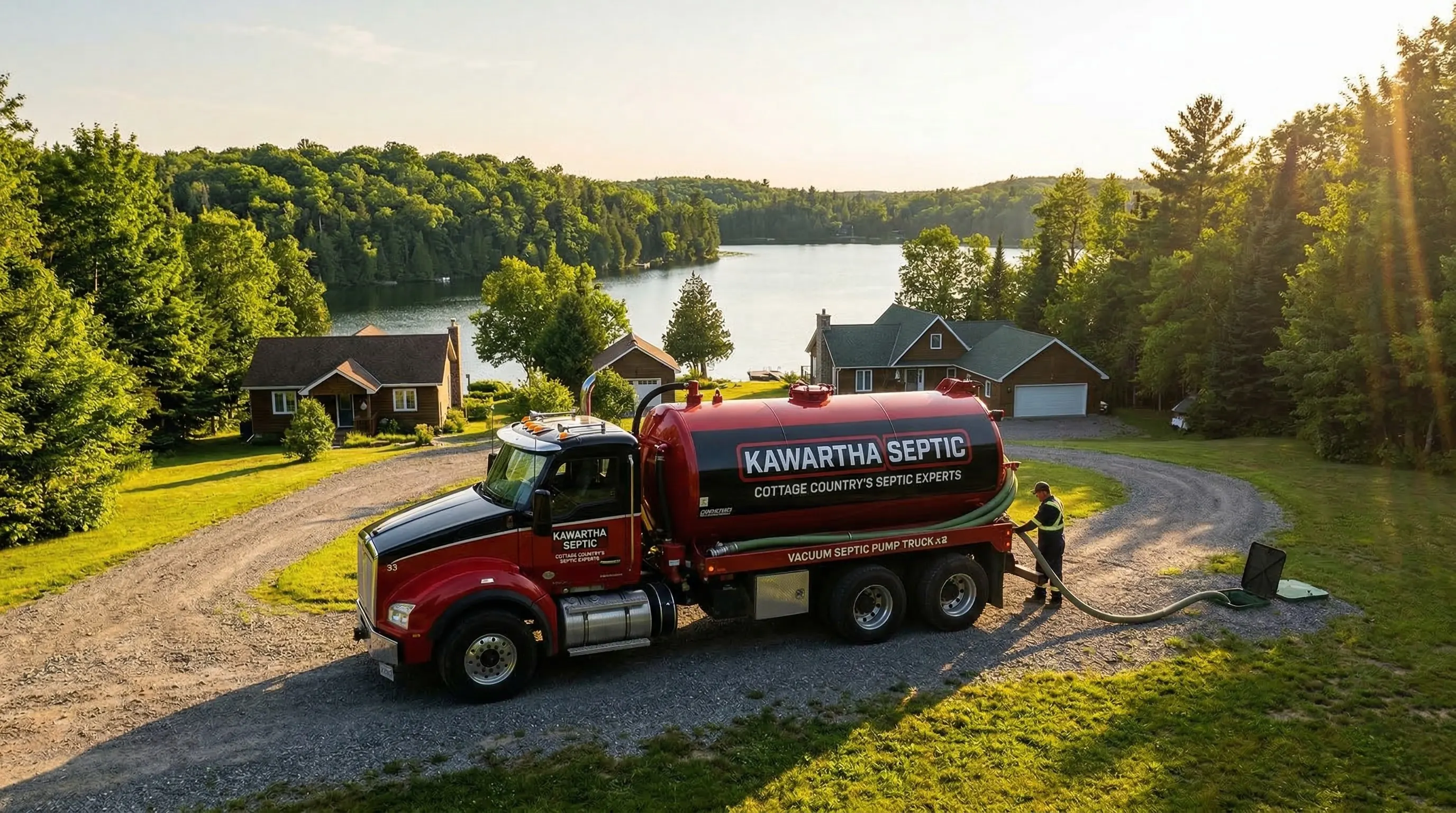
Part 8 of the Ontario Building Code is the rulebook for every septic system in the province that handles up to 10,000 litres a day: how it is designed, built, operated and maintained. Since 1 January 2025 that means the 2024 Code, O. Reg. 163/24.
Most people meet Part 8 through a contractor or a permit form. Fewer know that one section of it (8.9) is aimed at the owner: the duty to keep a system working sits with whoever holds the deed, not whoever installed it.
What follows is the owner’s version of Part 8. Most of it you can skip. The parts you cannot are marked with their article numbers, so you can check them against the Code yourself.
What Part 8 Covers, and Where It Stops
Part 8 governs on-site sewage systems with a design flow of 10,000 litres per day or less that sit on the lot they serve. That takes in effectively every house, cottage and bunkie in the Kawartha Lakes. Once the combined design flow on a lot goes over 10,000 L/day, the system leaves the Building Code and needs an environmental approval from the Ministry of the Environment, Conservation and Parks.
The Code in force today is the 2024 Ontario Building Code, O. Reg. 163/24, which took effect on 1 January 2025 and replaced the 2012 Code (O. Reg. 332/12). The province’s Ontario Building Code page is the starting point, and the regulation itself is on e-Laws as O. Reg. 163/24.
Part 8 is laid out in nine sections:
| Section | What it covers |
|---|---|
| 8.1 General | Scope, the five classes, what may go into a system |
| 8.2 Site evaluation and design | Test holes, design flows, clearances, tank rules |
| 8.3 to 8.8 | Construction rules by class; 8.5 is cesspools, 8.7 is leaching beds |
| 8.9 Operation and maintenance | What the owner must keep doing for the life of the system |
You will never need to read 8.3 to 8.8. You should know 8.1 and 8.9, and roughly what 8.2 says about distances and tanks.
The Five Classes in One Table
Article 8.1.2.1 sorts every sewage system into one of five classes. Our guide to Ontario septic system classes goes through each one in detail. The short version, with the City of Kawartha Lakes permit fee for each:
| Class | What the Code calls it | Everyday meaning | CKL permit fee (2026) |
|---|---|---|---|
| Class 1 | Privies, composting, chemical, incinerating and portable toilets | Outhouse or composting toilet | No permit; the standards still apply |
| Class 2 | Greywater system | Sink, shower and laundry water only, to a leaching pit | $433 |
| Class 3 | Cesspool | Old covered pit, rare today | $325 |
| Class 4 | Leaching bed system | Tank plus leaching bed: the normal septic system | $975 up to 4,500 L/day; $1,191 from 4,501 to 10,000 L/day |
| Class 5 | Holding tank | Sealed tank, pumped out, no bed | $542 |
A tertiary unit, a raised bed or a mound is still a Class 4. The class describes the regulatory category, not the equipment. A Class 2 has its own hard cap: it cannot be built above 1,000 L/day of design flow.
When You Need a Permit
The City of Kawartha Lakes requires a sewage system permit for a new Class 2, 3, 4 or 5 system and for replacing an existing system or any of its components. The City’s septic permits page is blunt about the order of events: no work starts until the permit has been issued. Before issuing it, an inspector visits to look at the test holes and the site.
Two rules catch owners out:
- Renovations and new buildings. Adding bedrooms, plumbing fixtures or living space, or putting up a garage or other new building, triggers an existing system review ($244 in the City) to confirm the current system can carry the load.
- Starting without a permit. If construction starts before the permit is issued, the City charges the applicable permit fee plus 100%, so the permit costs double.
Routine pumping needs no permit. Neither does a Class 1 privy, though it still has to meet the Code. Tank replacement or bed repair on a Class 4 is its own permit category at $461. For the full application sequence see our Ontario septic permit guide, and for work on an existing system, permits for septic repairs and modifications. Permit review for a straightforward application in Kawartha Lakes typically takes 2 to 4 weeks.
Clearances: How Far Things Must Be From What
Section 8.2 sets minimum distances between system parts and wells, water and lot lines. The ones owners ask about most, for a Class 4 system:
| From | Septic tank | Leaching bed (distribution pipe) |
|---|---|---|
| Drilled well with watertight casing at least 6 m deep | 15 m (50 ft) | 15 m (50 ft) |
| Dug well or any other well | 15 m (50 ft) | 30 m (100 ft) |
| Lake, river, pond, stream or reservoir | ask the City | 15 m |
| Property line | ask the City | 3 m |
| Building or structure | ask the City | 5 m |
A holding tank needs 15 m from any well. The well-type qualifier matters: a leaching bed 15 m from a dug well is half the legal minimum. Our post on septic system and well water distance explains why the numbers differ.
Three things push these distances out rather than in. Under 8.2.1.4(2), where the soil percolation time is under 10 minutes, the well and surface water clearances must be increased, and the inspector sets by how much. The City’s Rural Zoning By-law sets its own 30 m water setback, which is a zoning rule, separate from the Code’s 15 m. And conservation authorities can require more near shorelines and wetlands. A Class 2 greywater pit uses different figures again, so do not borrow the Class 4 table for one.
The Tank Rules in 8.2.2.3
The Code sizes a septic tank from the house, not the household. The minimum working capacity is the greater of 3,600 litres or twice the daily design flow. The daily design flow is set by bedroom count, with adders for a large finished floor area or a high fixture count.
| Bedrooms | Code minimum | Stock size typically installed |
|---|---|---|
| 1 to 3 | 3,600 L (about 800 imperial gallons) | 3,600 L |
| 4 | 4,000 L | 4,500 L (about 1,000 imperial gallons) |
| 5 | 5,000 L | about 5,700 L (about 1,250 imperial gallons) |
The same article requires at least two compartments, with the first holding at least 1.3 times the daily design flow and never less than 2,400 L. Liquid depth must be at least 1,000 mm, or 900 mm where rock or high groundwater prevents it. Where the lid sits more than 300 mm below grade, the tank needs risers. There is no reduction for a seasonal cottage. The septic tank size guide has the full design flow table and tank dimensions.
What Part 8 Asks of You as the Owner
Section 8.9 applies to every sewage system, old or new. It is short.
No sewage where it should not be (8.9.1.2)
A system must not discharge sewage or effluent onto the ground surface, must not leak from anywhere other than where it was designed to discharge, and must not let sewage reach a well, a watercourse, groundwater or surface water. The only exception is properly treated effluent going into soil, which is what a leaching bed is for. So a wet, smelly patch over the bed is a Code problem as well as a maintenance one.
Keep it working as built (8.9.2.2 and 8.9.3.2)
The system has to be run on the basis it was approved on and to the manufacturer’s requirements, kept so every component does its job, and the land around it kept in a condition that will not damage it. In practice: no parking, paving or building over the tank or bed, and no regrading that sends surface water onto it.
Pump at one third (8.9.3.4)
Septic tanks and other treatment units must be cleaned whenever sludge and scum take up one third of the tank’s working capacity. That is the legal trigger, which is why the interval depends on use. For most households it works out to every 3 to 5 years; the pumping frequency guide breaks it down by household size and cottage use.
Treatment units need a service agreement (8.9.2.3)
If your Class 4 uses a treatment unit other than a plain septic tank, such as a tertiary unit, you may not operate it without a maintenance agreement with someone the manufacturer authorizes to service it. If that agreement ends, or you stop giving them access, the service provider must notify the chief building official. Letting the contract lapse gets noticed.
Holding tanks run on an agreement too (8.9.2.5)
A Class 5 must be operated under its hauled sewage agreement, and it may not be used once it is full until it has been pumped.
Watch what goes in (8.1.3.1)
A system is built for sanitary sewage of domestic origin. Storm sewage may not be discharged into it at all. Water softener and iron filter backwash, and kitchen water from a garbage grinder, may go in only if the system was designed to accept them. A softener added years after the system went in is worth asking about.
Who Enforces Part 8 in Kawartha Lakes
In the City of Kawartha Lakes, Part 8 is enforced by the City’s Building and Septic Division, reached through the City at 705-324-9411. It is not the health unit: Lakelands Public Health (formerly HKPR) no longer handles onsite sewage, though it still does well water testing. Our Kawartha Lakes septic rules guide covers the local process.
Two local facts worth knowing:
- The City holds sewage system records going back to 1974. If there is no record for a system installed well after that, it was very likely never permitted.
- The City runs a mandatory maintenance inspection program, but only in 15 wellhead protection areas and 6 surface water intake protection zones. It is not a city-wide or lakefront-wide program. Ask the City whether your property falls inside one.
Elsewhere in Ontario the enforcing body depends on the municipality: it may be the municipal building department, a health unit or a conservation authority acting under agreement. If you own property in Peterborough County, Durham Region, Hastings or Haliburton, check with your municipality before assuming the Kawartha Lakes arrangement applies. We work across those areas too, with prices quoted up front.
For what an order involves and how to respond to one, see septic fines and non-compliance in Ontario.
What Changed on 1 January 2025
Any document citing O. Reg. 332/12 is citing the old Code. The change owners notice most sits outside Part 8, in 9.31.4.1: a new dwelling unit with a water distribution system must now have a water closet. The old option of a drainless composting toilet in its place is gone, which closes the composting toilet plus Class 2 greywater route for new homes. Existing setups are not affected. Whether a bunkie counts as a dwelling unit is a question for your building official; composting toilets for Ontario cottages covers the detail.
Frequently Asked Questions
What is Part 8 of the Ontario Building Code?
Part 8 is the section of the Ontario Building Code that governs on-site sewage systems with a design flow of 10,000 litres per day or less. It sets the five classes, design and construction rules, clearances and the owner’s maintenance duties. The current version is the 2024 Code, O. Reg. 163/24, in force since 1 January 2025.
Who enforces septic regulations in the City of Kawartha Lakes?
The City of Kawartha Lakes Building and Septic Division issues septic permits, inspects installations, keeps the records and enforces Part 8. The health unit no longer handles onsite sewage in the City, although it still does well water testing. The City can be reached at 705-324-9411.
Does the Ontario Building Code say how often I must pump my septic tank?
It sets a condition, not a calendar. Under 8.9.3.4 a septic tank must be cleaned whenever sludge and scum occupy one third of its working capacity. For most households that works out to every 3 to 5 years, depending on how many people use the system.
Is O. Reg. 332/12 still the Ontario Building Code?
No. O. Reg. 332/12 was the 2012 Code. It was replaced by O. Reg. 163/24, the 2024 Ontario Building Code, which took effect on 1 January 2025. Permits and advice should now refer to the 2024 Code.
When does a septic system fall outside Part 8?
When the combined design flow of the sewage systems on a lot exceeds 10,000 litres per day, or the system does not sit wholly on the lot it serves. Those systems need an environmental approval from the Ministry of the Environment, Conservation and Parks instead of a Building Code permit. A single house or cottage is almost always well under the line.
Keep Your System on the Right Side of 8.9
If you cannot remember the last pump-out, you probably do not know where your tank sits against that one-third line. A pump-out resets it and gives you a dated record for your file.
Call (705) 702-5526 or book a pump-out. A standard septic tank pumping visit for a 1,000 to 1,500 gallon tank runs $300 to $600 in the City of Kawartha Lakes, with no travel surcharge anywhere in the City, and most routine pump-outs are scheduled within 48 hours.