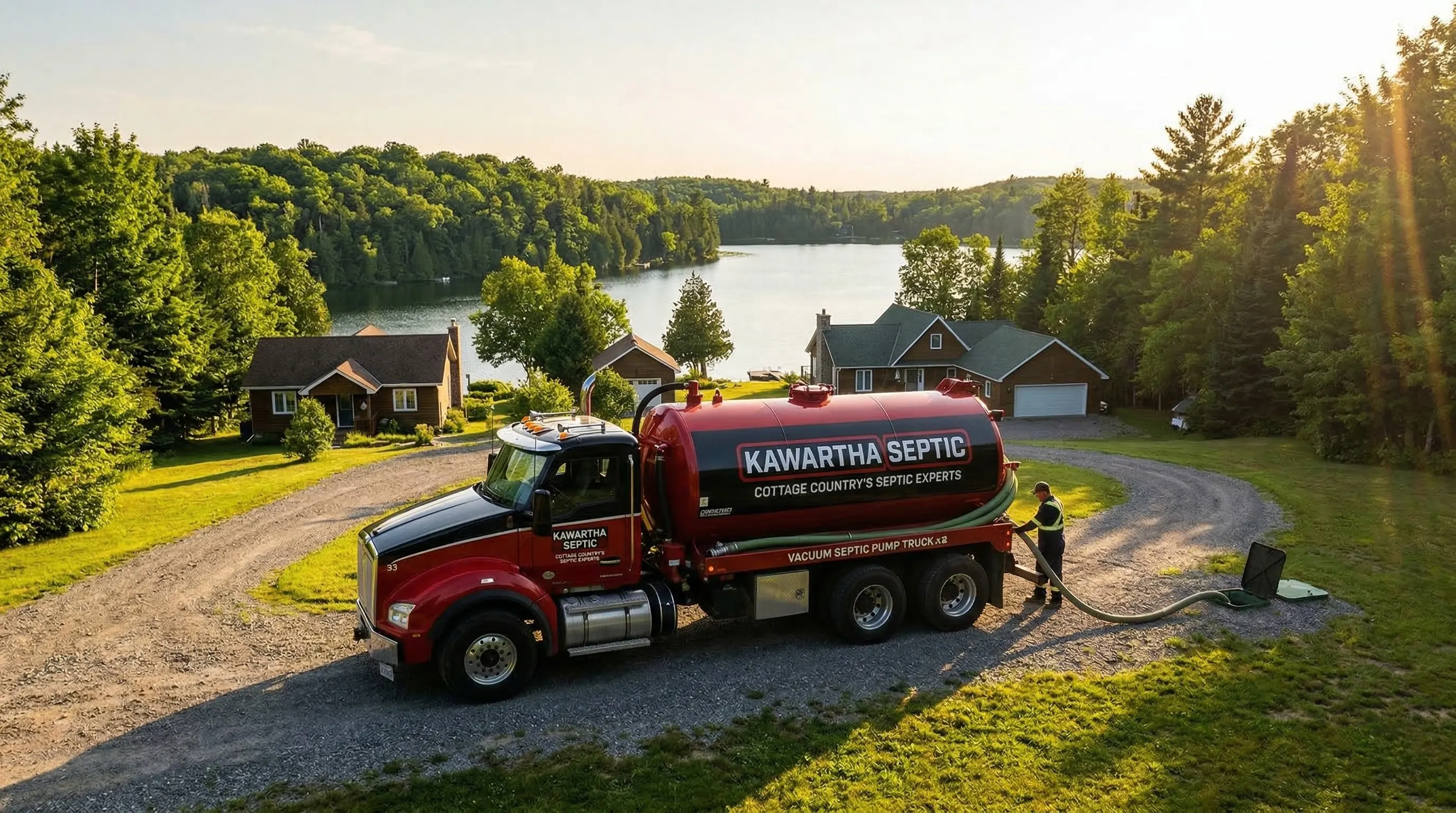
A loaded septic truck weighs somewhere between 25,000 and 40,000 pounds and needs about 11 feet of clear width and a place to turn around. If your cottage sits at the end of a narrow private lane with a soft shoulder and a low branch canopy, that is the constraint that decides your service date, not the calendar.
Access is the most common reason a pump-out gets rescheduled around the Kawarthas, and it’s almost always solvable if you know about it before the truck is dispatched rather than after.
Here’s what stops a truck, what you can do about each one, and how access affects what you pay. If you’re not sure whether your road works, call (705) 702-5526 and describe it. We’d rather sort it out on the phone than in your neighbour’s ditch.
The Quick Answer
| Obstacle | Can we work with it? | What it usually takes |
|---|---|---|
| Narrow lane under 11 ft clear | Sometimes | Trimming branches, moving a woodpile, or extra hose from a wider spot |
| No turnaround at the end | Usually | We back in, or park at the last wide point and run hose |
| Soft or unmaintained shoulder | Depends on conditions | Dry weather scheduling, or gravel added at the pinch point |
| Spring half-load restriction | Not during the restriction | Wait for the posting to lift, usually mid-April to mid-May |
| Unplowed seasonal road in winter | No | Plow it, or book before freeze-up |
| Tank more than about 150 ft from truck | Yes, with extra hose | Quoted up front, priced as difficult access |
| Low bridge or posted weight limit | No | Alternative route, or a smaller vehicle if one fits the job |
Access changes the price, distance never does. We charge no travel surcharge and no minimum distance anywhere in the City of Kawartha Lakes. Moderate access adds $50 to $100 and difficult access adds $75 to $150 on top of the base rate, and it’s quoted before any work starts.
The Difference Between Distance and Difficulty
This trips people up constantly, so it’s worth being blunt about it. Driving to Coboconk costs you nothing extra compared to a job in downtown Lindsay. The truck burns some fuel, that’s our problem, and we’ve never billed it.
What does cost more is the time and equipment a hard site eats. A hundred extra feet of hose has to be dragged out, run, and then flushed and coiled back. A tank the driver has to dig for is twenty minutes of shovel work. A lane that requires backing 400 feet in the dark in November is slower and riskier than a straight pull-in.
That’s the honest line: distance is free, difficulty is not. And difficulty gets quoted up front, never added after the job. Our full pricing breakdown covers how the rest of the estimate is built, and the cost calculator lets you set the access level yourself and see the effect.
Half-Load Season Is the One You Can’t Negotiate
Every spring, Ontario municipalities post reduced load restrictions on roads that soften during the thaw. During a posted period, heavy vehicles are limited to a fraction of their normal axle weight, and a loaded septic truck simply cannot legally travel those roads.
In the Kawarthas the posting typically runs from early March to late April or mid-May, depending on the winter. The exact dates change every year and are set by the road authority, not by us. The province explains the general framework in its reduced load periods guidance, and the City posts its own restrictions on the roads section of its site.
Two practical consequences.
If your tank is getting full in February, book it in February. A tank that would have been fine until June is a genuine problem in April when nobody can reach it.
If you own a seasonal place and open it in May, that first pump-out often lands right at the tail of the restriction. Build a couple of weeks of slack into your spring opening checklist rather than assuming a specific date.
Winter and Unplowed Seasonal Roads
Pumping in winter is entirely doable, and we cover the mechanics of it in septic pumping in winter. What isn’t doable is reaching a tank down 600 metres of unplowed private road.
If the lane is plowed to a width a truck can use, and there’s somewhere to turn or a straight run to back down, winter service is routine. If it isn’t plowed, the options are to arrange plowing before the appointment or to schedule the pump-out before freeze-up in the fall.
Owners around the smaller lakes near Bobcaygeon often handle this by making the fall pump-out part of closing up. The tank is emptied, the system sits over winter at a sensible level, and nobody is trying to get a truck down an ice-covered lane in February.
Five Things You Can Fix in an Afternoon
Most access problems on private lanes are small and cheap to solve. In rough order of how often they matter:
- Overhanging branches. A truck needs roughly 13 to 14 feet of vertical clearance. A single low limb will stop a job that everything else about the site allows. Trim it before the appointment.
- The pinch point. Almost every difficult lane has one spot that’s the actual problem, usually a rock, a post, or a corner. Widening or clearing that one spot often converts the whole site from “difficult” to “easy.”
- Somewhere to turn. A gravel apron big enough to swing a truck is worth more than another hundred feet of lane width. If there’s a field entrance or a neighbour’s wide spot, tell us about it.
- A marked tank. If nobody has to hunt for the lid, the job is quicker and cheaper. Risers bring the lid to grade permanently and remove the $100 to $200 digging fee from every future visit.
- A gate that opens fully. Standard farm gates are often narrower than they look once the posts are counted. Measure the clear opening, not the gate.
Shared Lanes and Road Associations
A lot of waterfront access in the Kawarthas runs over a shared private lane maintained by a road association. Two things to know.
The association’s maintenance standard sets your service window. If the lane is graded once a year and plowed to a single-vehicle width, that’s what a truck has to work with. If several owners on the lane all need pumping, booking together makes the visit far easier and lets everyone share the benefit of one trip in.
And check the association’s own rules before assuming. Some lanes carry a posted weight limit set by the association, particularly where there’s a culvert or a small bridge. A posted limit is a hard stop regardless of what the truck can physically manage.
Frequently Asked Questions
How much hose can you run from the truck to the tank?
Roughly 150 feet is comfortable on a standard setup, and more is possible on some sites with additional lengths. Past that, suction performance drops and the job takes noticeably longer. If your tank sits further from any drivable surface than that, tell us when you book so the right truck and hose are dispatched.
Do you charge more to come out to Coboconk or a remote lake road?
No. There is no travel surcharge and no minimum distance anywhere in the City of Kawartha Lakes, and there never has been. What can change the price is access difficulty: extra hose, digging for a buried lid, or a lane that has to be backed down. Moderate access adds $50 to $100 and difficult access adds $75 to $150, always quoted before work starts.
Can you pump during spring half-load restrictions?
Not on a restricted road. A loaded septic truck exceeds the reduced axle limits, and the restriction is a legal weight limit set by the road authority rather than a company policy. Restrictions in this area typically run from early March to somewhere between late April and mid-May. If your tank will be due in that window, book it in February instead.
What happens if the truck arrives and can’t get in?
We stop, and we talk it through with you on site rather than forcing it. Usually there’s a workable answer the same day, such as parking at the last solid spot and running extra hose. If there genuinely isn’t, we reschedule and tell you exactly what needs to change first. Nobody benefits from a truck buried in a soft shoulder.
Is it cheaper if several cottages on the same lane book together?
It’s easier, which usually means faster, and a faster job is a cheaper job when access difficulty is part of the quote. One trip down a hard lane serving four tanks beats four trips. If your road association wants to organise it, call us and we’ll work out a day that suits the group.
Not Sure If Your Road Works?
Describe it to us before you book. Width at the tightest point, the surface, whether there’s a turnaround, and roughly how far the tank sits from where a truck could park. Two minutes on the phone saves a wasted appointment.
Call (705) 702-5526 or book online. Routine pump-outs are scheduled within 48 hours, and genuine emergencies get same-day or next-morning response.