A property owner near Bobcaygeon connected to municipal sewer two summers ago and figured the old septic tank could just sit there, empty, under the side yard, forever. It couldn’t. A building inspector flagged it during an unrelated deck permit application, and the owner ended up paying about $1,600 for a rushed pump-out and crush-and-fill to close the file before the deck permit would move forward.
Here’s septic tank decommissioning ontario in plain terms: connecting to municipal sewer, replacing a failed system, or tearing down a building doesn’t mean the old tank just disappears. It stays in the ground, full of sludge and structurally weakening, unless someone deals with it properly. Decommissioning means pumping it out, then either crushing and filling it or removing it, and getting the paperwork closed off with the municipality. If you’re already staring at an old tank that needs to go, book a pump-out as the first step; nothing else can happen until that’s done.
Skipping this step doesn’t save you much, and it leaves a genuinely dangerous hole in your yard. An empty or partially collapsed tank underground is one of the more serious hazards on a rural property, worse than most homeowners realize until someone explains what’s actually happening under that patch of grass.
Here’s when decommissioning is required, how the two main methods compare, and what the process actually costs.
When You’re Required to Decommission a Tank
A few situations trigger this:
- Connecting to municipal sewer. Once your property ties into a sewer line, the old septic tank has to be taken out of service. See our piece on mandatory sewer connection rules if your road is getting sewer and you’re wondering whether connection is optional.
- Replacing a failed system. If the tank is being replaced with a new one, the old tank still needs formal decommissioning even though a new system is going in nearby.
- Demolishing a building. Tearing down a cottage or house with no plan to rebuild on septic means the tank has to be dealt with as part of the demolition permit, not left as an afterthought.
- Consolidating two systems into one. On properties with an old, unused tank from a prior building or addition, that orphaned tank needs the same treatment even if it hasn’t been “in service” for years.
Why You Can’t Just Leave It
An abandoned tank isn’t inert. Concrete lids and covers weaken with age, especially once they’re no longer being checked during regular pumping. A tank that isn’t crushed or filled is essentially a void underground with a deteriorating lid, and those lids fail. We’ve heard the same story more than once: someone’s mower, ATV, or worse, a kid, breaks through a cover that looked solid from the top.
There’s also a groundwater angle. A tank left with sludge inside will eventually let that material migrate into the surrounding soil as the structure degrades, which is exactly the kind of thing municipalities and health units want closed off with a proper sign-off, not left to chance. If you want the full picture on why lid integrity matters even on tanks still in active use, see our guide to septic tank lid safety.
Step One, Always: Pump It Out
Before anything else happens, the tank gets fully pumped. There’s no shortcut here. Crushing or filling a tank that still has sludge and liquid in it just buries the problem instead of solving it, and most municipalities won’t sign off on decommissioning without proof the tank was emptied first.
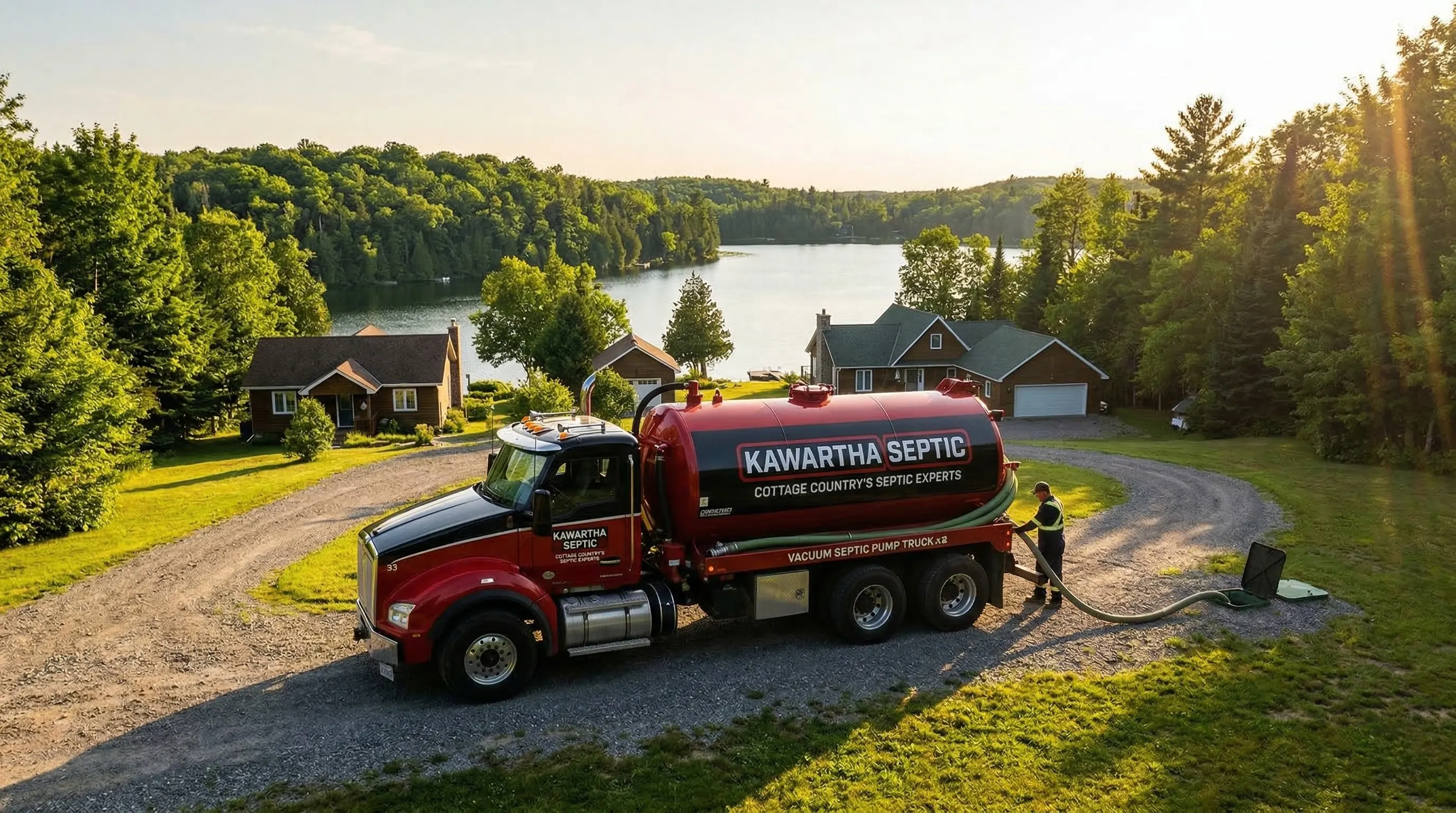
This is a standard pump-out, similar in scope to routine septic pumping, though access for a final decommissioning pump can sometimes be trickier if the lid or riser has deteriorated. Expect this step to run in a similar range to a normal pump-out, generally $300 to $600, though older or hard-to-access tanks can run higher. Our what happens during septic pumping page walks through what that visit involves if you haven’t had a tank serviced before.
Crush-and-Fill vs. Full Removal
Once the tank is empty, there are two accepted paths.
| Method | What happens | Typical use case |
|---|---|---|
| Crush-and-fill | Lid and top of tank are broken open or removed, tank is filled with clean granular material (sand or gravel), sometimes backfilled with the crushed concrete itself | Concrete tanks that are structurally accessible and where full excavation isn’t practical |
| Full removal | Tank is excavated and hauled off-site for disposal or recycling, hole is backfilled with clean fill | Poly and fiberglass tanks (they don’t crush the same way concrete does), or where the tank sits somewhere excavation is straightforward |
Concrete tanks are usually crushed and filled in place; it’s less disruptive and less costly than a full dig-out. Poly and fiberglass tanks are lighter and don’t break down the same way, so they’re more often pulled out whole. Either way, the goal is the same: no open void left underground, and no way for someone to fall through a weakened lid years from now.
This is not a DIY project past the pump-out stage. Renting an excavator and having a go at crush-and-fill yourself might look straightforward from the surface, but a partially collapsed tank, a lid that gives way mid-job, or fill material that doesn’t meet municipal spec can turn a weekend project into a safety incident or a failed inspection. Once the tank is pumped, bring in a contractor experienced with decommissioning to finish the job and get it signed off.
Permits and Sign-Off
Decommissioning a sewage system generally requires notifying the building department or health unit that issues septic permits in your area, and in many cases a formal inspection or sign-off once the work is done. This closes out the property’s sewage system record so a future buyer, appraiser, or building department reviewer doesn’t find an “active” system on file that no longer exists.
Requirements and the exact process differ by municipality, so check with the Kawartha Lakes building department before starting. Don’t assume a pumping company’s word alone satisfies the requirement; get the closure documented.
What Decommissioning Costs
Costs vary with tank size, material, and how easy the tank is to reach with equipment. As a general guide:
- Pump-out: roughly $300–$600
- Crush-and-fill on an accessible concrete tank: typically a modest add-on to the pump-out, often in the low thousands once excavator time and fill material are included
- Full removal and haul-away: higher, since it involves more excavation, transport, and disposal, and can run into several thousand dollars depending on access and tank size
- Permit and inspection fees: set by the municipality
Get quotes from a local septic contractor for your specific site. Access is the biggest cost driver: a tank buried under a deck, driveway, or mature landscaping costs more to decommission than one sitting in open lawn. Call (705) 702-5526 and describe your setup and we can give you a realistic range before you commit to a contractor.
What Happens to the Leaching Bed
Decommissioning covers the tank. The old leaching bed is a separate question. In most cases, an inactive leaching bed can simply be left alone, the soil continues to treat any residual moisture naturally over time, and there’s no requirement to excavate it. Where it becomes relevant is if you’re planning to build over that area later; disturbed septic soil isn’t necessarily suitable for a foundation, and your building department can tell you what setback or waiting period applies before construction on a former bed location.
Sewer Hookups: A Special Case
Properties switching from septic to municipal sewer face this exact decommissioning process, on top of the physical hookup itself. If your street is getting sewer service and you’re weighing whether you actually have to connect, or what the timeline looks like, that’s covered separately in our mandatory sewer connection guide. The short version: once you connect, decommissioning the old septic tank generally isn’t optional, it’s part of the process the municipality expects to see completed.
Common Mistakes
- Filling a tank that wasn’t fully pumped first. This just seals sludge underground instead of removing it.
- Skipping the permit or sign-off. Creates a paperwork headache at resale when a buyer’s lawyer asks for proof the old system was properly closed.
- Assuming a fiberglass or poly tank can be crushed in place like concrete. It usually can’t; lighter tanks tend to need full removal.
- Leaving the lid in place “for now.” A “temporary” plan to deal with an old tank later is how covers end up failing years down the road, often after everyone’s forgotten the tank is even there.
Decommissioning During a Property Sale
Decommissioning questions come up constantly during real estate deals, more than most sellers expect. A property near Fenelon Falls had an old, unused tank from a demolished bunkhouse sitting in the side yard, never formally closed out, when the sale was conditional on a septic inspection. The buyer’s lawyer wouldn’t waive the condition until the sellers produced proof the tank was decommissioned, which meant scrambling to get it pumped, crushed, and signed off in the middle of a closing timeline that had no room for delay. It cost them about $1,400 and a genuinely stressful two weeks.
If you know a sale is coming and there’s an inactive tank on the property, deal with it before the property is listed, not after an offer is conditional on it. Many buyers out here are moving from city sewer to septic for the first time, and their lawyers compensate by being thorough about septic records. An undocumented, unaccounted-for tank is exactly the kind of thing that stalls a closing date.
Decommissioning FAQ
Do I need a permit to decommission a septic tank? In most municipalities, yes, or at minimum a notification and inspection sign-off. Check with the Kawartha Lakes building department for the exact process before starting work.
Can I just fill the tank with dirt myself? Not safely, and probably not to code. The tank needs to be fully pumped first, and the fill material and process typically need to meet municipal requirements. This isn’t a DIY weekend project.
How much does it cost to decommission a septic tank in Ontario? It varies with tank size, material, and access, but budget for the pump-out (roughly $300–$600) plus additional cost for crush-and-fill or removal, which can range from a modest add-on to several thousand dollars depending on the scope. Get a quote for your specific site.
What happens if I sell the property without decommissioning the old tank? It can complicate the sale. Buyers and their lawyers increasingly ask for proof that inactive systems were properly closed, and an undocumented tank can raise questions during due diligence.
Is crush-and-fill safe long-term? Yes, when done properly with the tank fully pumped and filled with appropriate material. It’s a widely accepted method and generally less disruptive than full excavation.
Do fiberglass and poly tanks get decommissioned differently than concrete? Often, yes. Concrete is commonly crushed and filled in place. Poly and fiberglass tanks are more often excavated and removed whole since they don’t break down the same way.
Does decommissioning affect my property taxes or assessment? Not typically on its own, but removing a sewage system from the property record can matter if you later apply for permits tied to that area of the lot. Check with the municipality if you’re unsure.
Decommissioning Done Right in Kawartha Lakes
We handle the pump-out side of decommissioning for properties across Lindsay, Bobcaygeon, Fenelon Falls, Coboconk, and the surrounding Kawartha Lakes area, whether you’re switching to municipal sewer, replacing a failed system, or clearing a lot before demolition. We can also point you to the right permit contact so the closure gets documented properly.
Got an old tank that needs to be taken out of service? Call (705) 702-5526 or book online. Use the cost calculator for a 60-second estimate.