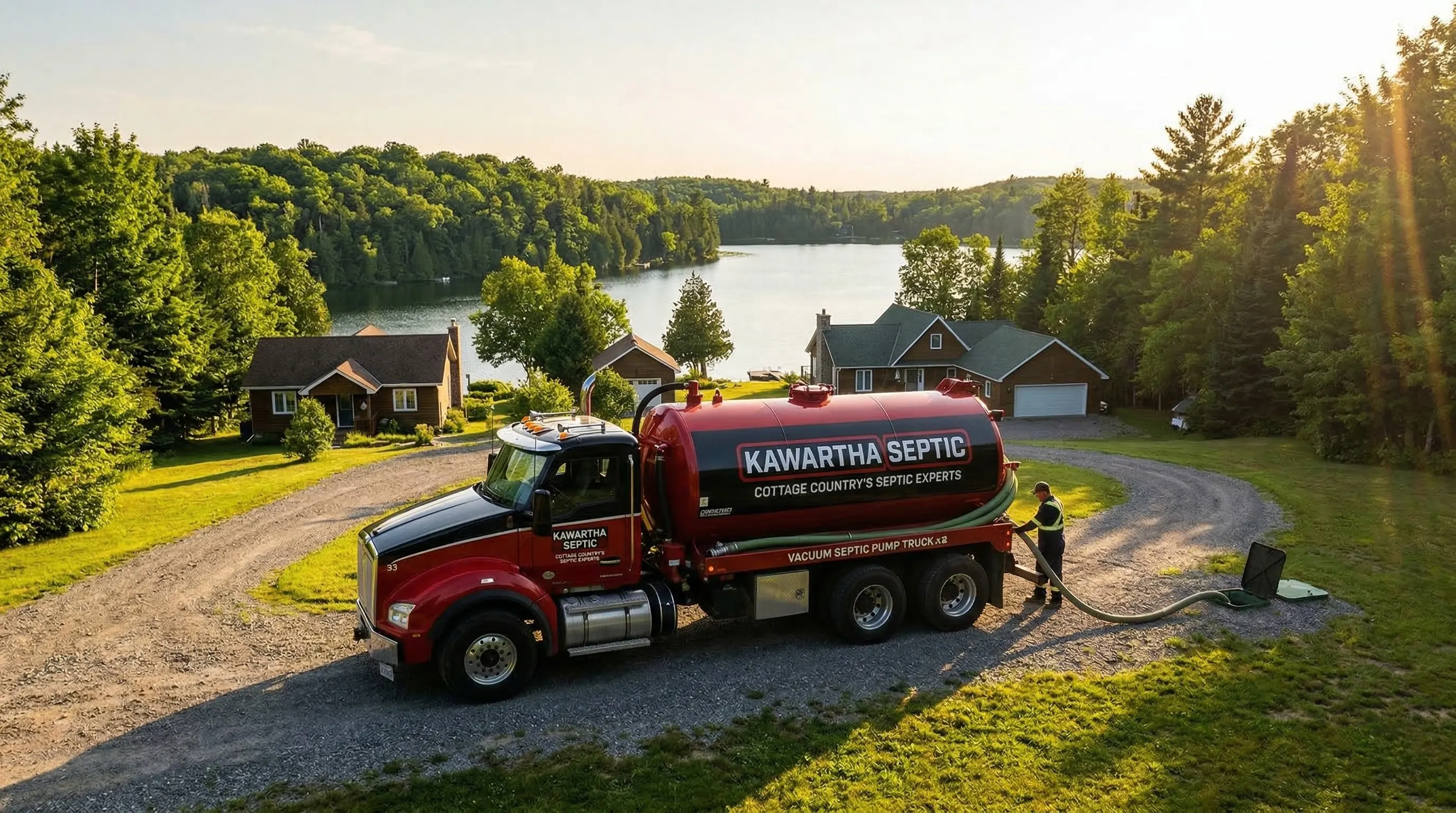
A routine septic tank pump out runs $300 to $500 for a typical home and takes under an hour. Most people still put off calling anyway, because they picture a bigger job than it actually is. There’s no digging in most cases, no long visit, and the crew leaves your yard the way they found it.
Here’s the whole thing in order: booking it, getting ready, what the crew does once the truck’s in the driveway, and what you’re told when it’s done.
Booking your pump out: the 48 hour promise
Routine pump-outs in Kawartha Lakes are scheduled within 48 hours of the call. That’s the standard turnaround for a normal booking, whether the tank’s in Lindsay or out past Norland.
A genuine emergency gets handled differently. Sewage backing up into the house, an alarm that won’t stop, or septic smell inside the house gets a same-day or next-morning response, not a scheduling queue. Book through the form instead of calling, and we’ll call you back within 24 hours during business hours.
Call (705) 702-5526 or book a pump-out online to get on the schedule. Most calls come after slow drains, a rough guess that it’s “been a while,” or a real estate deadline coming up fast.
Before the truck arrives: how to get ready
The crew handles the technical work. Your job is access. Get that right and it makes a real difference to how the visit goes.
- Clear driveway access. Move vehicles, trailers, or firewood out of the path the truck needs. A pump truck is full-size, and the hose only reaches so far from where it parks.
- Know roughly where the tank and lids are. You don’t need exact coordinates. A rough spot near the foundation, a flag from a past visit, or “somewhere along the south wall” all help. If you genuinely don’t know, that’s normal on a property you just bought, and the crew can find it. It just adds time.
- Unlock any gates. A locked gate the truck can’t get through is the single most common reason a visit runs long.
- Keep pets inside or contained. An open tank lid and a running vacuum hose are no place for a dog or cat to be wandering around.
None of it is complicated, but skipping it is what turns a 40 minute visit into an hour and a half.
Cottage owners often assume a seasonal property is automatically harder to service. It usually isn’t. A lakefront lot with a cleared path and an unlocked gate is easier to pump than a year-round home with a locked side gate and a car parked in front of the lid. The truck cares about access, not whether the property’s lived in full time or a few months a year.
What happens during the pump out
Locating and opening the lids
If the lids are marked, or you already know roughly where they are, this step takes a few minutes. If not, the technician follows the pipe line from the foundation and may probe the ground to find the tank edges. Buried lids sometimes need digging to reach.
Once the lid’s off, there’s a quick look inside before pumping starts: scum thickness on top, how high the liquid sits, anything obviously wrong.
The vacuum hose and breaking up the scum layer
A hose from the truck, usually 4 to 6 inches across, does the actual pumping. Waste inside a septic tank settles into three layers: a scum layer of fats and lighter solids floating on top, liquid effluent in the middle, sludge settled at the bottom. The scum layer has to break up before it’ll move through the hose, so the technician works it apart instead of just skimming the surface.
Backflushing to stir the solids
Suction alone won’t lift everything off the tank floor, especially compacted sludge in a tank that’s gone a few years between pump-outs. Backflushing briefly runs some liquid back into the tank to stir up the bottom, loosening that material so the hose can pull it out with everything else. The goal is a tank that’s genuinely empty, not just lighter.
Pumping both compartments
Most tanks built in the last few decades have two compartments, split by an internal wall rather than being two separate tanks. Solids settle mostly in the first compartment. The more fully separated liquid moves into the second before it exits toward the leaching bed. Both compartments need pumping, not just the one nearest the inlet.
A visual check while the tank is empty
This is the part most homeowners never see, and it’s the part that matters most. With the tank empty, the technician can actually see the baffles, the fittings at the inlet and outlet that control flow and keep solids from washing straight through to the leaching bed. They check that wastewater’s entering cleanly at the inlet with no blockage, that only liquid is meant to leave at the outlet, and the general condition of the tank walls for cracks or corrosion that wouldn’t show with the tank full.
If something looks off, like a worn outlet baffle, it gets flagged on the spot. See our guide on septic tank baffle repair for what a failing baffle looks and acts like.
Checking for signs the bed is backing up
While they’re there, a good technician also looks for anything suggesting the leaching bed itself is struggling: slow drainage back into the tank, odour near the bed area, or standing water over it. That’s a separate problem from a full tank, and it’s worth knowing about early rather than after it gets worse.
How long a pump out takes, and what you’re told after
For a typical residential tank in the 750 to 1,500 gallon range, a routine pump out runs 30 to 60 minutes total: locating the lid, pumping, the inspection, closing everything back up.
A few things stretch that out. A buried or hard-to-find lid can add 10 to 30 minutes. A tank that’s gone 5 or more years without pumping usually has thicker, more compacted sludge. Difficult access, a long driveway, a gate, a tank set back from where the truck can park, all adds time on top of the pumping itself.
Once the lid’s back on and the site’s cleaned up, you get a summary: how much was pumped, general tank condition, anything flagged during the visual check. A worn baffle or an early bed warning sign gets called out specifically, not buried in a checklist.
Two things surprise most first-timers. First, the tank shouldn’t be washed out or refilled with water afterward. An empty tank is normal. It doesn’t need rinsing or topping up. The bacteria that break down waste inside it come back on their own as the household uses water over the following days.
Second, a pump out is the one moment anyone can actually see inside your tank. The rest of the time it’s buried, full, and invisible. That makes the visual check part of the pumping visit the cheapest inspection you’ll ever get on the system, since it comes with the price of the pump out instead of being billed on its own.
Where the waste legally goes
Septage, the material pumped out of a residential tank, is regulated waste in Ontario. It has to go to an approved receiving facility, where it’s treated before being returned to the environment, and it has to get there through a licensed hauler. That’s not optional paperwork. It’s worth asking any company you hire whether they meet it.
For background on the provincial framework, see Ontario’s septic system page.
What a septic tank pump out costs
Pricing depends mainly on tank size, with modifiers for things like difficult access or a tank that’s never been pumped. A typical 1,000 gallon residential tank in Kawartha Lakes runs $300 to $500 for a routine pump out, with smaller and larger tanks scaling down or up from there.
There is no travel surcharge anywhere in the City of Kawartha Lakes, and no minimum distance either. Coboconk and Balsam Lake cost the same as a job in downtown Lindsay. What actually changes the price is access, not distance: a long or steep driveway, a gate the truck can’t fit through, or a tank the crew has to dig for. Any of that gets quoted up front, never added after the job is done.
For the full pricing breakdown across tank sizes and modifiers, see our septic pumping cost guide or run your own numbers through the septic pumping cost calculator.
Field example. A 1,000 gallon tank at a seasonal cottage north of Coboconk hadn’t been pumped in six years. The sludge layer was thick enough that backflushing took longer than usual, and the price landed near the top of the range once the never-recently-pumped modifier applied. The visual check also caught a lid that had cracked from age: a $100 to $300 fix on its own instead of a bigger problem down the road.
Second example. A waterfront property near Bobcaygeon had a 1,250 gallon tank set well back from the driveway, behind a locked gate the crew hadn’t been warned about. The homeowner wasn’t home, so the visit got rescheduled once access was sorted out. The pump out itself, once the gate was open, took under 40 minutes. The whole delay was about the gate. Not the tank, not the pumping, not the distance from the road.
| Tank size | Typical pump out cost |
|---|---|
| 750 gallon | $250-$400 |
| 1,000 gallon | $300-$500 |
| 1,250 gallon | $350-$550 |
| 1,500 gallon | $400-$600 |
| 2,000+ gallon | $500-$800 |
Ready to book? Call (705) 702-5526 or book a pump-out online. We serve the whole City of Kawartha Lakes, Lindsay to Coboconk and every lake between.
Frequently Asked Questions
Do I need to be home for a septic pump out?
Not necessarily, as long as the crew can reach the tank without a locked gate in the way and already knows roughly where to look. It’s still a good idea to be home for your first pump-out, though, so you can point out the lid location and hear the inspection results directly.
Will pumping damage my lawn or driveway?
On dry ground, a pump truck typically leaves little to no trace. Soft or saturated ground, especially during spring thaw or after heavy rain, carries a small risk of tire marks. It’s one more reason access matters more than distance.
How often does a tank actually need pumping?
Most households need it every 3 to 5 years, though heavy use, a large household, or a high-turnover rental cottage can shorten that. It comes down to tank size and how much water the home actually uses.
What if the crew finds a problem during the pump out?
You get told specifically what was found, whether that’s a worn baffle, a cracked lid, or an early sign the bed is struggling. We diagnose before we replace. If a $200-$500 baffle is the fix, that’s the quote. Not a new system.