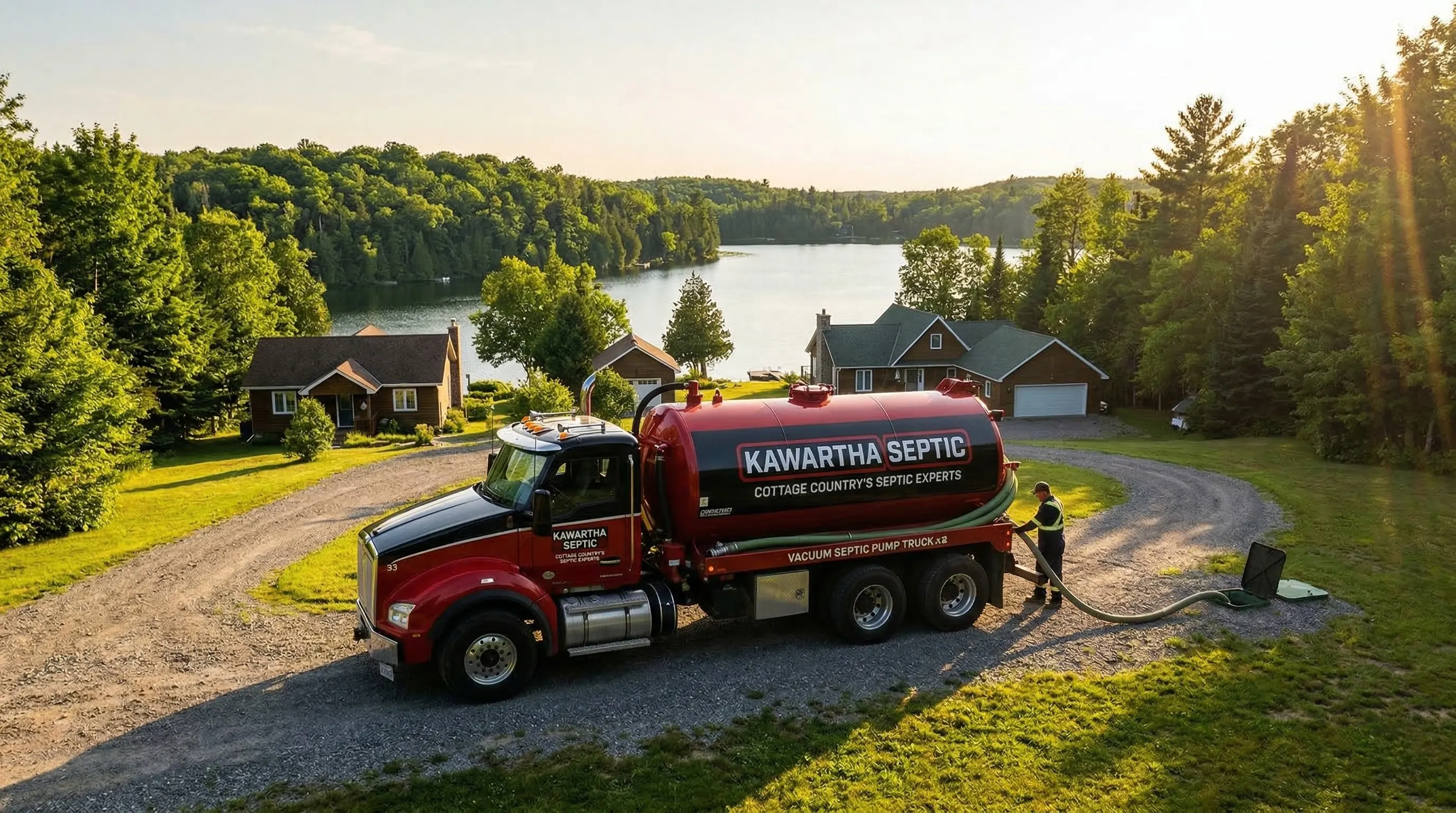
The truck runs its hose for forty minutes, the tank goes quiet, the driver coils up and leaves. And then a perfectly reasonable question occurs to almost everybody, usually about ten minutes too late to ask: where is that going?
It is not idle curiosity in cottage country. If you live on Balsam, Sturgeon or Cameron Lake, the answer determines whether the contents of a few hundred septic tanks a week end up in a treatment process or somewhere considerably closer to your swimming.
The short version is that it goes to an approved receiving site, and the entire regulatory apparatus around septic pumping exists to make sure it does.
The Quick Answer
| Stage | What happens |
|---|---|
| In the tank | Scum, liquid and sludge, collectively called septage |
| Onto the truck | Vacuum-loaded into a sealed tank on the truck |
| In transit | Regulated waste. Haulers operate under Ministry approvals |
| Destination | An approved receiving site: a wastewater treatment plant that accepts hauled sewage, or an approved septage facility |
| Treatment | Solids separated, liquid treated with the municipal waste stream |
| End product | Treated effluent, plus biosolids that are further processed |
| What is not allowed | Dumping on land, into a ditch, or down an unapproved drain |
| Your paper trail | Ask your hauler where loads go. A legitimate one answers immediately |
The load is tracked. That is the whole design.
Septage Is Not the Same Thing as Sewage
Municipal sewage is dilute and it flows continuously. Septage is what accumulates in a tank over three to five years, and it is a very different material: far more concentrated, high in solids, grease and nutrients, and delivered in one 1,000 to 1,500 gallon slug rather than a steady stream.
That concentration is why it cannot simply be poured into the nearest manhole. A treatment plant taking hauled septage has to have the capacity and the equipment to receive it at a controlled rate, or one truckload can disrupt the biological processes doing the actual treating. Receiving stations exist for exactly this reason: they meter the load into the plant instead of dropping it in whole.
Understanding what is in the tank helps here. As our guide to how a septic system works explains, the tank separates incoming wastewater into three layers, and only the middle band of clarified liquid leaves through the outlet to your leaching bed. The floating scum and the settled sludge stay behind and accumulate. A pump-out removes them. Those two layers are the concentrated part, and they are the reason the material needs a facility rather than a field.
The Path a Load Takes
1. Vacuum loading. The truck’s pump pulls a vacuum on a sealed tank, and the hose does the work inside your septic tank while the operator breaks up the crust and works the bottom. Nobody enters the tank, ever. What happens during septic pumping covers the on-site side.
2. Sealed transport. From the moment it is loaded, the material is regulated waste in transit. The vehicle, the operator and the handling all fall under approvals issued by the Ministry of the Environment, Conservation and Parks. This is not the same as a licence to drive a truck, and it is what distinguishes a septic hauler from someone with a tank on a trailer.
3. Discharge at an approved receiving site. Loads go to facilities approved to accept hauled sewage. In practice that is most often a municipal wastewater treatment plant with a septage receiving station, or a dedicated septage treatment or storage facility. The site logs what arrives and from whom.
4. Treatment. At the plant, screening removes rags, wipes and debris, then the septage joins the treatment stream: solids settle and are separated, and the liquid fraction goes through biological treatment along with the rest of the municipality’s wastewater. What comes out the far end is treated effluent that meets discharge criteria.
5. Biosolids. The separated solids become biosolids, which are stabilized and then either land-applied under a regulated nutrient management framework, composted, or landfilled, depending on the facility and the quality of the material. This is a controlled agricultural and waste-management process with its own siting, timing and record-keeping rules, and it is a different thing entirely from raw septage being dumped somewhere.
The province’s overview of septic systems in Ontario is the plain-language starting point for how the residential end of this is regulated, and the US EPA’s septic resources cover the underlying treatment science in more depth if you want it.
What Is Not Allowed, and Why It Matters Here
Raw septage on the ground is a public health matter, not a technicality. It carries pathogens at concentrations that make direct human contact genuinely dangerous, and it is loaded with nitrogen and phosphorus.
That second part is the local story. Phosphorus is the nutrient that drives algae growth in the Kawartha lakes, and blue-green algae blooms are a recurring summer problem across the chain, closing beaches and making water unsafe for pets and swimmers. Our post on septic systems and blue-green algae in Kawartha covers how nutrient loading from failing systems contributes. A dumped load of septage is that same problem delivered all at once.
So the prohibitions are firm:
- No discharge to land outside an approved, regulated program
- No discharge to a ditch, watercourse, or storm sewer, ever
- No discharge to a sanitary connection not approved to receive hauled waste
- No leaving it in a container to deal with later
This is also the reason pumping your own septic tank is a dead end for homeowners. The pumping is not the hard part. There is no receiving site that will take a load from someone without approvals, which means the DIY version of the job has no lawful ending.
How to Check Your Hauler Is Doing It Right
You do not need to audit anybody. You need to ask one question and listen to how fast the answer comes.
“Where do you take it?” A company that hauls septage daily answers this in one sentence, without hedging, because it is the most ordinary fact about their operating day. Vagueness, deflection, or irritation at being asked is the signal.
Reasonable follow-ups, particularly if you are a property manager, a cottage association, or someone with a commercial system:
- Are you approved to haul septage, and to which sites?
- Do you keep records of loads for my property?
- Can I get documentation of the service for my file?
That last one is worth having regardless of disposal. Pump-out records are what set your actual maintenance interval and what a buyer’s lawyer asks for at sale time.
There is one more reason to care about a hauler’s disposal arrangements that has nothing to do with ethics: cost stability. Tipping fees at receiving sites are a real input into what pumping costs, which is part of why prices sit where they do. A residential pump-out on a 1,000 to 1,500 gallon tank runs $300 to $600 in Kawartha Lakes, and $250 to $800 across all tank sizes from 750 to 2,000-plus gallons. Our septic pumping cost guide breaks it down. An operator quoting far below that range is either not pricing disposal properly or not doing it properly.
What Cottage Country Adds to the Problem
Three things make septage logistics harder in the City of Kawartha Lakes than in a city.
Distance to receiving sites. Rural haulers drive further with every load, and there are fewer places to take one. That is a real operating cost, and it is why some companies add a distance surcharge. We do not: there is no travel surcharge and no minimum distance anywhere in the City, so Coboconk and Balsam Lake cost the same as downtown Lindsay. What legitimately changes a price is access, meaning a long steep driveway, a gate the truck cannot pass, or a tank that has to be dug for, and that gets quoted up front.
Seasonality. Cottage country’s demand is not flat. May opening and the Thanksgiving-to-November closing window concentrate an enormous share of the year’s pump-outs into a few weeks, and receiving capacity has to absorb it.
Density near water. A high proportion of systems here sit within a few dozen metres of a lake, which is precisely where a disposal shortcut would do the most damage. It is also why the setback rules are what they are, and why compliance in this region is watched more closely than in drier, flatter parts of the province.
Frequently Asked Questions
Where does septic tank waste go after it is pumped out?
To an approved receiving site, usually a municipal wastewater treatment plant with a septage receiving station or a dedicated septage facility. There it is screened, the solids are separated, and the liquid is treated along with the municipality’s wastewater. The separated solids become biosolids, which are stabilized and then land-applied under a regulated program, composted, or landfilled.
Is septic waste treated or just dumped?
Treated. Septage discharged at an approved facility goes through the same treatment train as municipal sewage, metered in so its concentration does not upset the process. Dumping raw septage is prohibited, and the approvals and record-keeping around hauling exist to prevent it.
Can septic waste be spread on farmland?
Raw septage is not something a hauler or a landowner may spread at will. Land application in Ontario is a regulated activity governed by nutrient management rules, with siting, rate, timing and setback requirements, and in practice it is treated biosolids rather than raw septage that goes through that pathway.
How do I know my septic company is disposing of waste legally?
Ask where they take it. A legitimate operator answers immediately and specifically, because it is a routine part of their day. Also ask for documentation of the service, which is worth keeping anyway for your maintenance file and for a future sale.
Why does septic pumping cost what it does if the waste is just dumped?
It is not dumped, and disposal is a genuine line item. Tipping fees at receiving sites, the drive to get there, the approvals, and the equipment all sit inside the $300 to $600 a typical 1,000 to 1,500 gallon pump-out costs. A quote well below the going range usually means a corner is being cut somewhere.
Ask Us Where It Goes
It is a fair question and we would rather you asked it than wondered.
Call (705) 702-5526 or book a pump-out. A standard visit for a 1,000 to 1,500 gallon tank runs $300 to $600, most routine pump-outs are scheduled within 48 hours, and we will tell you exactly where the load is going and leave you with a record of the service.
We serve the whole City of Kawartha Lakes, Lindsay to Coboconk and every lake between, with no travel surcharge and no minimum distance.