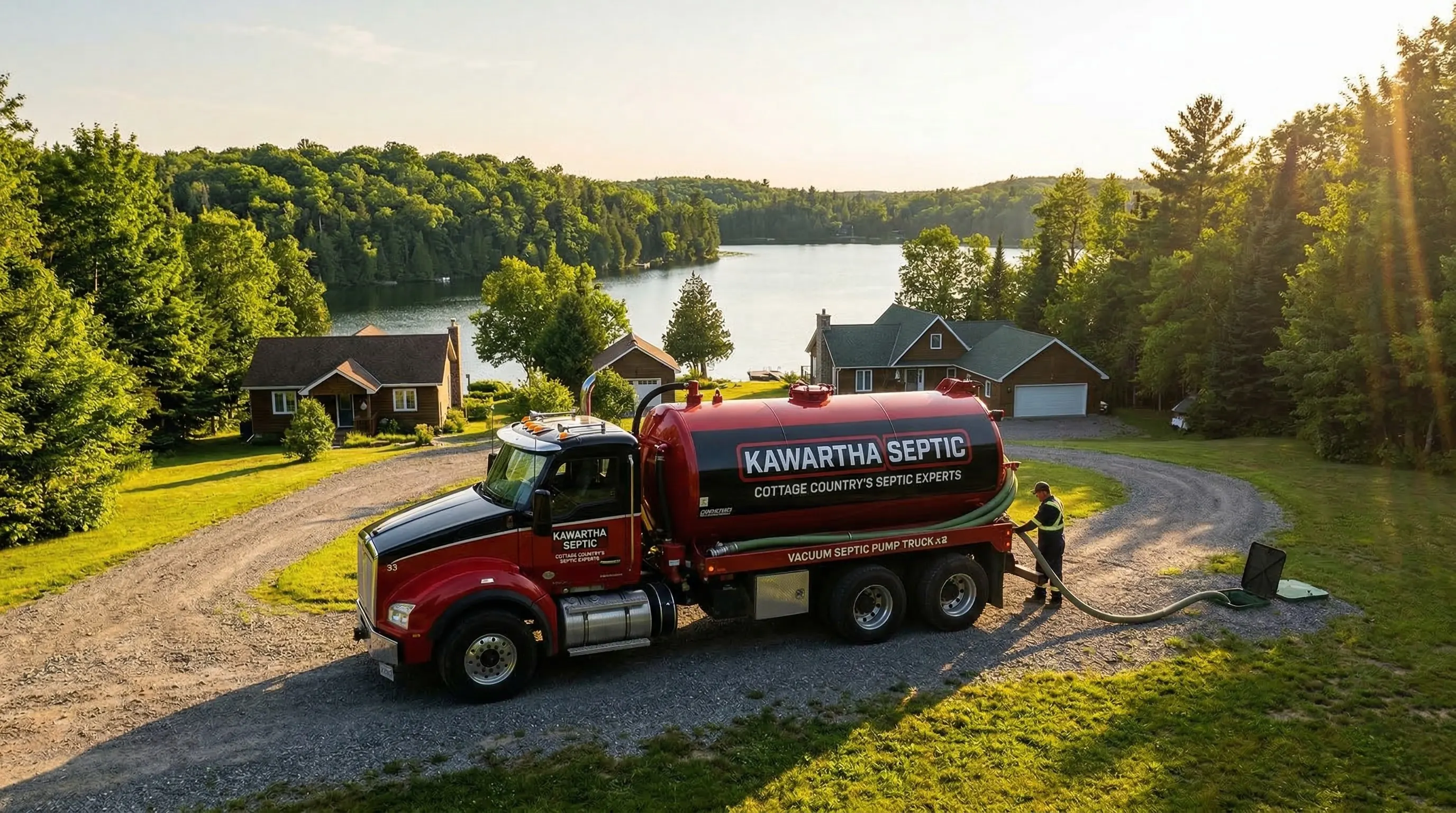
Yes, a septic system can be installed in an Ontario winter, but only if the soil testing is already done, and frozen ground usually makes the job cost more. Designers won’t run a perc test or read a test pit in frozen soil. On most properties, then, the real winter question is whether a design exists yet, not whether an excavator can dig.
That splits winter jobs into two groups. If a designer evaluated the site before freeze-up, the design, permit and install can carry on through the cold months, with extra work for frost built into the quote. If nobody has tested the soil, the new system waits for spring, and the winter job is keeping the old system (or the building schedule) alive until then.
Below: what to do when a system fails in December, how to plan a new build around freeze-up, and where the extra winter cost comes from.
The Short Version
| Your situation | Installed this winter? | What happens next |
|---|---|---|
| System failed, no soil evaluation on file | Rarely | Holding pattern until spring: pump-outs as needed, less water, designer booked for the first testing window |
| System failed, site evaluated in the fall | Often, yes | Design, permit and install go ahead, with winter conditions in the quote |
| Tank failed, leaching bed still sound | Often, yes | Tank-only replacement, $5,000 to $10,000, under a City permit |
| New build, soil tested before freeze-up | Yes | Design and permit over the winter, install when the builder is ready |
| New build, lot bought in winter, never tested | Not until thaw | Use the winter for the survey, house plans and booking a designer |
| Drains slow or backing up, cause unknown | Diagnose first | It may be a frozen line, not a failed system |
Why Soil Testing Stops at Freeze-Up
Ontario Building Code article 8.2.1.2 requires a site evaluation on every site where a new or replacement sewage system is going in. The designer finds the soil’s percolation time one of two ways: perc tests at no fewer than three spots across the bed area, with the slowest result used, or by classifying the soil itself.
Both need soil in its normal state. A perc test measures how fast water soaks in, and frozen ground doesn’t take water the way it does in June, so the reading tells you nothing about how the bed will behave. Classifying soil means looking at it in a test pit, and a frozen pit wall hides what the designer needs to see. That’s why soil and perc testing is effectively a late-spring-to-fall job in Kawartha Lakes, and why we won’t promise anyone a winter perc test.
Our perc test guide explains the test itself. For budgeting, a perc test runs $500 to $1,500 and a soil profile or deep test pit $500 to $1,000, often done on the same visit.
The Code applies across the province. The current version is the 2024 Ontario Building Code (O. Reg. 163/24), in force since 1 January 2025, and the province keeps its overview on the Building Code page.
When a System Fails in December
Rule out a freeze first
Slow drains, a gurgling toilet or a backup in January don’t always mean the leaching bed has failed. A line from the house to the tank can freeze solid, especially after a cold snap with thin snow cover or a stretch with nobody home. The symptoms look alike and the fixes are nothing alike. Our post on whether a septic system can freeze walks through the signs.
We diagnose before we replace. If the problem turns out to be a frozen pipe or a failed baffle, that’s the quote, not a new system.
The holding pattern
Once a bed has truly failed, effluent has nowhere to go. Every shower and load of laundry adds to a tank that can’t drain, so pumping becomes the treatment until the new system goes in. How often depends on how much water the house uses; after the first pump-out, the level tells you how fast it’s coming back, and the schedule follows from that.
- Pump-outs. A standard residential pump-out on a 1,000 to 1,500 gallon tank runs $300 to $600. If sewage is backing up into the house, that gets same-day or next-morning response, and an emergency pump-out runs $400 to $800 for a typical 1,000 to 1,500 gallon tank.
- Winter access. Snow and frozen lids are what slow a winter pump-out down, not the cold itself. Our guide to septic pumping in winter covers marking the lid and keeping a path clear. Where there’s no riser, digging to the lid adds $100 to $200. If you’ll be pumping all winter, a riser ($200 to $500) can pay for itself.
- Less water. Spread the laundry over the week, fix running toilets and dripping taps, and keep showers short. Whatever goes down the drain ends up on the truck.
- Stay off the bed. No snowmobiles, no parked vehicles and no plowed snow piled on it. If effluent is surfacing anywhere, keep children and pets away from it.
Line up the spring job now
The winter isn’t dead time. Most of the paperwork for a replacement doesn’t need thawed ground.
Start with the City’s records. The City of Kawartha Lakes Building and Septic Division holds sewage system records back to 1974, and a search of records usually takes one to two days. It tells you what was permitted, where it sits and what size it is, which is useful to whoever designs the replacement. Whether that old data saves any testing is the designer’s call.
Then book a licensed sewage system designer for the first testing window in spring, and get your quotes lined up. Spring is peak season for designers and installers alike, and the people who booked in February tend to be first in line when the frost comes out.
Once the soil is tested, a replacement typically takes 4 to 8 weeks from first call to finished system, with permit review in Kawartha Lakes typically 2 to 4 weeks for a straightforward application. A full replacement costs $15,000 to $35,000 in Ontario, with most jobs landing between $15,000 and $30,000; our replacement cost guide breaks down where it goes.
One thing not to do: start digging before the permit is issued because the situation feels urgent. In Kawartha Lakes, construction that starts without a permit is charged the applicable permit fee plus 100 percent. The permit still has to be issued before the work can be inspected and signed off.
Planning a New Build Around Freeze-Up
On a new home without municipal sewer, the septic permit comes first. The City encourages you to apply for the building and septic permits together, but it won’t issue the building permit until the septic permit is approved. That makes the soil test the first domino, and in this climate it has a deadline.
If you’re buying vacant land in late summer or fall, get the soil evaluated before the ground freezes, ideally before you close. A lot that turns out to need a raised bed can move the budget from a conventional system at $15,000 to $22,000 to a raised mound at $25,000 to $45,000, and you want to know that before you own the lot, not in April. Our new construction septic guide walks through the whole process, and the septic permit guide covers the application.
With the soil tested before freeze-up, the rest can run through the winter. The designer draws the system, the application goes in, and the permit can be in hand before the builder is ready. From first site visit to approved installation, a new build typically takes 5 to 10 weeks. A conventional system on a new build usually costs $15,000 to $25,000, and permitting plus design adds $3,000 to $7,000 for a standard Class 4 residential system, including the City’s $975 permit fee.
If you missed the window and the lot is already frozen, you have not lost the winter. The survey, house plans, well location and designer booking can all be settled so the soil test is the only thing left when spring comes. Say the soil gets tested in early May: the design and permit can follow in the weeks after, instead of starting from a blank page.
Why Winter Installs Cost More
There is no fixed winter surcharge. A winter job is quoted after a site visit like any other, and every installation or replacement ends with a written, itemized quote. The extra cost shows up in specific lines.
- Frost in the excavation. The top layer has to be broken through before normal digging starts, which means more machine time and slower progress on the tank hole and the bed.
- Snow and access. Plowing a route for a boom truck, stone deliveries and the excavator is work that doesn’t exist in August.
- Materials. Stone, sand and backfill that freeze in a stockpile can’t be placed and compacted properly. Frozen lumps settle as they thaw, which can pull pipes out of grade, so the material has to be kept thawed or brought in fresh.
- Protecting open work. An open excavation or exposed pipe can freeze overnight, so it has to be covered or finished the same day.
- Short days. Less daylight, fewer hours on site.
- Restoration comes back in spring. Topsoil, grading and seed can’t go onto frozen ground, so the final finish waits for spring. On a normal job that line is $500 to $2,000.
Raised beds feel this the most, because they depend on large amounts of imported sand being placed and shaped evenly.
Whether it’s worth paying depends on the alternative. For a house with a failed bed and a site already tested in the fall, a winter install can come out ahead of paying for pump-outs every few weeks until May. For a sound system on a planned upgrade, waiting for spring usually costs less. Our septic system installation page covers what we take on and how the quote works.
Inspections don’t pause for winter either. The City still inspects before the system is covered. How it handles a snow-covered site or a frozen bed area is a question for the City directly, at 705-324-9411, before the install is booked.
Frequently Asked Questions
Can a septic system be installed when the ground is frozen?
Yes, if the site evaluation was done before freeze-up and the permit is issued. The excavation takes longer and the materials have to be kept from freezing, so the job usually costs more than the same install in summer. Final grading and seeding wait for spring.
Can you do a perc test in winter in Ontario?
In practice, no. Frozen soil doesn’t absorb water normally and can’t be read properly in a test pit, so designers don’t test frozen ground and a result would not reflect how the bed will perform. Soil and perc testing is effectively a late-spring-to-fall activity in the Kawartha Lakes area.
What should I do if my septic system fails in winter?
First rule out a frozen line, because the symptoms look like a failure. If the leaching bed has failed, pump the tank as often as it needs, cut water use, and keep traffic and snow piles off the bed. Use the winter to pull the City’s records, book a designer for spring and get quotes, so the replacement starts as soon as the soil can be tested.
Does a winter septic installation cost more?
Usually, yes, though there is no fixed winter surcharge. The extra comes from breaking frost, clearing snow for trucks, keeping stone and backfill from freezing, and coming back in spring to finish grading and seeding. A written, itemized quote should show those items so you can compare it with a spring price.
When should I start planning a spring septic installation?
In the winter. Records searches, designer booking, house plans and quotes don’t need thawed ground, and spring is the busiest season for designers and installers. Having everything else ready means the soil test is the only thing left when the frost comes out.
Book the Spring Job While the Ground Is Frozen
If your system has failed or you’re building next year, call (705) 702-5526 or book online. We’ll tell you whether your job can go ahead this winter or should wait for thaw, and keep the tank manageable in the meantime. A sewage backup inside the house gets same-day or next-morning response, and we call back within 24 hours during business hours.
There is no travel surcharge anywhere in the City of Kawartha Lakes. For Peterborough County, Durham Region, Belleville and Hastings, or Haliburton, prices are quoted up front before anything is booked.