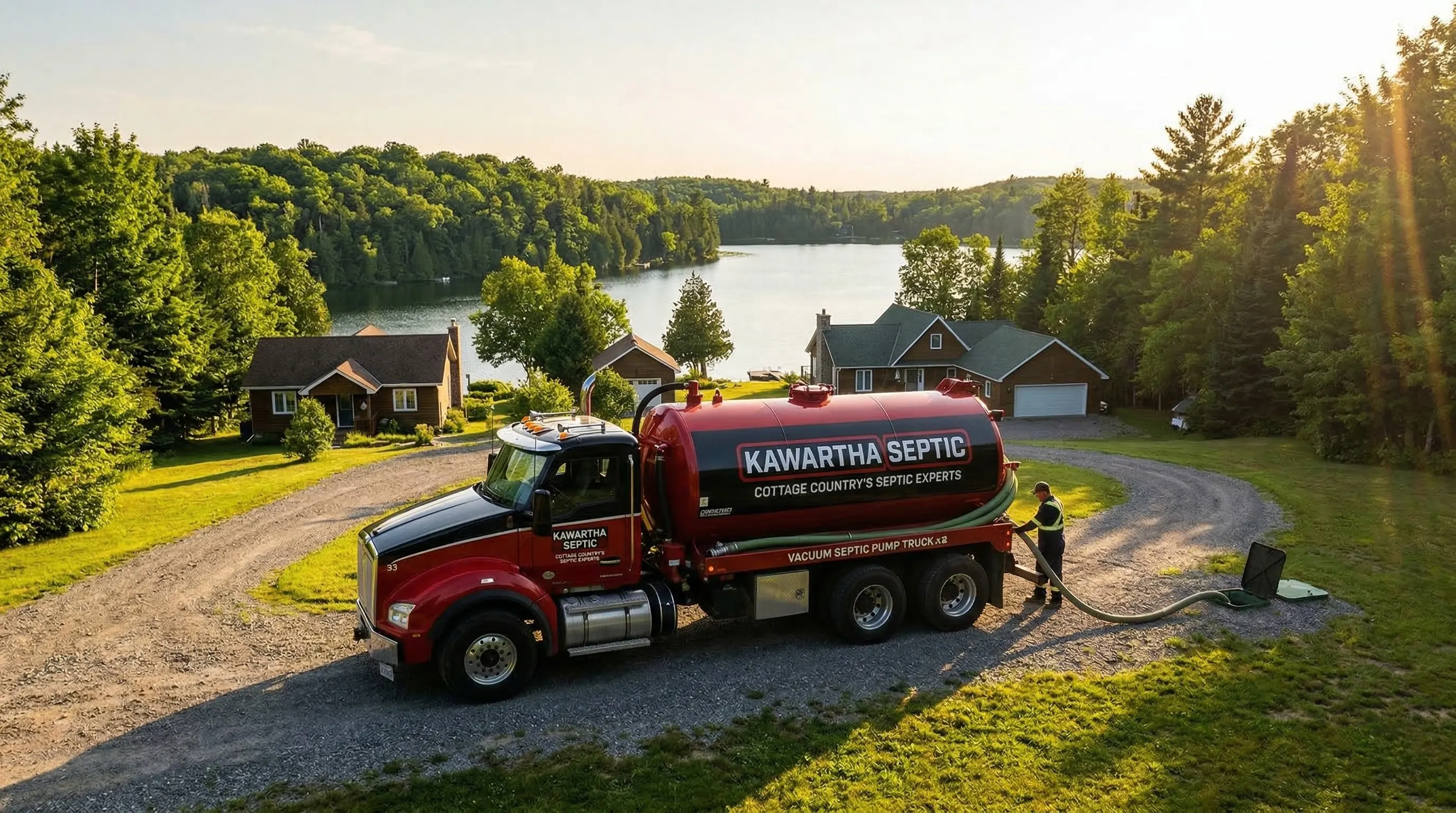
Four Mile Lake sits about three and a half kilometres northeast of Coboconk and two kilometres west of Burnt River, in the former Somerville Township. It covers 786 hectares — roughly 1,940 acres — and drops to 63 feet at its deepest point, with around 440 cottages spread along its shoreline.
Two things about this lake shape every septic decision made on it.
The first: there is no municipal sewer here, and there never has been. Kawartha Conservation’s Four Mile Lake Management Plan states it plainly — “all residents along Four Mile Lake are on private septic systems.” Roughly 409 of those systems sit within 75 metres of the water.
The second: Four Mile Lake is a closed lake. Corben Creek is both the main inflow and the outflow, and there is no navigable connection to the rest of the Kawartha chain. Whatever enters this lake stays in it far longer than it would on Balsam or Cameron, where the Trent-Severn keeps water moving.
Book A Pump or call (705) 702-5526 to get on the schedule.
What Makes Four Mile Lake Different
A Closed Lake Has No Downstream
On the big waterway lakes, a struggling septic system is partly a downstream problem. Water moves through, and what enters near Coboconk eventually flows south through the canal system.
Four Mile Lake does not work that way. A small creek in, the same creek out, and 786 hectares of water in between that turns over slowly. Nutrients entering along the shoreline stay in the same body of water the cottage draws its view — and often its drinking water — from.
That is not an abstract environmental argument. It is the reason a marginal system here deserves attention sooner than the same system would on a flow-through lake.
The Shield Cuts Straight Across It
The northern third of Four Mile Lake sits on Canadian Shield granite. The southern portion sits on deeper plain soil. The boundary runs across the lake itself, which means two properties on the same shoreline can need genuinely different septic systems.
On the north end, thin soil over rock leaves little vertical separation between a leaching bed and bedrock. There is less soil to do the treating, and less room to build a conventional bed. On the south end, there is usually workable soil depth and a conventional system is realistic.
The management plan is direct about what the thin end means: “Research suggests that in areas of shallow soil depths (as is the case along Four Mile Lake), there is a greater risk for leaching of contaminants into the lake if septic systems are not functioning optimally.”
Anyone quoting you a septic replacement on Four Mile Lake without knowing which end of the lake you are on, and without test pits, is guessing.
Somebody Already Measured the Septic Contribution
Most lakes have opinions about septic systems. Four Mile Lake has numbers.
Kawartha Conservation’s monitoring found roughly 468 kg of phosphorus enters Four Mile Lake every year, and broke that total down by source:
| Source | Share | Amount |
|---|---|---|
| Natural sources | 33% | 155 kg |
| Shoreline septic systems | 29% | 135 kg |
| Urban runoff | 15% | 69 kg |
| Agricultural runoff | 0.3% | 1 kg |
Shoreline septic systems are the largest human-caused source of phosphorus in this lake. And the plan notes the form matters as much as the quantity: phosphorus arriving from septic systems is orthophosphate, which is readily available to algae rather than locked up in sediment.
The plan sets a benchmark of reducing septic-derived phosphorus from 135 kg to 128 kg per year — about a 5% cut. That target was built on inspection findings from comparable Ontario lakes, where roughly 5% of shoreline systems were rated high risk of failing. It is an estimate applied to Four Mile Lake, not a count of failures found here. But it is the reason the plan’s first recommended action for shoreline landowners reads: “Undertake responsible management of septic systems, including routine inspections, along shoreline properties.”
Routine pumping and inspection is not a hard target to hit. It is a pump-out on schedule.
Our Septic Services on Four Mile Lake
Septic Tank Pumping
We provide septic tank pumping for cottages and year-round homes around the entire lake. Sludge and scum accumulate in every tank, cutting working capacity and pushing solids toward the leaching bed, where they do damage that pumping can no longer undo.
Most residential pump-outs for a 1,000 to 1,500 gallon tank cost $300 to $600, set by tank size, access, and how long it has been. There is no travel surcharge to Four Mile Lake — the price is the same as it is in downtown Lindsay.
Septic Inspections
A septic inspection tells you what you actually have: tank condition, baffle condition, whether the bed is accepting effluent, system type, and rough age. On a lake where the soil is thin and the water has nowhere to go, that is worth knowing before something forces the issue.
A full inspection runs $300 to $500, with most Kawartha Lakes properties landing between $300 and $450. Bundled with a pump-out it is less.
Septic Tank Repair
Not every problem is a replacement. A corroded outlet baffle, a broken lid, a failed pump, a cracked riser — these are repairs, and on an older cottage system they are often what is actually wrong. We diagnose before we quote, and if a repair solves it, we say so.
Installation and Replacement
When a system is genuinely finished, we handle septic system installation and replacement: site visit, test pits, a design stamped by a licensed sewage system designer, the City of Kawartha Lakes permit under Part 8 of the Ontario Building Code, Kawartha Conservation review where the lot falls within a regulated area, excavation, and final inspection.
What it costs depends on which end of the lake you are on. Where there is usable soil depth, a conventional tank and tile bed runs $15,000 to $22,000. On thin Shield soil or a high water table, the design usually lands on a raised mound at $25,000 to $45,000, or a tertiary treatment unit at $28,000 to $45,000. Across Ontario, full replacement runs $15,000 to $35,000, with most jobs landing between $15,000 and $30,000.
We tell you which category your lot falls into before anyone writes a quote, and the number is in writing before the excavator books.
Buying or Selling a Four Mile Lake Property
Waterfront on this lake changes hands regularly, and a large share of these cottages were built when septic standards were looser than they are now. Many have no records at all.
A real estate septic inspection gives both sides something concrete: what the system is, what condition it is in, and whether it will carry the use the buyer has in mind. For a seller, that removes the unknown that buyers price defensively. For a buyer, it is the difference between inheriting a working system and inheriting a $30,000 problem.
One practical note specific to this lake. An inspection needs the tank lids exposed and the baffles visible. If the lids are buried, they have to be dug up first, and if the baffles cannot be seen, the tank needs pumping before anyone can assess it. Sorting that out early keeps a closing on schedule instead of adding a week at the worst possible moment.
Getting a Truck Down Your Lane
Four Mile Lake is cottage country, and cottage lanes are cottage lanes: narrow, sometimes shared, occasionally soft in spring, and often with the tank a long way from anywhere a truck can park.
None of that is a problem if we know about it. Tell us what your access looks like when you book — the lane, the gate, roughly where the tank sits — and we arrive with the right length of hose and the right expectations. Access can change a price. Distance never does.
Seasonal properties do best on a fall pump-out. The system goes into winter with capacity, spring melt has somewhere to go, and the truck reaches the tank before the lanes soften.
Permits and Records
Septic permits, records, and inspections for Four Mile Lake go through the City of Kawartha Lakes Building and Septic Division — septicpermits@kawarthalakes.ca, 705-324-9411 ext. 1288. Systems installed or modified after 1974 may have a permit on file, which is worth requesting before you assume nothing is known about your system.
Section 8.9 of the Ontario Building Code requires sewage systems to be maintained according to their original approval. It also prohibits roof drains discharging into the tank, vehicles driving over the tank or bed, trees planted near weeping lines, and grease, paint, pharmaceuticals or chemicals going down the drain.
The Four Mile Lake Association is the other place worth knowing about — lake residents organized around water quality, and a reasonable source of what neighbours have run into.
How Often Should You Pump on Four Mile Lake?
| Property Type | Household Size | Recommended Frequency |
|---|---|---|
| Year-round home | 1-2 people | Every 4-5 years |
| Year-round home | 3-4 people | Every 3-4 years |
| Year-round home | 5+ people | Every 2-3 years |
| Seasonal cottage | Light use (weekends) | Every 4-5 years |
| Seasonal cottage | Heavy summer use | Every 2-3 years |
| Cottage converted to year-round | Any | Every 2-3 years |
That last row catches more Four Mile Lake properties than owners expect. A cottage built for July weekends and now lived in most of the year is asking a 1970s tank and bed to do roughly four times the work they were sized for.
Four Mile Lake Septic FAQ
Is Four Mile Lake on municipal sewers? No. Every property on the lake runs on a private septic system — Kawartha Conservation’s management plan confirms that all residents along Four Mile Lake are on private septic, with roughly 409 systems within 75 metres of the water.
Do you charge extra to come out to Four Mile Lake? No. There is no travel surcharge and no minimum distance anywhere in the City of Kawartha Lakes. Four Mile Lake costs the same as Lindsay. Access can change a price — a long carry, a gate the truck cannot fit through, a tank we have to dig for — but that is quoted up front, never added afterward.
Why does septic maintenance matter more on Four Mile Lake than other lakes? Because the lake has no meaningful outlet. Corben Creek in, Corben Creek out, with no navigable connection to the rest of the chain — so nutrients entering the shoreline stay in the same water rather than flushing downstream. Kawartha Conservation attributes about 29% of the phosphorus entering the lake each year, roughly 135 kg, to shoreline septic systems.
Can you service my cottage while I’m not there? Yes. If we can reach the property and know where the tank is, we can complete the pump-out while you are away. Many Four Mile Lake owners book off-season service so the system is ready when they arrive.
My cottage is on the north end and it’s all rock. Can a septic system even work there? Yes, but often not a conventional one. The northern third of the lake sits on Shield granite with limited soil depth, which usually points to a raised mound or a tertiary treatment unit rather than a standard tile bed. Test pits settle it. The south end generally has enough soil depth for a conventional system.
How much does septic pumping cost on Four Mile Lake? Most residential pump-outs for a 1,000 to 1,500 gallon tank cost $300 to $600. Tank size, access, and time since the last pump set the final price, quoted before we start.
I’m selling and have no septic records. What do I need? A real estate septic inspection. The lids need to be exposed and the baffles visible; if they are buried or the tank is too full to see into, that has to be handled first. Start early — it is the step that most often delays a waterfront closing.
Do you install and replace septic systems on Four Mile Lake? Yes. We handle full septic system installation and replacement on Four Mile Lake and across the City of Kawartha Lakes, including cottage and waterfront properties — site assessment, design and permit coordination with a licensed sewage system designer, excavation, and the City’s final inspection. A full replacement runs $15,000 to $35,000 in Ontario, with most jobs landing between $15,000 and $30,000, quoted in writing from a site visit. We always diagnose first — if a repair will solve the problem, we’ll tell you.
We Also Serve These Kawartha Lakes Communities
Four Mile Lake is one of many areas we cover across the region:
- Septic service in Coboconk — Southwest, on Balsam and Shadow Lakes
- Septic service in Burnt River — East, along the river and the concession roads
- Septic service in Norland — North on the Gull River
- Septic service in Kirkfield — West toward Canal Lake
- Septic services across Kawartha Lakes — Everything we do, municipality-wide
Need Septic Service on Four Mile Lake?
Whether it is a routine pump-out before the season ends, an inspection for a sale, or a straight answer about whether an old system has anything left in it, we are the local crew that shows up and quotes honestly.
Book A Pump online or call (705) 702-5526. We handle your dirty work so you can get back to the lake.