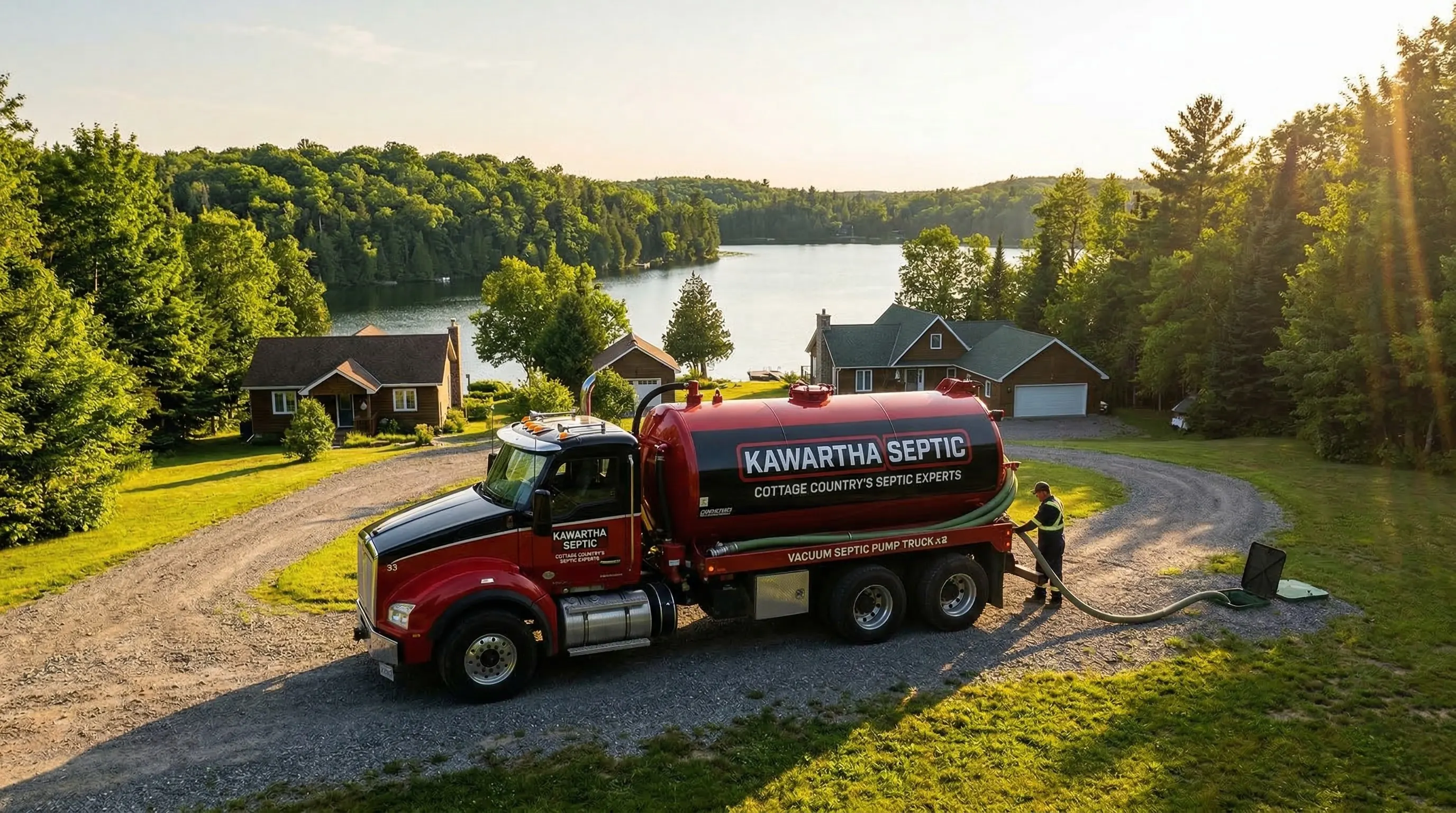
A conventional cottage septic system in Ontario (tank plus tile bed, on good soil) costs $15,000 to $22,000 installed. A raised bed runs $25,000 to $45,000, a tertiary system $28,000 to $45,000, and a composting toilet with a Class 2 grey water pit $5,000 to $15,000 where that route is still allowed.
The lot decides the price, not the building. Thin soil over rock, a high water table or a short run to the lake push you up the table. A flat, sandy lot with room for a bed keeps you near the bottom.
One rule change matters more than any price on this page. Since 1 January 2025, a new dwelling unit with running water has to have a flush toilet, which takes the cheapest path off the table for most new builds. More on that below.
Cottage Septic Costs at a Glance
| System | Installed cost |
|---|---|
| Class 1 composting toilet (toilet only) | $1,500–$5,000 |
| Class 2 grey water system, simple | $3,000–$8,000 |
| Class 2 grey water system, complex (lake setbacks, imported fill, raised pit) | $8,000–$15,000 |
| Class 1 + Class 2 combo, all in | $5,000–$15,000 |
| Class 4 conventional, tank and tile bed, good soil | $15,000–$22,000 |
| Class 4 conventional on a new build (no old system to remove) | $15,000–$25,000 |
| Class 4 raised mound | $25,000–$45,000 |
| Class 4 with tertiary (Level IV) treatment | $28,000–$45,000 |
| Tank-only replacement, bed still sound | $5,000–$10,000 |
| Class 5 holding tank | Quoted per site after a visit |
For a full replacement, the Ontario range is $15,000 to $35,000, with most jobs landing between $15,000 and $30,000. Our septic system replacement cost guide takes the Class 4 side apart line by line, and the replacement cost estimator will put a range on your own lot in a minute or so.
There is no holding tank install price on this page on purpose. Tank size, the dig and access vary too much between cottages for a number to mean anything, so it gets quoted after a site visit.
The 2025 Rule That Decides Which Rows Apply
Under the 2012 Building Code, a dwelling unit with running water needed “a water closet or a drainless composting toilet.” The 2024 Code, O. Reg. 163/24, in force since 1 January 2025, dropped the composting toilet. Article 9.31.4.1 now requires a water closet in every dwelling unit where a water distribution system is available. The province’s Building Code page is the place to start if you want the source.
What that means for a cottage budget:
- New cottage with running water: you are pricing a Class 4, or in narrow cases a Class 5 holding tank. Do not budget $5,000 to $15,000 for a combo you cannot get permitted.
- Existing composting toilet with a permitted Class 2: still legal. The change is not retroactive.
- Bunkie, sauna or outbuilding that is not a dwelling unit: arguably outside the article, but building officials read it differently. Ask your inspector before you buy a toilet.
Our guide to composting toilets at Ontario cottages covers the change in detail.
Path 1: Composting Toilet and Grey Water Pit
This is the cheapest permitted setup, at $5,000 to $15,000 for both halves, and it now fits a narrower set of buildings: existing cottages that already run it, and buildings that are not dwelling units.
The toilet is the smaller half at $1,500 to $5,000. The Class 2 system takes the sinks, shower and laundry, and on a small one the design and permit can come close to half the bill. The hole is small. The paperwork is not.
If there is already a Class 4 on the lot with spare capacity, a bunkie sink can often tie into it for $1,500 to $4,000 instead. Our grey water system cost guide breaks down Class 2 pricing and the honest comparison against a full septic, and the bunkie and sleeping cabin rules cover the outbuilding question.
Path 2: A Conventional Class 4 System
For most cottages with a flush toilet, this is the system: a two-compartment tank and a leaching bed in native soil. On good soil it costs $15,000 to $22,000.
Roughly where that money goes:
| Line item | Approximate cost |
|---|---|
| New tank, supplied and set | about $2,500–$5,000 |
| Leaching bed materials | about $3,000–$6,000 |
| Excavation, installation and backfill | about $4,000–$8,000 |
| Topsoil, grading and seed | about $500–$2,000 |
| Old tank removal and disposal (replacements only) | $1,500–$3,000 |
Then there are the soft costs before anyone digs: a perc test ($500 to $1,500), a soil profile or deep test pit ($500 to $1,000), the sewage system designer ($1,500 to $3,500) and the permit. Together they come to $3,000 to $7,000 for a standard Class 4 residential system.
The design is stamped by a licensed sewage system designer. We handle the excavation, the installation and booking the inspections. From first call to a finished replacement usually takes 4 to 8 weeks, and a new build takes 5 to 10 weeks from the first site visit to an approved installation.
Designers will not perc-test frozen ground, so soil testing is a late-spring-to-fall job. If you want a system in before next summer, book the site evaluation this fall.
Path 3: Raised Bed or Tertiary on a Difficult Lot
Plenty of Kawartha cottage lots are thin soil over limestone, wet, or tight to the shoreline. When native soil cannot treat effluent, the options get more expensive.
A raised mound builds the bed up out of imported fill and runs $25,000 to $45,000. A tertiary (Level IV) treatment unit cleans the effluent before it reaches the bed, which lets a designer work with a smaller footprint, and runs $28,000 to $45,000 installed. Tertiary units also need regular servicing; see advanced treatment units in Ontario.
Setbacks drive a lot of this. Under the Building Code a leaching bed must be 15 m from a lake or river, 15 m from a drilled well with a watertight casing at least 6 m deep, and 30 m from a dug well or any other well. The City of Kawartha Lakes rural zoning by-law separately sets a 30 m water setback. That is zoning, not the Building Code, and how it applies to your lot is a question for the City.
Path 4: A Holding Tank (Class 5)
A holding tank stores everything and treats nothing, and a truck empties it for as long as you own the place. People assume it is the easy cottage option. Under the current Code it is the restricted one.
Article 8.8.1.2 allows a Class 5 in four situations only:
- a temporary operation of 12 months or less, excluding seasonal recreational use
- remedying an unsafe system where a Class 4 is impracticable
- upgrading the system for an existing building where a Class 4 is not possible because of lot size, slope or clearances
- an interim measure until municipal sewers arrive
So a holding tank is not a way to skip a bed on a cottage lot that can take one. It is what gets approved when the lot cannot. The Code also requires a written agreement with a hauled sewage operator for every Class 5, an audible and visual high-level alarm, and, for a residence, at least 7 days of holding capacity at the daily design flow. For a three-bedroom cottage with a design flow of 1,600 litres a day, that works out to 11,200 litres of tank.
What we can price:
| Holding tank cost | Amount |
|---|---|
| City of Kawartha Lakes Class 5 permit | $542 |
| Each pump-out | $300–$500 |
| Supply and installation | Quoted after a site visit |
The pump-outs are where the money goes. Say your cottage needs eight pump-outs in a season: at $300 to $500 each, that is $2,400 to $4,000 a year, every year. Run that over ten years and a holding tank can cost more than the bed you could not build. Our holding tank pumping cost and schedule guide covers how fast tanks fill, and septic vs holding tank covers when a conversion is worth a site evaluation.
Running Costs After the Install
| System | Ongoing cost |
|---|---|
| Class 4 pump-out, 1,000–1,500 gallon tank | $300–$600, plus $0–$50 for a cottage or seasonal property |
| Class 2 grey water pump-out | $200–$400 |
| Class 2 maintenance over 25 years | $2,000–$4,000 |
| Class 5 holding tank pump-out | $300–$500 per visit, as often as it fills |
How often a Class 4 gets pumped depends on use. A lightly used weekend cottage goes 4 to 5 years between pump-outs, a cottage with heavy summer use 2 to 3 years, and a rental with high guest turnover every 1 to 2 years. The full table is in how often to pump a septic tank.
A whole system lasts 20 to 30 years with maintenance, a tile bed 15 to 25. On an older cottage the bed often comes due first, at $10,000 to $25,000.
Permit Fees in the City of Kawartha Lakes
Permits and septic records here come from the City’s Building and Septic Division, not the health unit. The City’s number is 705-324-9411. The 2026 fees:
| Permit | Fee |
|---|---|
| Class 2 grey water system | $433 |
| Class 4, up to 4,500 L/day | $975 |
| Class 4, tank replacement or bed repair | $461 |
| Class 5 holding tank | $542 |
| Existing system review (addition, renovation, new detached building) | $244 |
Start construction without a permit and the fee doubles. The City holds sewage records back to 1974, so if you are buying a cottage, a records request tells you what is in the ground before you waive conditions. Outside the City, fees are set by each municipality, so check with yours.
Frequently Asked Questions
How much does a cottage septic system cost in Ontario?
A conventional Class 4 system on good soil costs $15,000 to $22,000 installed. A raised mound runs $25,000 to $45,000 and a tertiary system $28,000 to $45,000. A composting toilet with a Class 2 grey water system costs $5,000 to $15,000, but since 1 January 2025 that route is closed to new dwelling units with running water.
Is a holding tank cheaper than a septic system for a cottage?
It can be cheaper to put in, but it is rarely cheaper to own, because every pump-out costs $300 to $500 and a used cottage fills the tank again and again. The Building Code also limits where a holding tank is allowed, and its temporary-use allowance specifically excludes seasonal recreational use. In practice a holding tank is approved where a Class 4 cannot be built, not as a budget choice.
Can I still put a composting toilet in a new cottage instead of a septic?
Not if the cottage is a dwelling unit with running water. The 2024 Ontario Building Code requires a flush toilet in that case, which means a Class 4 system or, in narrow cases, a Class 5 holding tank. Existing composting toilet and grey water setups stay legal, and buildings that are not dwelling units are a question for your inspector.
How much is a septic permit for a cottage in Kawartha Lakes?
The City of Kawartha Lakes charges $975 for a standard Class 4 system up to 4,500 litres a day, $461 for a tank replacement or bed repair, $433 for a Class 2 grey water system and $542 for a Class 5 holding tank. These are the City’s 2026 fees, paid in full at application. Permits come from the City’s Building and Septic Division, not the health unit.
Does a seasonal cottage need a smaller septic tank?
No. The Building Code sizes a tank by bedrooms and design flow, and there is no seasonal reduction for a private cottage. Light seasonal use changes how often you pump, not the minimum tank size.
Get a Number for Your Lot
The lot sets the price, so the fastest way to narrow these ranges is someone walking the site and telling you which path is actually open.
Every installation or replacement starts with a site visit and ends with a written, itemized quote. We coordinate the design and permit and do the installation, and we pump and inspect what is already in the ground, including holding tanks. Anywhere in the City of Kawartha Lakes there is no travel surcharge; farther out, the price is quoted up front before anything is booked.
Call (705) 702-5526, book a visit, or read more about septic system installation. We call back within 24 hours in business hours.