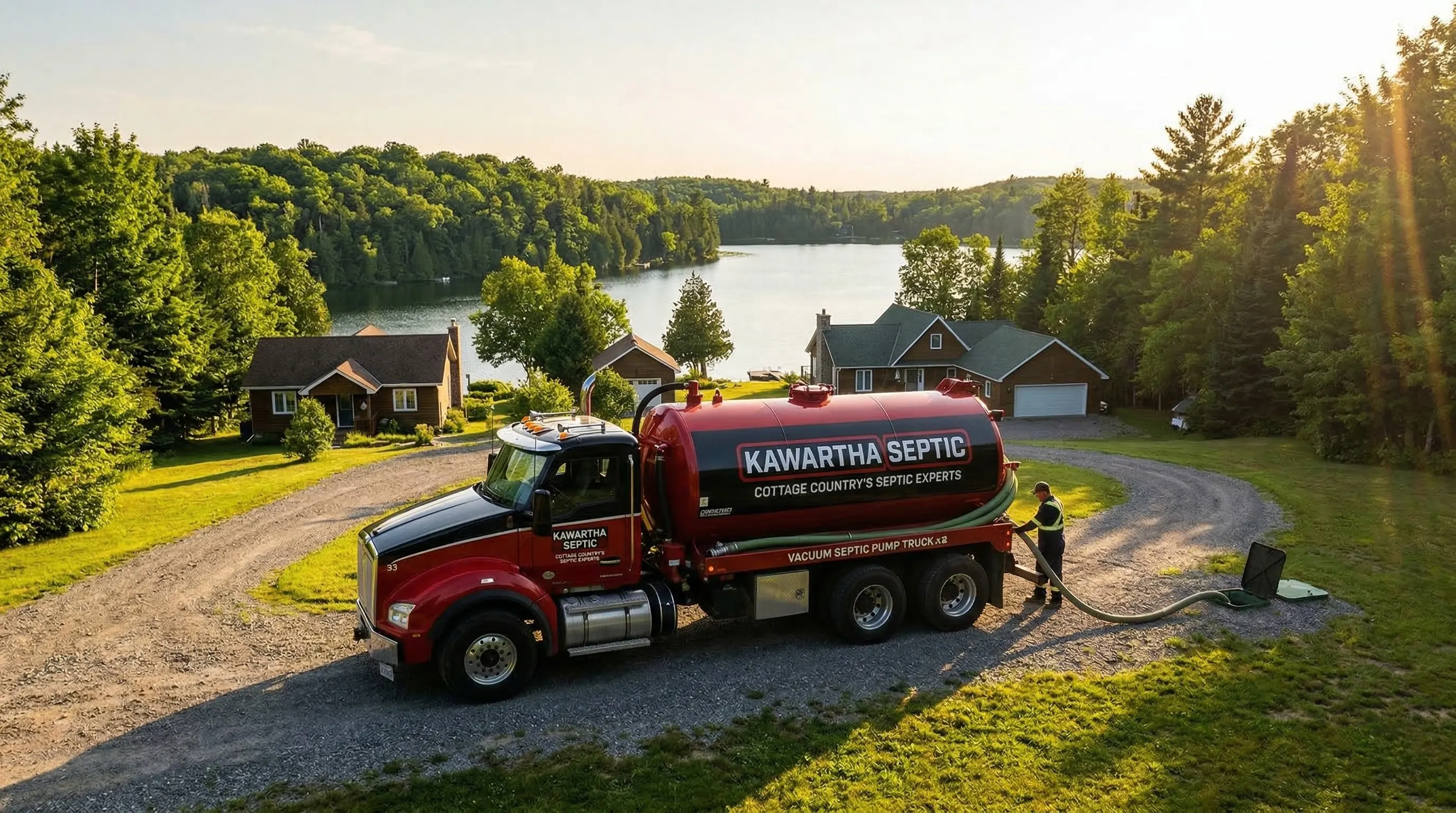
What does it actually cost to own a holding tank for a full season versus a full year? For a lot of cottage owners in this region, the honest answer is somewhere between $600 and $6,000 depending on how many people are using the place and how often. That range is the whole ballgame with holding tanks, and most owners don’t find out where they land on it until after their first summer.
If you already know you have a holding tank rather than a septic system (if you’re not sure, that’s a different question worth sorting out first), this is the practical side: real holding tank pumping cost numbers for Ontario cottage country, how often pumping actually needs to happen, and what the real annual number looks like once you stop guessing.
The Quick Answer
| Usage pattern | Typical pump-out frequency | Rough annual cost |
|---|---|---|
| Weekend cottage, May–October | Every 3–6 weeks in season | $600–$1,800/year |
| Full-season cottage, heavy weekend use | Every 2–4 weeks in season | $1,200–$2,800/year |
| Year-round home, family of 3–4 | Every 2–4 weeks, all year | $3,000–$8,000+/year |
| Short-term rental cottage, high turnover | Every 1–3 weeks in season | $2,000–$5,000+/year |
How Fast a Holding Tank Actually Fills
A holding tank has no outlet. Everything that goes down a drain in the house sits in that sealed tank until a truck comes to remove it. That means the fill rate is a straightforward math problem: gallons or litres used per day, times number of people, divided into the tank’s total capacity.
A typical residential holding tank runs somewhere in the 3,000 to 5,000 litre range. A family of four using normal amounts of water (showers, laundry, dishes, toilets) can put through 800 to 1,200 litres a day in a year-round home. Do that math and a 3,600-litre tank fills in roughly three to five days for a full household, which is why year-round holding tank living gets expensive fast. A weekend-only cottage with two people using the place four days a month tells a completely different story, sometimes stretching a pump-out to six or eight weeks between visits.
If you’re trying to work out where your property sits on this before committing to a rental cottage or a full-time move, it’s worth a call to (705) 702-5526 early. We can walk through your expected household size and usage pattern and give you a realistic pumping interval before you’re surprised by it in August.
The 75% Alarm: What It Means and Why It’s There
Most holding tanks with a properly installed alarm system trigger at roughly 75% capacity, not when the tank is nearly full. That’s intentional. It gives you a buffer of several days to a couple of weeks (depending on usage) to schedule a pump-out before the tank actually overflows.
Ignoring the alarm, or worse, not having one installed at all, is how holding tanks end up overflowing. If your alarm has started going off and you’re not sure what to do next, our guide on a septic alarm going off covers the general troubleshooting steps, most of which apply directly to a holding tank alarm as well. An overflow isn’t just an inconvenience. It’s raw sewage on your property, a genuine environmental violation in Ontario, and depending on where it ends up relative to a lake or waterway, a serious problem. If your holding tank doesn’t currently have a working alarm, that’s worth fixing before your next season starts, not after the first false start.
Holding Tank Pump-Out Cost: What to Expect
A single holding tank pump-out in the Kawartha Lakes region typically runs $300 to $500 depending on tank size, access, and distance from the road. That’s roughly in line with a standard septic tank pump-out, which makes sense since it’s the same truck, the same crew, and often a similar volume being removed.
The difference isn’t the per-visit price. It’s the frequency. A septic system gets pumped every three to five years. A year-round holding tank might need the same crew out fifteen to twenty times a year. Multiply a $350 average visit by that frequency and the annual number climbs fast, which is the real story behind why holding tanks are expensive to live with full-time and perfectly reasonable for occasional cottage use.
Annual Cost Reality: Holding Tank vs Septic
| Holding Tank (year-round) | Septic System | |
|---|---|---|
| Per-visit cost | $300–$500 | $300–$500 |
| Visits per year | 12–25+ | 0.2–0.33 (once every 3–5 years) |
| Annual cost | $3,000–$8,000+ | $60–$150 (averaged) |
| Installation cost | $5,000–$12,000 | $15,000–$30,000+ |
This is the trade-off in a single table. A holding tank costs less to install and nothing to maintain beyond pumping, but the pumping cost never stops. A septic system costs more upfront but the ongoing cost drops to almost nothing between pump-outs. Our full comparison of septic vs holding tank systems covers which one makes sense for a given lot in more detail; this guide assumes you already have the holding tank and want to manage what it actually costs to run.
A Real Example: Weekend Cottage on Sturgeon Lake
A couple with a cottage on Sturgeon Lake used it most weekends from May through Thanksgiving, plus two weeks in August with extended family visiting. Their 3,400-litre holding tank needed pumping roughly every five weeks during normal weekend use, but the August family stretch cut that down to under two weeks. Across the season they averaged eight pump-outs a year at about $375 each, landing at roughly $3,000 annually. When they compared that to quotes for converting to a septic system, about $24,000 installed, they worked out it would take eight years of avoided pumping costs to break even, and decided to stick with the holding tank since they had no plans to make the cottage a year-round home.
Contracts vs Calling as Needed
Some pumping companies offer standing contracts, a set number of visits per season scheduled in advance, sometimes at a small discount over calling each time individually. This works well for predictable usage: a cottage rented out on a fixed schedule, or a year-round home with a stable household size.
Calling as needed, watching the alarm or gauge and scheduling a pump-out when it’s actually warranted, tends to suit variable-use properties better, a cottage used heavily some months and barely at all in others. Neither approach is objectively better. It comes down to whether your usage is predictable enough to schedule around or genuinely variable enough that a standing contract would mean paying for visits you don’t need, or scrambling when you need more than planned.
If you’re not sure which model fits your property, the easiest way to find out is to track your first season on a call-as-needed basis and see how the visits actually fall. Once you have two or three seasons of real data, a contract conversation becomes a lot more concrete than guessing up front. Book online whenever the alarm trips, or set up a recurring arrangement once you know your pattern.
Short-Term Rentals Change the Math
If your cottage is on Airbnb or a similar platform, guest turnover usually means heavier, less predictable water use than an owner would generate themselves. Guests don’t ration water the way an owner managing their own holding tank bill does, and back-to-back bookings can push a tank toward its alarm faster than the listing’s booking calendar accounts for. Our guide on Airbnb cottage septic systems covers the broader rental-property considerations; on the holding tank side specifically, budget for pumping more frequently than owner-only use would suggest, and build that cost into your nightly rate rather than discovering it eats your margin at season’s end.
Don’t Try to Stretch It Yourself
Some owners try to extend the interval between pump-outs by rationing water hard once the alarm goes off, hauling extra loads of laundry to a laundromat, skipping showers, that kind of thing. A short stretch of a day or two while you wait for a scheduled truck is normal and fine. Treating the alarm as a suggestion rather than a deadline, or trying to manually override or silence it to buy more time, is where things go wrong. Once the tank is genuinely full, there’s nowhere for the next flush to go, and that backup happens inside your house, not conveniently outside. If the alarm is on and you can’t get a pump-out scheduled fast enough on your own, that’s the moment to call a professional rather than experiment with workarounds.
Reducing Your Pumping Frequency Legitimately
A few things genuinely stretch the interval between pump-outs without any risk:
- Low-flow toilets and showerheads, which cut daily volume meaningfully in a busy household
- Spacing out laundry loads rather than running several back to back
- Fixing running toilets and dripping taps immediately (a running toilet alone can add hundreds of litres a day)
- Avoiding a garburator or garbage disposal entirely on a holding tank, since it adds solid volume for no water-treatment benefit
None of these are dramatic changes, but stacked together over a season they can shift a property from the high end of its usage bracket to the low end, which is a real dollar difference at $350 a visit.
Water softeners deserve a specific mention here. A softener that regenerates frequently can add a surprising amount of volume to a holding tank over a month, since the backwash cycle flushes brine water straight into the tank along with everything else. If you’re running a softener on well water feeding a holding tank, checking the regeneration frequency and adjusting it to actual hardness rather than a factory default is worth doing. Our guide on water softeners and septic systems covers the mechanics in more detail, and most of it applies just as directly to a holding tank as to a treatment system.
One more variable worth naming: an RV or camper parked on the property and draining into the same holding tank adds volume that’s easy to forget about when you’re doing the seasonal math. If you’re hosting guests with trailers or running a camper alongside the cottage, our piece on RV waste and septic tanks walks through how that additional load factors in, and it’s a common reason a tank fills faster than an owner expects during a busy long weekend.
Holding Tank Pumping FAQ
How do I know when my holding tank needs pumping? A working alarm at roughly 75% capacity is the standard signal. If you don’t have an alarm, watch for slow drains or gurgling as an informal warning sign, though that’s a less reliable method than a proper alarm system.
Can I go longer between pump-outs to save money? Not safely. Once the tank is full, the next thing that happens is a backup inside your home or an overflow outside it, both of which cost far more to deal with than a pump-out would have.
Is holding tank pumping cost the same everywhere in Kawartha Lakes? The base per-visit price is fairly consistent regionally, but access (a long, narrow driveway, a tank set back from the road) can add to the cost. Ask for a quote specific to your property rather than assuming a flat rate.
Do holding tank contracts save money? Sometimes, for predictable, high-frequency usage. For variable or seasonal use, paying per visit often works out cheaper since you’re not locked into a fixed number of scheduled pump-outs.
What happens if I let the tank overflow? It’s an environmental violation in Ontario with potential fines, on top of the mess and the emergency pump-out cost, which typically runs higher than a scheduled visit. It also risks contaminating nearby soil or water if it happens near a lake or waterway.
Does a holding tank ever make financial sense for a year-round home? Rarely, once you run the annual numbers against a septic conversion. It’s usually a stopgap while a septic system is being planned, or a necessity on a lot that genuinely can’t support a leaching bed.
Holding Tank Service in Kawartha Lakes
We pump holding tanks across Kawartha Lakes, Bobcaygeon, and the surrounding cottage-country region on both scheduled contracts and as-needed calls. If you’re not sure where your property lands on the usage-to-cost curve, we can help you figure it out after a season or two of actual pump-out data.
Need a holding tank pumped or want to work out a realistic seasonal schedule? Call (705) 702-5526 or book online. Use the cost calculator for a 60-second estimate.