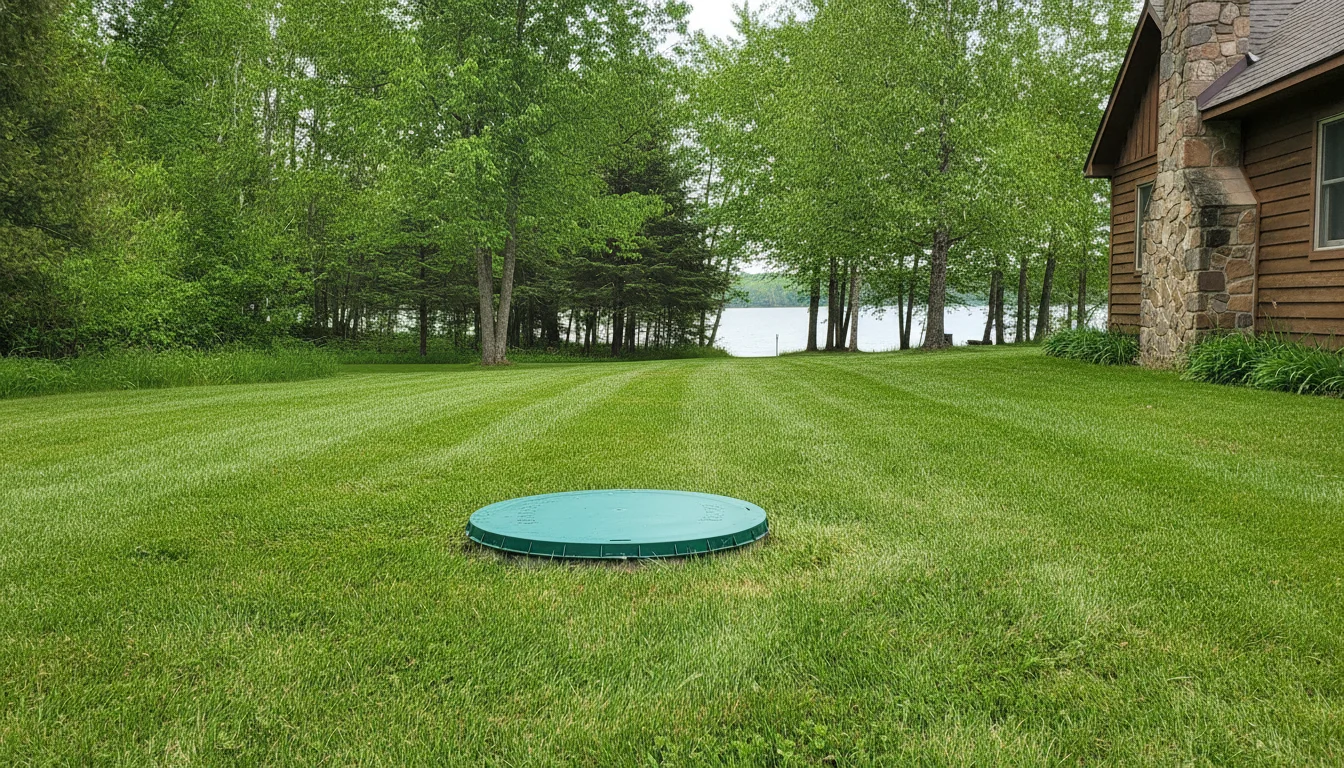
A green plastic septic lid in the middle of a nice lawn is an eyesore, and hiding it is fine, as long as the hiding doesn’t make it dangerous or impossible to find.
Most septic tank decorative covers sold in garden centres do a decent job of making a lid disappear. The trouble starts when the cover becomes permanent, heavy, or so convincing that nobody remembers what’s under it. The pump crew spends half an hour probing the yard, and a cracked lid goes unnoticed until something falls through it.
Below are the septic tank cover ideas that work on a Kawartha Lakes property, what each roughly costs, and the “ideas” we’d talk you out of. Every one gets measured against two rules first.
The Quick Answer
| Question | Short answer |
|---|---|
| Best ways to hide a septic lid | Hollow fake rock, low resin “stone” cover, lift-off wishing well or box, gravel ring with a stepping-stone look, low plantings around the lid |
| What never goes on a lid | Soil, sod, heavy concrete planters, stone pavers, raised beds, trees, anything bolted or built over it |
| Lid is 12–24 inches underground | Get a riser first; you can’t decorate what’s buried |
| Finding it in winter | A tall marker stake set in fall, plus a photo with measurements from the house |
| Leaching bed landscaping | Grass. Keep it simple |
Two Rules Every Cover Idea Has to Pass
Rule one: the lid underneath stays secure and child-proof. A decorative cover is not a lid. It’s a costume. Most hollow rocks and resin covers weigh a few kilograms and lift off with one hand, so a curious kid can move one as easily as you can. The real lid underneath has to be sound, properly seated, and locked, bolted, or too heavy for a child to open. An open or collapsed lid over a full tank is a genuine drowning hazard for small children and pets. Our septic tank lid safety guide covers how lids fail and what locking options cost. Check the lid before you hide it.
Rule two: the pumper can find it and open it in minutes, in any season. If the crew needs a shovel, a pry bar, or a second person to get your cover off, it’s the wrong cover. That includes January, when it’s under a snowbank and possibly frozen to the ground. A good test: could someone who has never seen your property find the lid from a sketch and have it open in five minutes?
Most tanks have more than one opening, and a system with a pump has a separate pump chamber lid too. Treat every one the same way. Hiding the main lid nicely and burying the second one is how second lids get skipped at pump-outs.
Riser First: You Can’t Decorate a Buried Lid
If your lid sits 12 to 24 inches below the lawn, none of these ideas apply yet. You’d be decorating grass over a hole, and the crew still digs every visit.
A riser brings the opening up to grade, capped with a septic tank riser lid that sits flush with the lawn or just above it. That flush lid is what makes a fake rock or lift-off cover possible. Our septic tank riser guide explains installation, and are septic risers worth it runs the payback math against digging fees. Most risers go in during a regular pump-out as part of our septic tank repair work.
Not sure where the lid is? Start with how to find your septic tank.
Septic Tank Cover Ideas That Work
Prices are rough retail ballparks. They vary by size, store, and season.
Hollow fake rocks and boulder covers (roughly $50–$300)
The classic. A hollow shell shaped like a boulder sits over the riser lid, and from the road it’s just a rock.
- Pros: Blends in, especially on rocky lots. Lifts straight off. Nothing to maintain.
- Cons: Cheap ones fade and look plasticky after a few summers. Light models get knocked around by mowers and wind. Easy for a kid to lift, so rule one matters more here. Measure first: a 24-inch riser needs a bigger rock than people expect.
Low resin “stone” covers (roughly $80–$300)
Flatter than a boulder, often shaped like a flagstone, sitting almost flush with the lawn.
- Pros: Low profile, so you can mow right to the edge.
- Cons: Not something to stand or park on, whatever the look suggests. Flat covers vanish under snow faster than a boulder shape.
Wishing-well or low box covers (roughly $100–$400)
A small wooden or composite wishing well, or a low box that looks like a storage bench, set over the lid. The whole thing must lift off in one piece: no footings, no screws into the ground.
- Pros: Looks intentional rather than disguised. Can hold a couple of flower pots.
- Cons: Wood rots where it touches wet ground, so set it on flat stones. If it takes two people to lift, it’s too heavy.
Gravel or mulch ring with a stepping-stone look (roughly $30–$150 DIY)
Cut a neat circle around the lid, fill it with pea gravel or mulch, and let the lid read as a stepping stone in a short path.
- Pros: Cheap. Keeps the lid visible, which helps safety and inspection.
- Cons: Doesn’t truly hide the lid. Keep gravel off the lid and out of its seal. Mulch needs topping up.
Perennials and ornamental grasses around the lid (roughly $50–$200)
The best of the septic system landscaping ideas for most yards. Plant a loose ring of low perennials or compact ornamental grasses a short distance out, so they soften the view without covering the lid. Daylilies and black-eyed Susans are common picks.
- Pros: Reads as a garden feature. Low maintenance once established.
- Cons: Needs trimming so it doesn’t swallow the lid by August. Leave a clear strip right around it. Avoid aggressive, spreading roots near riser seams; our post on trees and plants near septic systems has the species list.
A small bench or light planter (roughly $50–$250)
A light bench or a single plastic planter on the lid gives the eye something else to land on.
- Pros: Moves in seconds.
- Cons: A pot full of wet soil gets heavy fast, so keep it small. Water draining onto the lid all summer isn’t ideal.
Decorative Covers Compared
| Idea | Rough cost | Keeps pumper access? | Watch out for |
|---|---|---|---|
| Hollow fake rock / boulder cover | ~$50–$300 | Yes, lifts off | Kids can lift it too; sizing to the riser |
| Low resin “stone” cover | ~$80–$300 | Yes | Not for standing on; vanishes under snow |
| Wishing well or low box | ~$100–$400 | Yes, if it lifts off in one piece | Rot at ground contact; too heavy to lift |
| Gravel or mulch ring | ~$30–$150 | Yes, lid stays visible | Gravel working into the lid seal |
| Perennials and grasses around the lid | ~$50–$200 | Yes, with a clear strip | Plants overgrowing the lid; aggressive roots |
| Small bench or light planter | ~$50–$250 | Yes, if it stays light | Soil weight; drainage onto the lid |
| Soil, sod, pavers, heavy planters on top | Varies | No | Lid gets forgotten and damaged |
What Not to Put Over a Septic Lid
- Soil and sod. Burying a riser lid undoes the riser. You’re back to digging fees and a lid nobody inspects.
- Heavy concrete planters or stone pavers. Lids generally aren’t meant to carry a few hundred pounds of concrete for years. The crew can’t move them easily, pavers freeze to the lid, and steady weight on an aging lid is how cracks start.
- Raised garden beds. That’s buried soil with a frame around it, plus digging and watering on top of the opening.
- Trees and shrubs with aggressive roots. Roots chase moisture into riser seams and pipe joints.
- Anything bolted, screwed, or built over the lid. If it needs tools to move, it fails rule two.
- Covering vents, inspection ports, or the alarm. Some systems have a vent cap or inspection port in the yard, and some pump systems have an outdoor alarm light. Leave those visible. A hidden alarm is an alarm nobody sees.
Marking the Lid So You Can Find It Under Snow
A fake rock that blends in perfectly in July is one white lump among many in February. Plan before the first snowfall:
- Set a tall marker stake in fall. A 4-foot stake or driveway marker with bright flagging tape, right beside the lid so it pokes well above the snow. Our winter pumping guide explains why this saves real time on a January call.
- Take a photo with measurements. Get the house in the shot, then measure from the lid to two fixed points, like a house corner and the well cap. Save the photo and numbers somewhere that survives a new phone.
- Keep a sketch with your house papers. If a permit site plan exists, the City of Kawartha Lakes building and septic department is where to ask for a copy.
Cottage Lots: Shield Rock, Snow Load, and Lids Under Decks
Cottages in the north of the City, around Norland, Coboconk, and Burnt River, often sit on thin soil over Canadian Shield rock with granite outcrops in the yard. A grey or pink fake boulder looks right at home there, which is exactly why it needs a marker. Picture a cottage closed in late October with a crew booked for spring: the one rock that isn’t real is the one nobody can pick out.
Snow load matters too. Heavy snow and repeated freeze-thaw can crack lids and shift risers, and a hollow cover can be crushed or frozen in place under a plow bank. Don’t pile plowed snow over the lid, and check the cover and lid when you open up in spring.
Lids under decks come up often at older cottages where a deck was added after the tank. A deck on posts over a tank can work, but only with a hatch or removable boards directly over each lid, big enough to work through. Our post on decks, pools, and septic setbacks covers what’s generally acceptable over a tank versus over the bed.
Landscaping the Leaching Bed
All of the above is about tank lids. For the leaching bed, grass is the best cover. It holds the soil without compacting it and lets air reach the soil doing the final treatment. Decorative rock, raised beds, and heavy landscaping over the bed do more harm than good. See what can go over a leaching bed for the full list.
Frequently Asked Questions
What are the best septic tank decorative covers?
For most yards, a hollow fake rock or low resin stone cover over a riser lid. Both lift straight off, blend in, and cost roughly $50 to $300. If you’d rather keep the lid visible, a gravel ring with a stepping-stone look costs less.
Are fake rock septic covers safe for kids?
The rock is harmless, but it isn’t a safety device. Most lift off easily, so a child who finds it finds the lid. Safety comes from a sound lid underneath that’s locked, bolted, or too heavy to lift. If you don’t know your lid’s condition, have it checked at your next pump-out before you cover it.
Can I put a planter on my septic tank lid?
A small, light planter one person can move is fine. Skip heavy concrete or stone planters: they load the lid, the crew can’t shift them easily, and they freeze in place over winter.
What septic system landscaping ideas work around the tank?
Low perennials and ornamental grasses in a ring around the lid, with a clear strip next to it. Keep trees and large shrubs well back, and keep the leaching bed in grass.
Do septic lids have to be at ground level?
No, but a buried lid costs digging time on every visit and can’t be inspected or decorated. If yours sits 12 to 24 inches down, a riser with a flush septic tank riser lid is the usual fix.
Hide It, Mark It, Keep It Safe
A good cover makes a septic lid disappear from the yard without making it disappear from your memory. Get the lid to grade, make sure it’s secure, pick something that lifts off, and mark it before the snow flies. If you want the lid checked or a riser added before you decorate, we can do both on a regular pump-out.
We service homes and cottages across Lindsay, Bobcaygeon, Fenelon Falls, and Coboconk, with no travel surcharge anywhere in Kawartha Lakes. Call (705) 702-5526 or Book A Pump and mention you’d like the lid looked at.