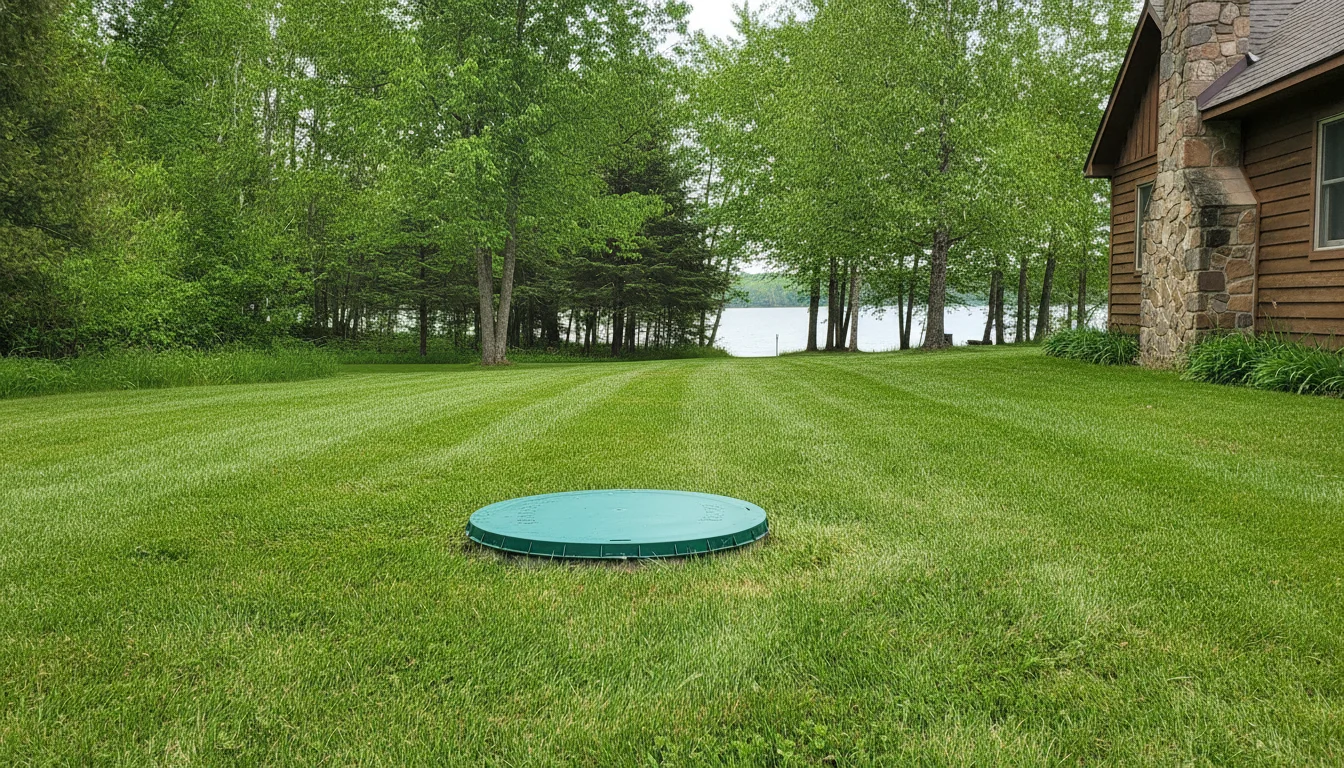
Every septic tank is full of water all the time, so the question worth asking is what else it’s full of.
“Full” means two different things with a septic tank. A working tank always holds liquid right up to its outlet pipe, which is normal (our guide to septic tank water levels shows what that looks like), while the full that costs money is when sludge and scum have taken up so much room that solids start slipping out toward your leaching bed.
That second kind is what this guide covers. You can’t see it from the lid, and it rarely announces itself until it’s late. Here’s the rule pumpers use, how they measure it, the signs you can spot yourself, and how to estimate your own timeline.
The Quick Answer
| Detail | |
|---|---|
| When a tank counts as “full” | Sludge plus scum take up about one-third of the liquid depth |
| Water right up near the lid | Normal. It sits at the outlet pipe and says nothing about sludge |
| How it’s measured | A sludge judge or measuring pole through the lid |
| Typical interval | Every 3 to 5 years for most households, 1 to 2 for busy rental cottages |
| Early signs it’s due | Slow drains in several fixtures, gurgling, odour near the tank |
| Signs it’s past due | A lush or soggy strip over the bed, sewage at the lowest drain |
| Standard pump-out | $300 to $600 for a 1,000 to 1,500 gallon tank |
| No idea when it was last pumped | Treat it as due and use the next pump-out as your baseline |
”Full” Means Sludge and Scum, Not Water
Inside the tank, heavy solids sink into a sludge layer and grease and soap residue float up into a scum mat. Between them is a band of fairly clear liquid, and that band is the only thing that should leave through the outlet.
Bacteria digest some of the sludge but never all of it. So both layers thicken and the clear band gets squeezed. With less clear zone, water moves through faster and carries more fine solids with it. Eventually the sludge or scum reaches the bottom of the outlet baffle, and solids go straight out to the bed.
One wrinkle: a clogged effluent filter produces symptoms that look exactly like a full tank. If yours has one, cleaning the effluent filter is part of the answer either way.
The One-Third Rule
The common Ontario guideline: pump when sludge and scum together take up about a third of the tank’s working depth, meaning the liquid depth from the floor up to the outlet.
Many residential tanks hold liquid roughly 1.2 to 1.5 metres (4 to 5 feet) deep, so a third is something like 40 to 50 cm (16 to 20 inches) of combined sludge and scum. Your tank’s real depth depends on its make and age, which is why it gets measured.
Is it law or a trade rule? Provincial training material for septic installers and inspectors has long described one-third of working capacity as the point where the Building Code’s maintenance provisions expect a tank to be cleaned. The Code was reissued in 2024, though, so for a compliance question, confirm the current wording with the City’s Building Division rather than relying on a contractor’s blog. The province’s septic systems page is a good starting point on the rules.
Pumpers also check how close the layers sit to the bottom of the outlet baffle. A widely used rule of thumb says pump when the bottom of the scum is within about 15 cm (6 inches) of it, or the top of the sludge within about 30 cm (12 inches). Whichever limit you hit first is the one that counts.
In a two-compartment tank, the first side gets there first because it catches most of the solids. Both sides still get measured and pumped.
How a Pumper Measures Sludge and Scum
You can’t judge sludge from the surface. It takes a tool that reaches the floor.
The sludge judge. A clear plastic tube with a check valve at the bottom. The tech lowers it to the tank floor, it fills with a core of everything it passed through, and the valve closes as it’s lifted. The dark band at the bottom is your sludge depth; the band at the top is scum.
The measuring pole. The older method. A pole wrapped in white cloth comes back stained to the height of the sludge. A pole with a hinged flap is pushed down through the scum, then drawn up until the flap catches the underside of the mat.
Readings are taken in both compartments and should go on your invoice so the next visit has something to compare against. Most of the time it happens during a routine pump-out, alongside the baffle check described in what happens during a septic pump-out.
Don’t try this with your head over the opening. Tank gases, mainly hydrogen sulphide and methane, can overcome an adult in seconds. Never lean over an open tank, never climb in, and never leave a lid off with kids or pets around.
Signs From the House and Yard That the Tank Is Due
You can’t see sludge, but you can often notice its effects:
- Slow drains everywhere at once. One slow sink is a local clog. Every fixture slowing together points past the house plumbing.
- Gurgling. A toilet that burbles when the tub drains means air is fighting past a restriction downstream.
- Odour near the tank or in the lowest level of the house.
- Lush, green grass over the leaching bed in a dry spell, meaning effluent and possibly solids are reaching the root zone.
- An alarm on a pumped system. Solids carried out of an overdue tank can foul the floats or pump in the chamber.
- Sewage at the lowest drain, usually a basement floor drain or shower.
None of these belong only to a full tank. A clogged filter, a frozen line in February or a tired bed can produce the same list, which is why a pump-out with a look inside settles it. Our list of signs your septic system is failing covers the bed-side causes.
Which Signs Mean It’s Past Full
Some signs mean “book a pump-out soon.” Others mean solids have already left the tank and the bed is taking damage:
| What you notice | What it usually means | What to do |
|---|---|---|
| Drains slower throughout, occasional gurgle | Tank near the one-third mark, or a clogged filter | Book a routine pump-out |
| Odour at the tank, yard dry | Tank full, or a lid not sealing | Pump-out and check the lid |
| Lush or soggy strip over the bed in dry weather | Solids or excess effluent reaching the bed | Pump now and have the bed assessed |
| Pump alarm on a pumped system | Chamber level high: pump, float or bed trouble | Cut water use, call the same day |
| Sewage at the lowest drain | Tank or bed can’t take any more | Stop using water, emergency call |
Once solids clog the trenches, pumping stops the damage from getting worse but doesn’t undo it. Leaching bed rehabilitation runs $3,000 to $10,000 and replacement $10,000 to $25,000.
Local soil raises the stakes. The heavy clay around Lindsay drains slowly and has little tolerance for extra solids, and up around Norland and Coboconk many beds sit on a thin layer of soil over bedrock. On either, pumping on the early side is cheap insurance.
How Long Until Your Tank Is Full? A Rough Timeline
How often to empty a septic tank comes down mostly to its size and how many people use it. This is an estimate for year-round use with ordinary habits, not a promise:
| Tank size | 1 to 2 people | 3 to 4 people | 5 to 6 people |
|---|---|---|---|
| 750 to 800 gallons (older cottages) | 3 to 4 years | 2 to 3 years | 1 to 2 years |
| 1,000 gallons | 4 to 5 years | 3 to 4 years | 2 to 3 years |
| 1,250 gallons | 5 years | 3 to 4 years | 2 to 3 years |
| 1,500 gallons | 5 years | 4 to 5 years | 3 years |
Shorten it if you run a garburator, do all the laundry in one day, or rent to guests. We don’t recommend going past five years for any household.
For your own numbers, the septic tank size calculator returns a pumping interval alongside tank size, and the pumping cost calculator prices your tank. How often to pump a septic tank explains what moves the number.
Cottages, Seasonal Use and Holding Tanks
Seasonal cottages fill by use, not by calendar. Summer weekends only, and 4 to 5 years is often fine. Full every week from Victoria Day to Thanksgiving, and it can be every year or two.
Don’t judge it at opening. Lift the lid in May and the tank looks full to the outlet after sitting all winter, which is normal. Fall is the better time to pump a seasonal place anyway: firm ground, no spring thaw softening the lane, and the tank goes into winter with room to spare.
Holding tanks are the exception to everything above. With no outlet and no bed, a holding tank really does fill with every litre that goes down the drain, and a year-round household can fill one in weeks. That’s why it needs a high-level alarm with a light and buzzer that goes off while there’s still some reserve, something Ontario’s Building Code has long called for. No working alarm? Fix that first.
Not sure which you have? Septic vs holding tank walks through the difference, and our holding tank pumping page covers scheduling.
Don’t Know When It Was Last Pumped?
Common, especially after buying a property. Try these in order:
- Paperwork. Pump-out receipts, a pre-purchase inspection report, the closing file.
- Ask. The previous owner, their agent, or a long-time neighbour who remembers the truck.
- The City’s files. Permit records sometimes show the tank size and install date. Septic records in Kawartha Lakes explains how to request them.
- The lids. Exposed risers or fresh dig marks hint at a recent visit. A lid buried under decades of lawn suggests the opposite.
If nothing turns up, treat the tank as due. A standard pump-out for a 1,000 to 1,500 gallon tank runs $300 to $600, and the crew measures the layers and checks the baffles while it’s open. Write the date down, and from then on you’re working from a baseline instead of a guess.
Frequently Asked Questions
How do I know if my septic tank is full without opening it?
You can’t know for sure. Slow drains across the house, gurgling, odour near the tank or a green strip over the bed all point that way, but the only real confirmation is measuring sludge and scum through the lid.
My septic tank is full of water up near the lid. Does it need pumping?
Not because of the water. A healthy tank holds liquid up to its outlet pipe at all times, usually 8 to 12 inches below the lid. Whether it needs pumping depends on how thick the sludge and scum layers are.
How often should you empty a septic tank?
Most households need it every 3 to 5 years. Five or more people, a garburator or a busy rental cottage shortens that to every 1 to 3 years. The best schedule is one based on an actual sludge measurement.
Should an empty septic tank be refilled with water after pumping?
No. An empty septic tank refills on its own from normal use, and the bacteria come back with it. There’s no need to add water, starters or additives.
How much does it cost to pump a full septic tank?
A standard pump-out for a 1,000 to 1,500 gallon tank runs $300 to $600 in the City of Kawartha Lakes, with no travel surcharge. A badly overdue tank can land at the top of that range because compacted sludge takes longer to remove.
Not Sure How Full Yours Is?
If you can’t remember the last pump-out, or the drains have started to drag, get it measured before it becomes a bed problem. Call (705) 702-5526 or Book A Pump. We pump and measure tanks across the City of Kawartha Lakes, including Lindsay, Bobcaygeon, Fenelon Falls and Coboconk, and we’ll tell you straight whether it was due.