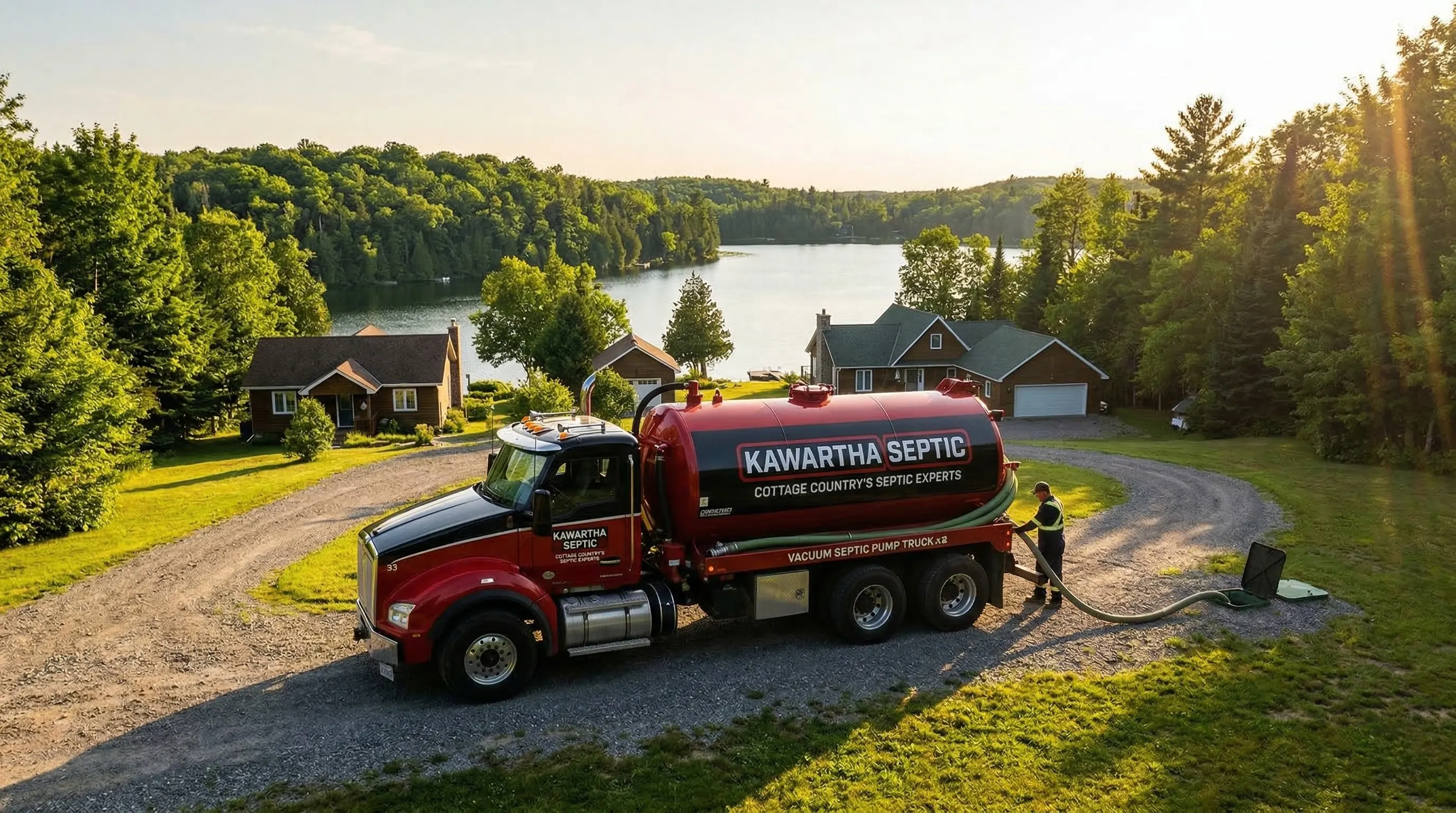
Your cottage sits on an island in Pigeon Lake. The tank hasn’t been pumped since before you bought the place, and no pump truck on earth can drive there. Now what?
That’s the question behind island cottage septic pumping in Ontario, and the answer is more routine than most owners expect. Trucks don’t reach island tanks. Barges, workboats, and long hoses do. The Kawarthas are full of water-access cottages on Pigeon Lake, Sturgeon Lake, Balsam Lake, and Cameron Lake, and every one of them has a workable way to get its tank emptied. It just takes more planning than a job with a driveway.
The Quick Answer
| Detail | |
|---|---|
| Can an island tank be pumped? | Yes. Barge-mounted equipment, a workboat with portable gear, or a long hose run from shore |
| Base price | $300-$600 for a standard 1,000-1,500 gallon tank, same base as a mainland job |
| Travel surcharge | $0 anywhere in the City of Kawartha Lakes, islands included |
| What moves the price | Access, not distance. Difficult access adds $75-$150; the marine leg is quoted up front |
| How often | Every 4-5 years for light weekend use, 2-3 years for heavy summer use |
| Holding tank instead? | $300-$500 per visit, far more often than a septic tank |
| Lead time | More than a driveway job. Book before the season gets busy |
| Emergencies | Sewage backup or septic smell in the house gets same-day or next-morning response |
The one-line version: the pumping part is normal, the getting-there part is the project. If you’d rather hand the whole thing off, call (705) 702-5526 or book a pump-out and we’ll talk through your access before anything gets scheduled.
How Water-Access Septic Pumping Actually Works
There are three ways to empty a tank you can’t drive to, and the right one depends on your lake, your shoreline, and how far you are from a landing.
A barge carries the equipment to your shore. On the bigger Kawartha lakes, marine contractors run barges that can float a small vacuum truck or a dedicated pump and tank unit right to your dock or a flat stretch of shoreline. Hoses run from there to the tank, and the pump-out itself goes exactly like it would on land.
A workboat ferries portable gear. Smaller tanks sometimes suit a portable pump and tote tanks loaded onto a workboat. The waste gets ferried back across the water to a vacuum truck waiting at a marina or municipal launch.
A hose run reaches from the mainland. An island that sits close to a mainland road or landing can sometimes be pumped with an extended hose run across the gap. There’s a hard physical limit here, though. Every extra length of hose and every foot of lift costs the truck suction, so this only works over short distances.
Whichever route fits your property, the truck still needs a legal place to park and work on the mainland side. If your landing is at the end of a cottage lane, our guide on pump trucks and private road access covers what the crew needs.
What Island Cottage Septic Pumping Costs
Start with the number that anchors everything. A routine septic tank pump-out in Kawartha Lakes runs $300 to $600 for a standard 1,000 to 1,500 gallon tank. That’s the same base an island job starts from, because location never changes our price. There’s no travel surcharge anywhere in the City of Kawartha Lakes, so an island on Balsam Lake starts from the same base as a bungalow in downtown Lindsay.
What moves the number is access. These are the modifiers that come up most often on water-access properties:
| Factor | What it adds |
|---|---|
| Moderate access (long carry, awkward landing) | +$50-$100 |
| Difficult access (steep terrain, long hose run) | +$75-$150 |
| Cottage or seasonal property | +$0-$50 |
| Last pumped 5+ years ago | +$25-$75 |
| Never pumped, or history unknown | +$50-$100 |
| Digging out buried lids (no riser) | +$100-$200 |
| Location, any town or lake | $0, always |
The marine leg itself, barge or boat time, depends on your lake and your landing, and it’s quoted up front before anything gets booked. Nothing gets added after the job. You’ll know the full cost before a boat leaves the dock.
One island-specific tip: if your lids are buried, you’ll pay a $100 to $200 digging fee every single visit. A riser installed once for $200 to $500 brings the lid to the surface permanently, and it pays for itself fast on a property where every visit involves marine logistics.
Septic Tank or Holding Tank? It Changes the Whole Plan
Plenty of small islands can’t fit a conventional septic system. Between lot size, bedrock, and waterfront setbacks, there’s often no room for a leaching bed, so the property runs a holding tank instead. Ontario classifies these as Class 5 systems under Ontario Regulation 163/24.
The difference matters more on an island than anywhere else. A septic tank treats and disperses wastewater, so it only needs pumping every 3 to 5 years for most households. A holding tank stores everything, full stop. It gets pumped at $300 to $500 per visit, far more often than a septic tank, and it has an alarm that tells you when it’s filling up.
On a water-access property, that rhythm is the whole ballgame. A septic tank owner plans one marine pump-out every few years. A holding tank owner needs a standing arrangement for the season, and a full tank with no boat trip booked is how long weekends get ruined. Our septic tank vs holding tank comparison covers how to tell which one you have, and our holding tank pumping page covers the service side.
How Often an Island Cottage Tank Needs Pumping
Island cottages follow the same frequency logic as any seasonal property. Use drives the schedule:
| Cottage use pattern | Pump the tank every |
|---|---|
| Light use, mostly weekends | 4-5 years |
| Heavy use all summer | 2-3 years |
| Rental with high guest turnover | 1-2 years |
The island wrinkle is that running to failure costs you more than it costs a mainland owner. A genuine emergency, meaning sewage backing up or a septic smell inside the cottage, gets same-day or next-morning response. But coordinating boats and barges under pressure is nobody’s idea of a long weekend, and an August failure can mean a full cottage, guests, and a scramble.
So island owners should run ahead of schedule, not behind it. If your cottage sees hard summer use and it’s been three years, book the pump-out now rather than next year. Cottage systems also age differently than year-round home systems, and the differences are worth understanding before they cost you money.
Planning the Pump-Out: Docks, Water Levels, and Lead Time
Most routine pump-outs get scheduled within 48 hours. A water-access job usually needs more runway than that, because the marine leg has its own schedule, weather windows, and season. Here’s what to line up.
Book in the shoulder, not the peak. June through September is when everyone wants barge time. If your tank is due, booking in late spring or early fall gets you better availability.
Watch the water levels. Most Kawartha lakes are managed as part of the Trent-Severn Waterway, and the fall drawdown can turn a usable landing into a mudflat. If your shoreline is shallow, mid-season water levels are your friend. The waterway has its own rules worth knowing too, covered in our Trent-Severn septic rules guide.
Have a landing spot. A solid dock or a gently sloping stretch of shore where equipment can sit level. Tell us what you have when you call, and the access plan gets built around it.
Find and clear the lids before the crew arrives. Know where the tank is, cut back the brush, and expose the lids if they’re near the surface. Every minute a crew spends hunting for a tank is time on the clock on a job that already involves a boat.
Ask your island neighbours. If three cottages on the same island are all due, getting them pumped in one trip is worth asking about. It’s common sense logistics.
One hard safety rule while you’re prepping: never lean into an open tank, and never climb in, no matter what’s been dropped down there. Septic gases can overcome a person in seconds, and it happens fast enough that would-be rescuers become victims. Clear the lids if they’re accessible, keep kids and pets away, and leave everything else to people with the right equipment.
Planning a pump-out for this season? Call (705) 702-5526 and tell us which lake you’re on, or book online and we’ll call you back within 24 hours during business hours.
Frequently Asked Questions
Can you pump a septic tank on an island in Ontario?
Yes. Water-access pump-outs get done with barge-mounted equipment, a workboat carrying portable pumping gear, or a long hose run where the island sits close to a mainland landing. The pumping itself is a normal job; the marine transport is the part that takes planning. It happens on the Kawartha lakes every summer.
How much does island cottage septic pumping cost?
The base is the same as any Kawartha Lakes pump-out: $300 to $600 for a standard 1,000 to 1,500 gallon tank, with no travel surcharge anywhere in the City of Kawartha Lakes. Access modifiers apply, with difficult access adding $75 to $150, and the marine leg is quoted up front before anything gets booked. You’ll have the full number before you commit.
How often should an island cottage septic tank be pumped?
Every 4 to 5 years for light weekend use, every 2 to 3 years for heavy summer use, and every 1 to 2 years if the cottage runs as a rental with high guest turnover. Island owners should stay ahead of that schedule rather than behind it, because arranging water access on short notice is harder and more stressful than planning it in advance.
What if my island cottage has a holding tank instead of a septic tank?
Then pumping is a recurring service, not a once-in-five-years event. Holding tanks store all wastewater and get pumped at $300 to $500 per visit, far more often than a septic tank. On a water-access property that means setting up a standing arrangement for the season, not calling when the alarm sounds and hoping a barge happens to be free.
Got an Island Tank That’s Overdue?
Tell us which lake you’re on, how you get to the cottage, and when the tank was last pumped. We’ll sort out the access plan and quote the whole job up front, marine leg included.
Call (705) 702-5526 or book a pump-out. Serving the whole City of Kawartha Lakes, islands included, with no travel surcharge and no minimum distance.