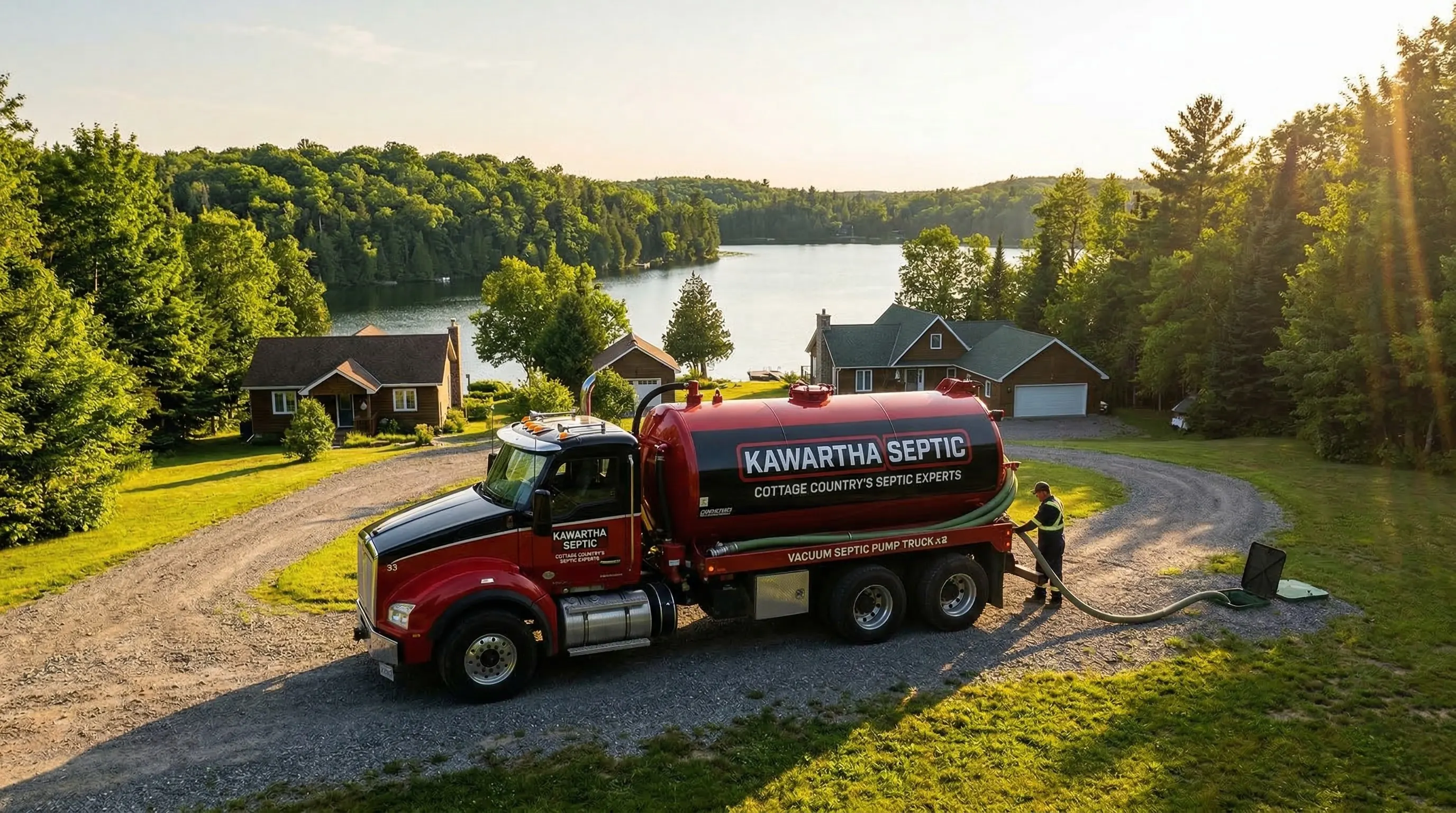
To prepare for a septic pump-out, find and mark the tank lid, clear a path the truck and hose can use, and have your tank size and last pump date ready when you book. Do those and the quote you get on the phone is the price you pay, with nobody probing your lawn for twenty minutes first.
The crew’s side of the visit is covered in what happens during septic pumping. This post covers your side: before, the day before, and after.
The Checklist at a Glance
| When | Task |
|---|---|
| Before you book | Find your tank size and last pump date |
| Before you book | Know where the lid is, or say you don’t |
| Before you book | Describe the driveway, lane and gate |
| Day before | Mark the lid, move vehicles, unlock the gate |
| Day before | Mark the leaching bed so nobody parks on it |
| Day of | Pets and kids inside, laundry on hold |
| After | Ask for a written record |
Before You Book: Four Things to Have Ready
Your tank size
Price follows tank size, so this is the first question you will be asked. A routine pump-out on a 1,000 to 1,500 gallon tank runs $300 to $600 in Kawartha Lakes, and $250 to $800 across all sizes from 750 to 2,000-plus gallons. Our septic pumping cost guide has the full table by size.
If you don’t know the size, two places help. Your bedroom count is a rough guide, because tanks are sized by bedrooms under the Building Code: a four-bedroom house typically has a 4,500 litre (“1,000 gallon”) tank, a five-bedroom about 5,700 litres (“1,250 gallon”). Gallons on this site are imperial. The better source is the permit file. The City of Kawartha Lakes Building and Septic Division holds sewage system records back to 1974, and a permit file usually includes a site plan. Call the City at 705-324-9411 to ask what they have for your address.
When it was last pumped
A tank that has gone five years or more, or has never been pumped as far as anyone knows, takes longer to empty. That shows up in the quote: +$25 to $75 for last pumped five or more years ago, +$50 to $100 for never pumped or unknown. Old receipts, a note from the previous owner, or a sticker inside the utility room all count. If you have nothing, say so. An honest “unknown” gets a better quote than a guess.
For most households the interval is every 3 to 5 years, depending on how many people live there. How often to pump your septic tank has the table by household size and cottage use.
Where the lid is
If you have never seen it, how to find your septic tank covers records, following the sewer pipe, and probing. You don’t need a perfect answer. “No idea” is useful too, because it tells us to plan time for locating and digging.
How the truck gets in
Tell us about the driveway or lane, the tightest spot on it, any gate, and roughly how far the tank sits from where a truck could park. Private roads and septic pumping goes through seasonal roads, spring load restrictions and narrow lanes one by one.
Mention anything unusual about the system too: a pump chamber with an alarm, a treatment unit, or a tank that is actually a holding tank. A holding tank pump-out is a different service at $300 to $500, pumped far more often. If you want the tank inspected while it is open, say so at booking. An inspection bundled with pumping adds $75 to $150.
What Changes the Price, and What Does Not
Distance does not. There is no travel surcharge and no minimum distance anywhere in the City of Kawartha Lakes, so Coboconk and Balsam Lake cost the same as downtown Lindsay. Outside the City, in Peterborough County, Durham, Belleville and Hastings, or Haliburton, the price is quoted up front before the truck is booked.
What can change the price is access and the state of the tank. Every one of these is quoted before work starts, never added after the job.
| Factor | Added to the base price |
|---|---|
| Moderate access (longer hose run, tight parking) | +$50 to $100 |
| Difficult access (long, steep or narrow approach) | +$75 to $150 |
| Digging to reach a lid with no riser | $100 to $200 |
| Last pumped 5+ years ago | +$25 to $75 |
| Never pumped or unknown | +$50 to $100 |
| Cottage or seasonal property | +$0 to $50 |
| Emergency or after-hours callout | +$100 to $200 |
You can set these yourself in the pumping cost calculator and see the range move.
Uncovering the Septic Tank Lid Yourself
The digging fee exists because a buried lid means shovel time. If you know where the lid is and want to expose it before we arrive, you can, with three rules.
First, submit a locate request through Ontario One Call before you put a shovel or probe in the ground. Buried lines run through rural yards in places nobody remembers.
Second, take the soil off the lid and stop. Do not lift or pry the lid; leave that to the crew. Septic tanks hold gases that can overcome a person quickly, and an open tank is a fall hazard for children and pets. Nobody should lean over an open tank.
Third, tell us when you book that the lid will be exposed, so the quote reflects what is actually left to do.
If you are digging every three or four years, a riser is the better answer. Riser installation runs $200 to $500, and it can often go on during a pump-out while the lid is already exposed. The current Ontario Building Code requires tank access openings to sit no more than 300 mm below the ground surface when a tank is installed, with risers brought up to within 300 mm of grade where the tank is deeper (OBC 8.2.2.3). Plenty of older tanks around here sit deeper than that. Our guide to septic tank risers covers materials and how they go on.
The Day Before
Mark the lid. A stake, a garden flag, or a stone on top. If snow is coming, mark it before it falls; septic pumping in winter covers the rest of the cold-weather routine.
Clear the route. Move cars, the boat trailer and the woodpile out of the way between the road and the tank. The truck parks as close as it safely can, and the hose needs a clear line across the yard.
Open the gate. Unlock it and prop it fully open. Measure the clear width between the posts if you never have. Gates are often narrower than they look.
Mark the leaching bed. A loaded pump truck should never drive or park on the bed. If the bed sits between the driveway and the tank, stake its edges.
Pets and water. Dogs inside. Normal flushing is fine, but hold the laundry and the dishwasher until the truck has gone.
You do not have to be home if the gate is open and the lid is marked. For a first visit it helps to be there to point out the tank and hear what the crew found.
After the Truck Leaves: What to Ask For
Ask for a written record before the crew drives off. A good one lists:
- The date and the volume pumped
- Tank size and number of compartments
- Condition of the inlet and outlet baffles
- Whether there is an effluent filter, and whether it was cleaned
- Any cracks, damage or signs of water coming in
- A recommended date for the next pump-out
The outlet baffle matters most. It keeps floating scum from leaving the tank and reaching your leaching bed, so a missing or broken one is worth fixing soon.
If the crew flags something, here is what the common fixes cost. We diagnose before we replace: if a baffle is the fix, that is the quote, not a new system.
| Finding | Typical fix | Price |
|---|---|---|
| Damaged or missing baffle | Baffle replacement | $200 to $500 |
| Clogged or broken effluent filter | Filter replacement | $50 to $150 |
| Cracked or unsafe lid | Tank lid replacement | $100 to $300 |
| Lid buried too deep | Riser installation | $200 to $500 |
| Other minor faults | General septic repair | $200 to $800 |
Anything beyond those is quoted after a proper look. Our tank repair page covers the tank-side work.
File the record with your house papers. It sets your next pump date from facts rather than memory, and a buyer’s lawyer will ask for it when you sell.
When It Can’t Wait
Most routine pump-outs are scheduled within 48 hours, so there is rarely a reason to let a tank run until it backs up. A sewage backup, a screaming alarm, or septic smell inside the house is different. Those get same-day or next-morning response. An emergency pump-out runs $400 to $800 for a typical 1,000 to 1,500 gallon tank, and after-hours or weekend work runs $600 to $1,200. The cheapest pump-out is the one booked on a dry weekday with the lid marked and the gate open.
Frequently Asked Questions
Do I need to uncover my septic tank lid before the truck arrives?
No, but a buried lid adds a digging fee of $100 to $200. If you know where the lid is, you can remove the soil from on top of it after submitting a locate request through Ontario One Call. Never lift or open the lid yourself, and tell us at booking that it will be exposed.
Should I stop using water before septic pumping?
You do not need to stop using water in the days before. On the day, hold off on laundry, the dishwasher and long showers while the truck is there, since that water just adds to what has to be pumped. Flushing a toilet or washing your hands is fine.
Do I need to be home for a septic pump-out?
Not usually. If the gate is unlocked, the lid is marked and any pets are secured, the crew can do the job and leave the record for you. For a first pump-out at a new property it is worth being there to show the crew where the tank is and hear what they found.
What should I get from the septic company after pumping?
A written record with the date, the volume pumped, the tank size, the condition of the inlet and outlet baffles, the state of the effluent filter if there is one, and any damage found. That record sets your next pump date and answers the questions a buyer or inspector will ask later. If a company will not put it in writing, ask why.
How far in advance should I book a septic pump-out?
Most routine pump-outs are scheduled within 48 hours, so a few days’ notice is normally enough. Book earlier ahead of spring load restrictions on rural roads and the busy cottage opening and closing weeks. A backup, an alarm or septic smell inside the house gets same-day or next-morning response.
Book Your Pump-Out
Have your tank size, last pump date and a rough idea of the lid location ready, and the call takes two minutes. Call (705) 702-5526 or book a pump-out. A routine visit on a 1,000 to 1,500 gallon tank runs $300 to $600, most are scheduled within 48 hours, and we call back within 24 hours during business hours. Details of the service are on our septic tank pumping page.