A septic system is only a handful of parts in a row, and once you’ve seen them drawn out, most of the words on a pump-out invoice start to make sense.
Baffle, effluent filter, D-box, riser. Homeowners hear these the first time something needs fixing, usually standing in the yard while someone points at a hole in the ground. It’s easier to follow when you already know where each part sits and what it’s for.
This page is the visual reference: three labelled diagrams, then a part-by-part glossary covering what each component does, what it’s made of, how it usually fails and roughly what the repair costs. For the plain-language story of how wastewater moves through the whole thing, read how a septic system works first, or keep it open alongside.
The Quick Answer
| Component | What it does | Typical repair cost |
|---|---|---|
| Building sewer | Carries everything from the house to the tank | General repair range, $200 to $800 for short sections |
| Septic tank | Settles solids and floats grease so only liquid leaves | Tank replacement is a permitted, quoted job |
| Inlet baffle | Slows incoming flow and aims it below the scum | $200 to $500 |
| Outlet baffle and effluent filter | Lets only clear liquid out, screens fine solids | Baffle $200 to $500, filter $50 to $150 |
| Risers and lids | Bring access up to ground level and keep people out | Riser $200 to $500, lid $100 to $300 |
| Distribution box (D-box) | Splits effluent evenly between trenches | $200 to $800 |
| Leaching bed trenches | Spread effluent into soil for final treatment | Rehab $3,000 to $10,000, replacement $10,000 to $25,000 |
| Pump, floats and alarm (some systems) | Push effluent uphill or into a raised bed | Pump $600 to $1,500, floats within $200 to $800 |
Most tank-side repairs, meaning baffles, lids, risers, filters and pumps, land between $200 and $800. The bed is where the big numbers live.
Septic Tank Diagram: Inside a Two-Compartment Tank
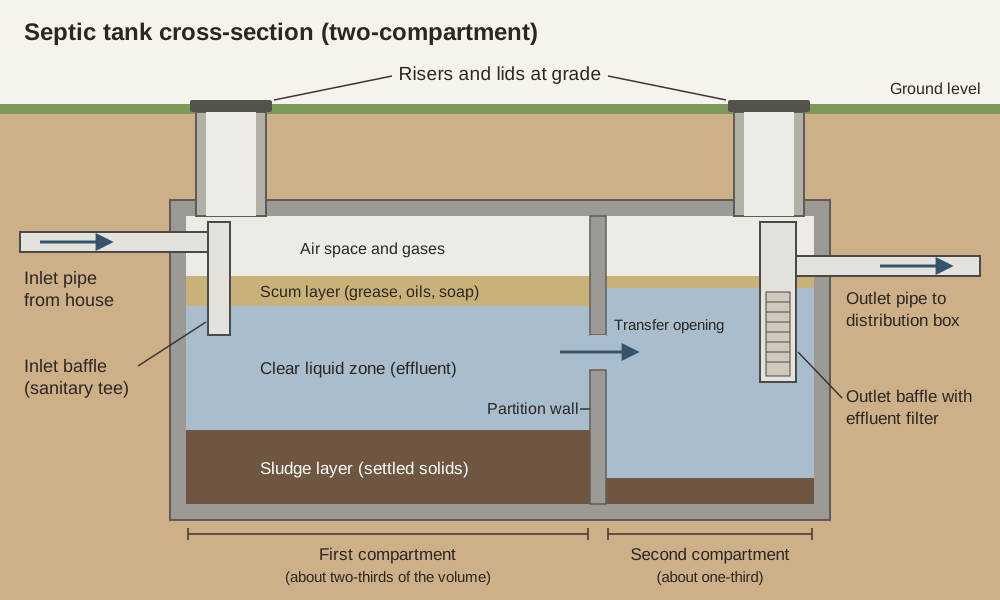
Read it left to right, the way the water moves.
Wastewater arrives through the inlet pipe and drops through the inlet baffle, which sends it down into the middle of the tank instead of letting it churn across the surface. In the first compartment it separates: scum floats, sludge sinks, and a clear liquid zone forms between them.
The partition wall divides the tank, usually about two-thirds to the first compartment and one-third to the second. Its transfer opening sits at mid-depth, so it draws from the clear zone and not from the scum or sludge. The second compartment is calm, which gives fine solids a second chance to settle. Why both sides must be pumped is covered in two-compartment septic tanks.
Liquid then leaves through the outlet baffle, often fitted with an effluent filter, and heads for the leaching bed. Risers bring both access points up to the lawn so nobody has to dig.
Notice the liquid sits right up at the outlet. That’s normal. What decides when a tank needs pumping is how thick the sludge and scum have grown, explained in how to tell if your septic tank is full.
Plenty of older Kawartha tanks are single-compartment, with no partition at all.
Septic System Layout: From House to Leaching Bed
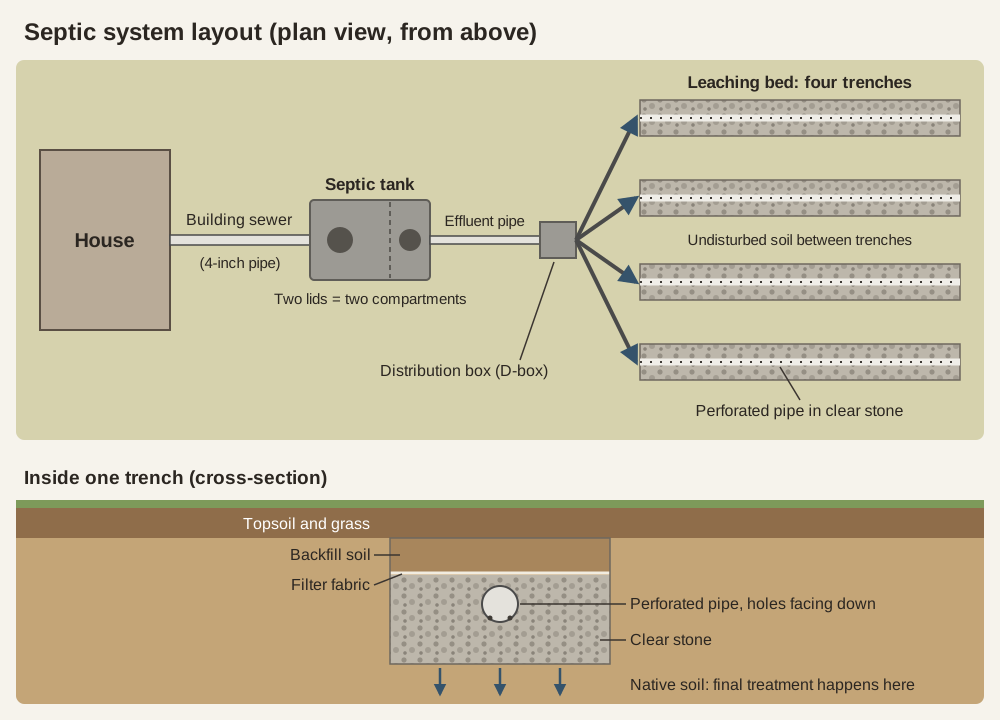
This is the septic tank and leach field diagram most people are after: the whole system from above.
The building sewer leaves the house, runs to the tank, and an effluent pipe carries the clarified liquid to the distribution box. The D-box splits it between several parallel trenches, each holding a perforated pipe in clear stone. Ontario installers usually call the whole area a leaching bed; you’ll also hear tile bed, drain field and weeping bed.
The lower panel shows one trench cut open. Effluent leaves the pipe through holes along the bottom, spreads through the stone, and seeps into the native soil underneath. That soil does the final treatment, which is why its type drives the design. The heavy clay around Lindsay accepts water slowly and needs more trench length. Near Kirkfield, the limestone plain often leaves too little soil over rock for a conventional bed at all.
Real layouts are rarely this tidy. Trenches follow the lot, and every system has to respect setbacks from wells, lakes and property lines.
Pumped System Diagram: Pump Chamber and Raised Bed
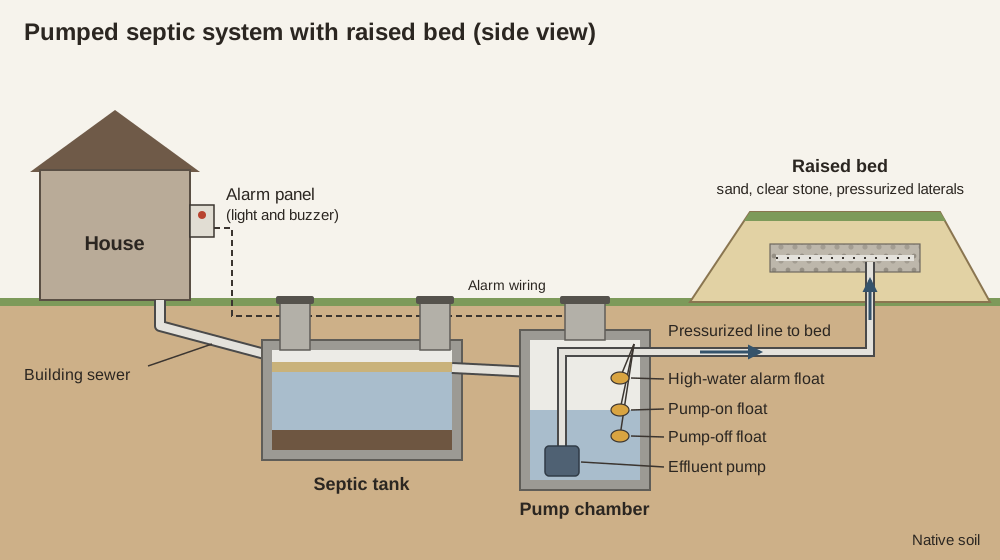
A pump gets added when the bed sits uphill from the tank, when the bed is a raised bed built above shallow soil, bedrock or a high water table, or when a treatment unit needs dosing on a timer.
After the tank, effluent collects in a pump chamber, either its own tank or a compartment of the main one. Inside, float switches control an effluent pump. The pump-on float starts it, the pump-off float stops it before the chamber runs dry, and the high-water alarm float trips a light and buzzer on the alarm panel if the level climbs too far. The pump then pushes a dose through a pressurized line into small-diameter laterals in the bed.
Raised beds are common where soil is thin or wet, including waterfront lots and parts of the north around Norland and Coboconk. Raised and mound systems in Ontario covers when they’re required.
What Does a Septic Tank Look Like?
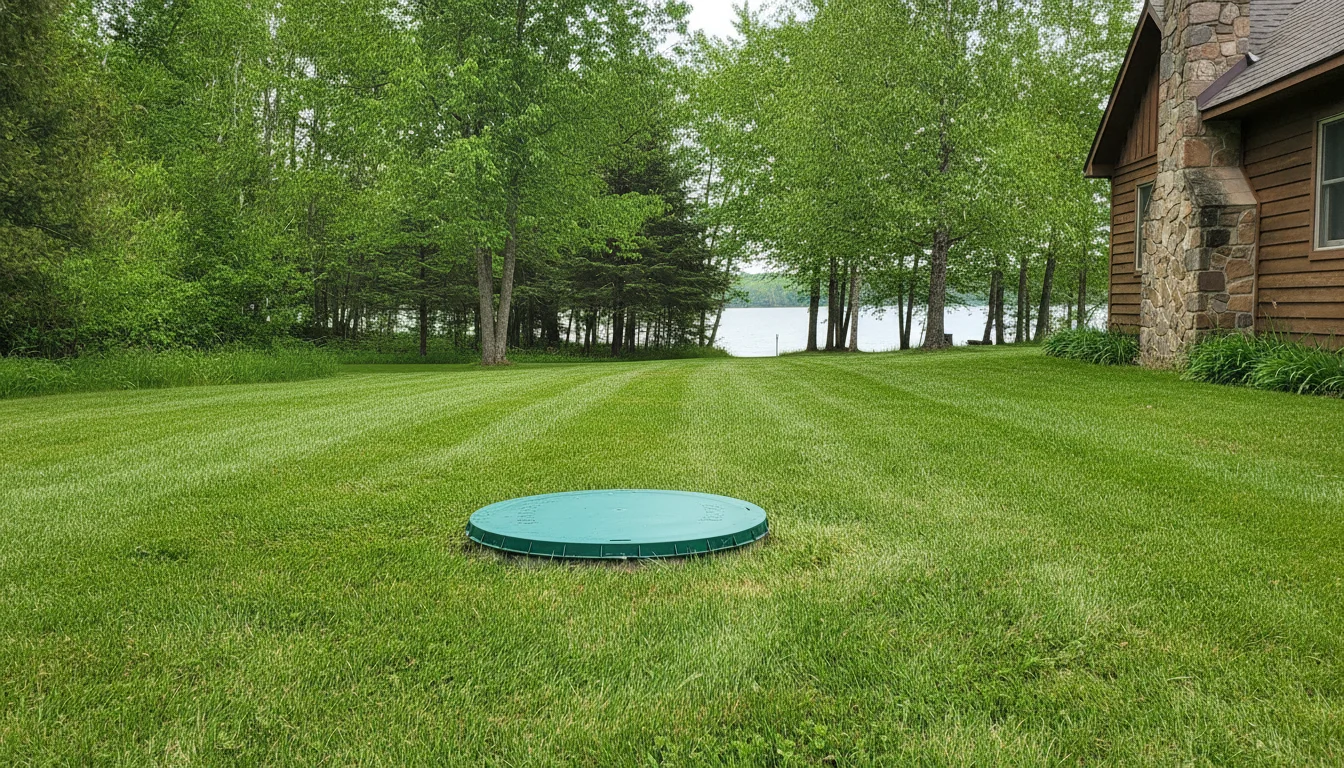
From the yard, often not much. You might see one or two round or square lids at grass level, concrete or green or black plastic, spaced a metre or two apart. On an older system you may see nothing, just a slightly sunken or oddly green rectangle, because the lids are buried under a foot or more of soil.
Inside a septic tank with the lid off, you’ll mostly see the top of the scum mat: a grey-brown crust, sometimes cracked, with the top of a baffle or the handle of an effluent filter poking through. The liquid sits roughly 8 to 12 inches below the lid. You won’t see the sludge.
After a pump-out is the only time the inside is on display: bare walls, baffles, the partition, and any cracking or corrosion. That’s why a good crew inspects while it’s empty.
Look from a step back. Never lean over an open tank or climb in, because the gases inside can overcome an adult in seconds.
Septic System Components: A Part-by-Part Glossary
Building sewer
The 4-inch pipe from the house to the tank, usually PVC or ABS on newer homes and cast iron or clay tile on older ones. It fails at the joints, where roots get in, or where it sags and holds water. In a hard Kawartha winter, a shallow run can freeze. Short repairs fall in the general $200 to $800 range; longer runs get quoted after a camera look.
Septic tank
Most tanks here are precast concrete. Older properties may have steel, which typically lasts 15 to 20 years before rusting through, and some newer or hard-to-reach installs use polyethylene or fibreglass. Tanks fail by cracking, leaking at seams, or, in steel’s case, corroding. Replacing a tank needs a permit, and in the City of Kawartha Lakes the permit fee alone is $461.
Inlet baffle
A concrete wall cast into older tanks, or a PVC sanitary tee on newer ones. It slows incoming flow and aims it below the scum. Concrete baffles slowly corrode from the gases in the tank and can fall off. A failed inlet baffle usually shows up as backups toward the house. Replacement runs $200 to $500, and septic tank baffle repair covers the signs.
Scum, clear zone and sludge
Not parts, but they’re what’s inside a septic tank and what a pumper measures. When sludge and scum together take up about a third of the liquid depth, the tank is due.
Partition wall and transfer opening
Found in two-compartment tanks, usually concrete. It fails by cracking or by the opening clogging, which pushes the first compartment’s load onto the second. It’s usually spotted when the tank is empty. Minor fixes sit in the general repair range, while a structural crack can point toward a new tank.
Outlet baffle and effluent filter
The last line of defence for the bed. The outlet baffle is a PVC tee or concrete wall, and many now hold a slotted plastic filter cartridge that catches fine solids. A clogged filter backs water up toward the house, which is its way of protecting the bed, and it needs cleaning at pump-outs or more often. Replacement filters run $50 to $150; see effluent filter cleaning. A failed outlet baffle, $200 to $500, is more serious because it lets solids straight out to the bed.
Risers and lids
Risers are PVC, polyethylene or concrete collars that bring access up to grade. They cost $200 to $500 installed and save digging on every visit, as septic tank risers explains. Lids crack from freeze-thaw and weight, and plastic lids that aren’t screwed down are a hazard to kids. A new lid runs $100 to $300; more in septic tank lid safety.
Distribution box
A small concrete or plastic box with one inlet and an outlet for each trench, set dead level. It fails when it settles or frost-heaves out of level, sending most of the effluent down one trench, or when solids from an overdue tank silt it up. Levelling or replacement falls in the $200 to $800 range. Distribution box problems goes deeper.
Leaching bed trenches
Perforated plastic pipe laid in clear stone, covered with fabric and backfill, sitting on native soil or imported sand. Some newer beds use plastic chambers in place of stone. Beds fail when solids, grease or constant saturation seal the soil, or when vehicles compact it. Rehabilitation runs $3,000 to $10,000; replacement $10,000 to $25,000.
Pump, floats and alarm
Found only on pumped systems. Effluent pumps typically last 7 to 10 years. Floats stick, tangle or fail, and alarm panels lose power in outages. A float or wiring fix usually lands in the $200 to $800 range, and a pump replacement runs $600 to $1,500. Signs and costs are in septic pump replacement.
How One Cheap Part Takes Down an Expensive One
Look at the layout diagram again and the chain is easy to see. Every part downstream depends on the one before it keeping solids back.
A typical sequence: the tank goes a few years past due, or the outlet baffle crumbles. Solids get out. They settle in the D-box and start blocking its outlets. What gets past the box coats the stone and soil in the first trench. Now one trench is doing all the work and failing faster.
Each step costs more than the last. A baffle is a few hundred dollars; a new bed is five figures. The best protection for the expensive parts is keeping the cheap ones working: pump on schedule, clean the filter, and have the baffles checked while the tank is empty.
Part 8 of the Ontario Building Code governs all of these parts, and the province’s septic systems page is the plain-language starting point. In Kawartha Lakes, permits go through the City’s Building Division.
Frequently Asked Questions
What are the main parts of a septic system?
A conventional system has a building sewer, a septic tank with inlet and outlet baffles (often an effluent filter too), a distribution box and a leaching bed of perforated pipe in stone over soil. Pumped systems add a pump chamber, an effluent pump, float switches and an alarm panel.
What does the inside of a septic tank look like?
With the lid off, you’ll mostly see a grey-brown crust of scum with liquid close to the top, and maybe the top of a baffle or filter. Below that is a clear liquid zone and a sludge layer on the floor, which you can’t see without pumping or measuring.
Where is the leach field in relation to the septic tank?
Downstream of it, usually a few metres or more away, and connected through the distribution box. On gravity systems it sits level with or below the tank. If it’s uphill, there’s a pump chamber in between. Check your permit drawing for the actual layout.
How many lids does a septic tank have?
Usually one or two. Two lids generally means two compartments, and both need opening at every pump-out. Pumped systems also have a separate lid over the pump chamber. Older tanks sometimes have a lid buried well below the grass.
Does every septic system have a pump?
No. Most conventional systems run on gravity alone. You likely have a pump if there’s an alarm panel on the house, a raised bed, or a separate smaller lid near the tank.
Want to See Your Own System’s Parts?
A pump-out is the cheapest look inside your tank you’ll ever get, and we’ll point out each part and its condition while it’s open. Call (705) 702-5526 or Book A Pump. We work across the City of Kawartha Lakes, including Lindsay, Fenelon Falls, Kirkfield and Norland.