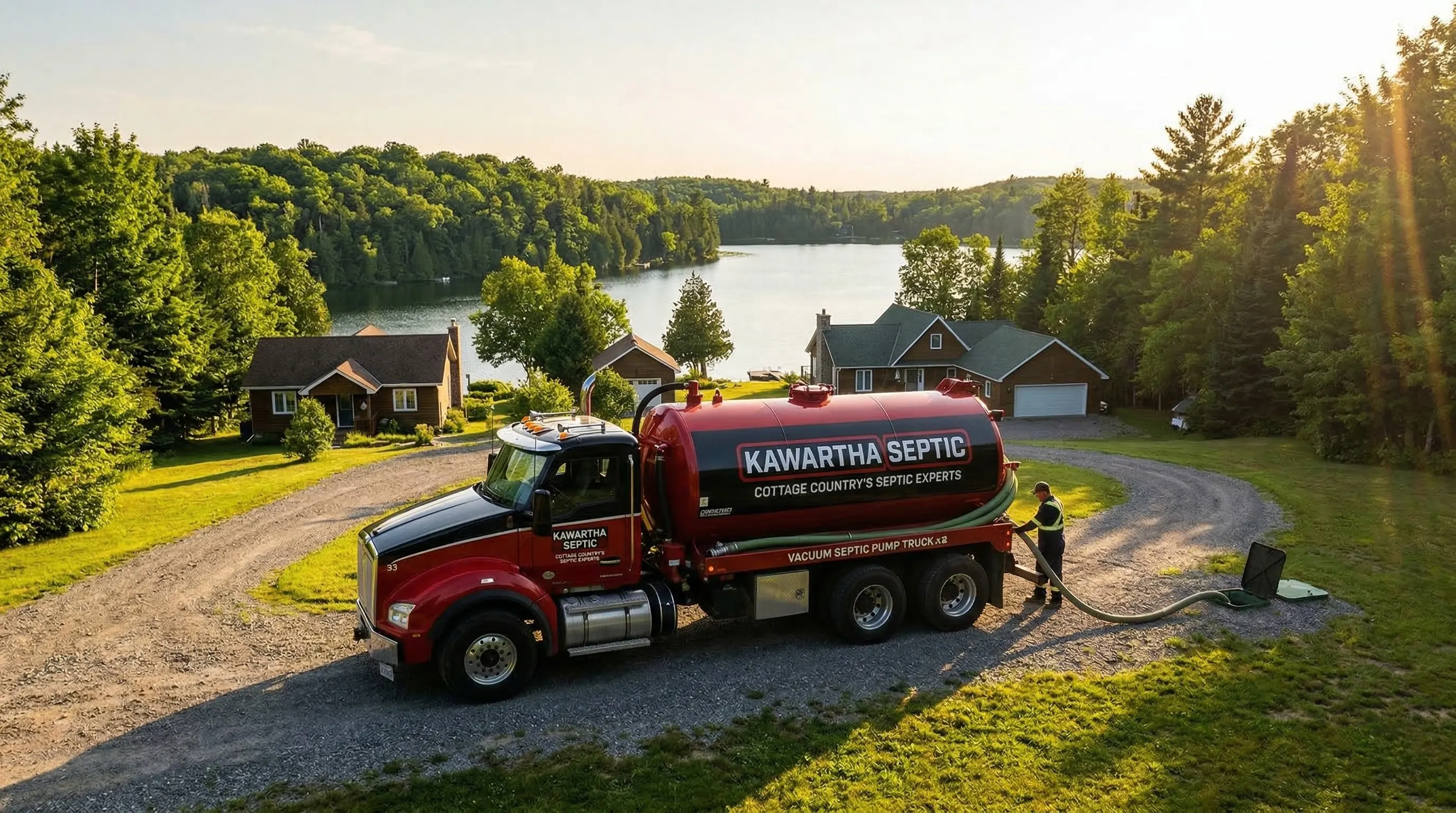
A septic company can tell you anything on the phone. The part most homeowners skip is the five minutes it takes to check whether any of it is true, and that five minutes is where the real protection lives. A truck with a logo and a friendly dispatcher is not a credential. Neither is “fully licensed and insured” on a website, which is a phrase, not a document.
The good news is that septic work in Ontario runs on a small number of checkable approvals, and each one lives with a specific body that will confirm it. Here is what those approvals are, who needs which, and how to check them without becoming an expert.
The Quick Answer
| Who | Credential to ask for | Where it is checked |
|---|---|---|
| Pumper / hauler | Ministry of the Environment, Conservation and Parks approval covering hauled sewage, plus a named receiving site | The approval number, and the Ministry’s public environmental registry |
| Installer | Ontario Building Code qualification in the on-site sewage systems category | The provincial qualification registry, or the City of Kawartha Lakes Building and Septic Division at 705-324-9411 |
| Designer | BCIN registration in the sewage systems category | Same registry; the building department will confirm an active number |
| Any of them | Liability insurance and a WSIB clearance certificate | The certificate itself, issued in the company’s legal name |
If a company can only produce one of these and gets vague about the rest, that is your answer. If it can produce all of them without hesitation, you are probably dealing with a professional.
Why the Credential Depends on the Job
Septic work is three trades wearing one name. A pumper empties and assesses tanks. An installer builds and replaces systems. A designer produces the drawing the permit is issued against. Our guide to designers, installers and engineers walks through who does what; the short version is that each role has its own approval, and a company that does everything should hold, or contract, all three.
That matters when you are checking credentials because the wrong question gets a true but useless answer. Asking an installer whether they are “licensed” and hearing “yes” tells you nothing about who is hauling the septage away or who stamped the design. Ask about the specific approval for the specific work you are buying.
Checking a Pumper or Hauler
Septage, the material pumped from your tank, is regulated waste from the moment it leaves the ground. Moving it requires an approval from the Ministry of the Environment, Conservation and Parks covering the hauling operation, and it can only be discharged at an approved receiving site, typically a municipal wastewater treatment plant with a septage receiving station or a dedicated septage facility.
What to ask: the approval number, and where the load is going. A legitimate hauler answers both instantly, because it is the thing their whole operation depends on. The number is commonly displayed on the vehicle.
How to check: the Ministry publishes its environmental approvals in a public online registry that can be searched by company name. The exact approval type is less important than whether an active one exists in the name of the company in your driveway. If a company trades under a name that does not appear anywhere, ask which legal entity holds the approval.
Why it matters to you, not just the environment: disposal fees are a real cost inside every pump-out. A typical residential pump-out on a 1,000 to 1,500 gallon tank runs $300 to $600 in Kawartha Lakes, and a quote far below that range is usually cutting a corner somewhere. The cheapest corner to cut is where the load goes.
Checking an Installer
Building or replacing a sewage system in Ontario is regulated work under Part 8 of the Ontario Building Code. The people who construct these systems are expected to be qualified and registered with the province in the on-site sewage systems category, and the municipality issuing the permit can see whether that registration is current.
What to ask: the qualification number, and whether the permit for your job will be pulled in their name or yours. The answer you want is theirs, with the permit fee named. In the City of Kawartha Lakes that fee is $975 for a standard Class 4 system, $461 for a tank replacement or bed repair, and $433 for a Class 2 greywater system; elsewhere in Ontario fees range $400 to $1,200. Our septic permit guide covers what the application involves.
How to check: the provincial qualification registry is public and searchable by name. The faster route for most people is one call to the City of Kawartha Lakes Building and Septic Division at 705-324-9411, who deal with these registrations every week and will tell you whether a number is active in the right category. They can also tell you whether the company has pulled permits in the municipality before, which is its own kind of reference.
The tell: an installer who proposes to start work without mentioning a permit, or who suggests the permit is optional on a “like-for-like” replacement, is proposing something that can come back on you at sale time. Septic fines and non-compliance in Ontario covers how that plays out, and it is never the contractor who pays.
Checking a Designer
Every new or replacement system is built to a design, and in Ontario that design is produced by a sewage system designer holding a BCIN in the sewage systems category, or by a professional engineer for sites outside standard scope. The design is what the permit is issued against, and the design is what the inspector checks the finished system against.
What to ask: who is designing the system, and their BCIN number. Many installation companies employ or contract a designer in-house, and that is fine. What is not fine is an installer “designing as they go” without a stamped drawing, which is not a shortcut, it is an unpermittable system.
How to check: same registry as the installer, or the same phone call to the building department. Confirm the number is active and in the sewage systems category specifically, because a BCIN in another building category does not cover septic design.
Insurance and WSIB
Two documents protect you from things that have nothing to do with septic expertise: someone getting hurt on your property, and damage to your property.
Commercial general liability insurance covers damage the contractor causes, from a cracked foundation drain to a flattened well casing. Ask for the certificate. It should be in the company’s legal name, current, and from an insurer you can look up.
A WSIB clearance certificate confirms the company is registered with the Workplace Safety and Insurance Board and current on its premiums. Without it, an injured worker on your property can become your problem. Clearance certificates are issued by WSIB and are easy for any registered business to produce on request.
Neither document costs you anything to ask for, and a company that does not have them ready has told you something about how it runs.
The Five-Minute Check, in Order
- Get the legal business name from the quote or invoice, not the truck.
- Ask for the approval or qualification number that matches the work you are buying: hauling approval for a pump-out, installer and designer numbers for a replacement.
- Look it up, or call 705-324-9411 and ask the building department to confirm.
- Ask for the insurance certificate and WSIB clearance in the same name.
- Get the scope in writing before anything starts. For a replacement that means an itemized quote; for a pump-out it means the price for your tank size, confirmed before the truck rolls.
If you have done those five things, you have done more due diligence than most people do on a five-figure job, and you have a paper trail if something goes wrong. What to do in a septic contractor dispute starts with exactly this paperwork.
What Credentials Do Not Tell You
A valid approval means the company is allowed to do the work. It does not mean the company does it well, and it does not mean the quote in front of you is fair. The twelve questions to ask a septic company cover the rest: whether they inspect while the tank is open, whether they diagnose before recommending replacement, and whether a price can change after the fact.
The two checks work together. Credentials rule out the companies that should not be in your driveway at all. The questions sort the rest.
Frequently Asked Questions
Does a septic pumping company need a licence in Ontario?
Hauling septage requires an environmental approval from the Ministry of the Environment, Conservation and Parks, and the material can only be discharged at an approved receiving site. There is no separate “pumper’s licence” in the way people sometimes imagine, but the hauling approval is checkable and a legitimate company will give you the number.
Does a septic installer need to be licensed in Ontario?
Installing or replacing a sewage system is regulated under Part 8 of the Ontario Building Code, and installers are expected to hold a provincial qualification in the on-site sewage systems category. The municipality issuing the permit can confirm whether a registration is current. The design itself comes from a BCIN-registered designer or an engineer.
How do I check a BCIN number?
Ask for the number and the category, then confirm it through the provincial qualification registry or with the City of Kawartha Lakes Building and Septic Division at 705-324-9411. Make sure the category is sewage systems, not a general building category.
Is a company’s word that it is insured good enough?
No. Ask for the certificate of insurance and a WSIB clearance certificate, both in the company’s legal name. Both are routine documents for a properly run business and take minutes to produce.
What if my contractor cannot produce any of this?
Do not let the work start. For a pump-out, book someone else. For a replacement, get a second quote from a company that can, and keep the first one as a comparison. Ontario’s consumer protection rules for home services give you leverage on written estimates, but only if you have one.
Ask Us First
Everything on this page applies to us, and we would rather you checked. Call (705) 702-5526 or book online and ask for the approval number for hauling, the permit plan for a replacement, and the insurance certificate. You will get them.
Routine pump-outs are scheduled within 48 hours. Sewage backing up, a screaming alarm, or septic smell inside the house gets same-day or next-morning response. Every installation or replacement starts with a site visit and ends with a written, itemized quote that changes only if the scope changes, and we tell you before any extra work happens, not after. No travel surcharge and no minimum distance anywhere in the City of Kawartha Lakes.