A well inspection on an Ontario purchase is really four separate checks: a free bacteria test through Public Health Ontario, a chemistry test at a private licensed lab, a flow test and wellhead check by a licensed well contractor, and a look at the provincial well record. No single company does all four, and there is no one price for “a well inspection”, because the pieces are billed by different people.
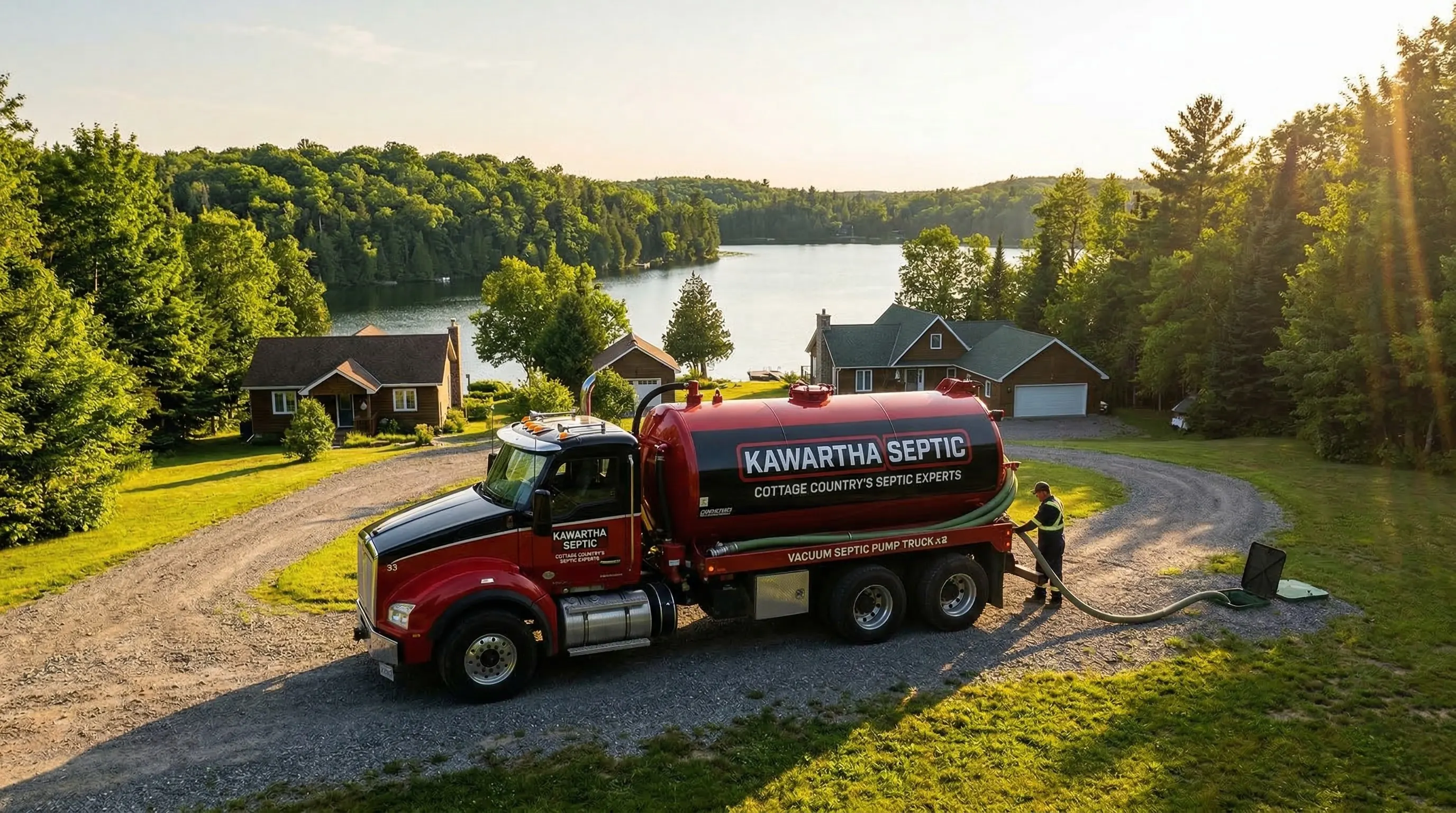
We should say up front what we do and don’t do. Kawartha Septic inspects, pumps and repairs septic systems. We don’t test wells, measure yield or work on pumps. But on a rural purchase the well and the septic share one yard, and both tend to get checked in a rush, or not at all. This guide covers the well half so you can book the right people inside your condition period.
The septic half has its own guide: septic inspection before buying a house in Ontario.
The Four Checks at a Glance
| Check | What it tells you | Who does it | What it costs |
|---|---|---|---|
| Bacteria (total coliform and E. coli) | Whether the water is contaminated with bacteria right now | You collect it; Public Health Ontario’s lab tests it | Free |
| Chemistry (nitrate, metals, minerals, others) | What bacteria testing misses | A private licensed laboratory | Set by the lab |
| Flow and wellhead | How much water the well delivers, and whether the cap, casing and pump are sound | A licensed well contractor | Quoted by the contractor |
| Well record | Depth, casing, construction date, original pumping test | The province’s well records map | Free |
Then there is the one check that joins the two systems: the distance from the well to the septic tank and leaching bed. That one is ours, and we come back to it below.
Who Does What on a Rural Purchase
Most buyers assume the home inspector covers the well. A general home inspector may run the taps, look at the pressure tank and note that a well is present. Useful, but it is not a yield test and it is not a water test.
The physical well work belongs to a licensed well contractor. Ontario’s guidance on wells on your property says to hire one for building, repairing, modifying or abandoning a well, and the contractor’s staff need the right class of well technician licence for the job. The septic side, meaning the tank, the bed and their distance from the well, is what we check on our real estate septic inspections.
Search “well and septic inspection” and you will find companies offering both. Ask who is doing each part and what licence they hold for it.
The Bacteria Test: Free, and Easy to Get Wrong
Ontario’s free program is run through Public Health Ontario’s well water testing service. It covers private wells and other private drinking water sources, including treated lake water, which matters for waterfront cottages drawing from an intake line. The test looks for total coliforms and E. coli. That’s all.
Samples are only accepted in the program’s sterile bottles. In Kawartha Lakes, Lakelands Public Health (formerly the Haliburton, Kawartha, Pine Ridge District Health Unit) has pickup and drop-off points, including its Lindsay office; check their site for current locations and hours. The sample has to be tested within 48 hours of collection, so keep it cold and out of a hot trunk. Results usually come back in 2 to 4 business days.
Add in pickup and drop-off hours and a result can take most of a week. Start on day one of your condition period.
Who should take the sample
Ideally you, your agent or the well contractor, not the seller. That isn’t an accusation. You just want to know the sample came from the kitchen tap on a normal day, taken by someone following the bottle instructions.
Two questions for the seller are worth asking. Has the well been shock chlorinated recently? And is there a treatment system, such as a UV light or softener? A sample taken right after chlorination, or only after treatment, tells you about the treatment, not the well. If there is a treatment system, some buyers test both before and after it. Your well contractor can tell you where to draw each sample.
One clean result is one clean result
Well water quality moves with the seasons, and shallow wells move the most. Ontario’s guidance on testing and treating private water wells says deeper, properly built wells tend to be more stable than shallow ones, and that extra testing is worth doing around events like spring melt. If you are buying in a dry August, a clean result is good news, but it is not a guarantee about April.
If a result does come back positive, don’t jump to the septic. Our guide to a failed well water test walks through the order to check things, starting with the cap and casing.
Chemistry: What the Free Test Misses
Public Health Ontario is plain about the limit: water with no bacteria can still be unsafe to drink, because the free test does not look for chemicals or minerals. For those you send a sample to a private licensed lab, and the lab sets its own fees and parameter packages.
Nitrate is the one we care about, because septic effluent is a nitrogen source. It is worth testing on a shallow or dug well, a well near an older leaching bed, or a lot beside farm fields. Beyond that, ask the lab or a local well contractor what is common in your part of the county. Hardness, iron and sulphur are mostly about taste, staining and equipment, but a result tells you what the softener or filter in the basement is there to handle.
The Flow Test
A flow test (you will also see it called a yield or quantity test) answers a different question from the water test: will this well keep up with the house?
A licensed well contractor runs water from the well over a set period and measures how much comes out and how the water level in the well drops and recovers. How long they run it, and what result counts as acceptable, varies by contractor and sometimes by lender, so ask both before you book.
It matters most on a cottage you plan to live in year-round. A well that covers summer weekends may not keep up with a family doing laundry, showers and dishes on the same morning. Around Norland, Coboconk and further north, wells are usually drilled into rock, where the water comes from fractures and yield changes a lot from one lot to the next. Old dug wells can run low in a dry late summer.
The well record helps here. Many drilled wells have a pumping test on their original record, with a rate and a recovery. That tells you what the well did the day it was drilled. The flow test tells you what it does now. Our guide to Ontario well records shows how to find and read yours.
The Wellhead: Cap, Casing and Ground
You can check some of this yourself at a showing. The provincial guidance on wells asks for a cap that is secured in place so insects, mice and surface water can’t get in, and a casing that sticks up above the ground, typically at least 40 cm. The ground around it should be mounded and slope away so water doesn’t pond at the casing. Look for rust, cracks, holes or gaps in the casing and cover.
Don’t open anything up. Don’t lift a dug well cover to look in, and don’t lower anything down a drilled well. The province lists falling in, explosive gas and electrocution among the hazards. Leave it to the contractor.
Ask about wells you can’t see
Older rural lots often have more than one well: the original dug well by the back door and a drilled well added later. An unused well is a direct pathway from the surface to the groundwater, and Ontario requires unused wells to be plugged and sealed. If the seller mentions an old well, or you see a concrete ring or a pipe stub in the yard, ask whether it was properly abandoned and whether there is paperwork.
Where the Well Meets the Septic
This is the check most rural purchases skip. The Ontario Building Code sets minimum distances between septic components and a well:
| Septic component | Well type | Minimum distance |
|---|---|---|
| Septic tank or treatment unit | Any well | 15 m (50 ft) |
| Leaching bed | Drilled well with watertight casing at least 6 m deep | 15 m (50 ft) |
| Leaching bed | Dug well or any other well | 30 m (100 ft) |
| Holding tank | Any well | 15 m (50 ft) |
Note the leaching bed rows: a dug well needs twice the distance of a properly cased drilled well. Your neighbour’s well counts too, and municipalities and conservation authorities can require more. The full explanation is in our guide to septic and well water distance.
This is where the well record earns its keep. It tells you whether the well is drilled or dug and how deep the casing goes, which tells you which setback applies. The septic file from the City tells you where the tank and bed were supposed to go. Our guide to septic records in Kawartha Lakes covers how to request it.
On a pre-purchase septic inspection we locate the tank and bed and note how far they sit from the well. On older properties, it is common to find a well and a bed placed before anyone measured between them. That is a negotiating point, not always a deal breaker. Our post on grandfathered septic systems in Ontario explains what an older system can keep doing and what forces an upgrade.
What a Well Inspection Costs
The bacteria test and the well record are free. Chemistry is priced by the lab and depends on what you ask it to test. The flow test and wellhead inspection are quoted by the licensed well contractor, so ask what the quote includes and how long the test runs.
We don’t publish a price for the well side because we don’t do that work. For the septic side, a pre-purchase inspection runs $350 to $500, and most Kawartha Lakes buyers pay $300 to $450 for a full inspection. Our septic inspection cost guide breaks down each type.
Ask your lender and your lawyer early whether they want a water result or a flow test on file before closing. Better to know on day one than on day eight.
Frequently Asked Questions
How much does a well inspection cost in Ontario?
There is no single price, because the parts are done by different people. The bacteria test through Public Health Ontario is free, chemistry is priced by the private lab you choose, and a flow test and wellhead inspection are quoted by a licensed well contractor. Get the contractor’s quote in writing and ask what it includes.
Is well water testing free in Ontario?
Bacteria testing is. Public Health Ontario tests private well water for total coliforms and E. coli at no charge, using sample bottles from your local public health unit or a designated pickup point. Tests for nitrate, metals and other chemicals are not covered and go to a private licensed lab.
Who does a well flow test when buying a house?
A licensed well contractor. They run water from the well over a set period and measure the flow and how the water level drops and recovers. A home inspector running the taps is not the same thing, so ask your inspector what they actually measured.
Does a septic company inspect the well?
We don’t. We inspect the septic tank and leaching bed and note how far they sit from the well, which is where the two systems meet. The well itself, including flow, casing and pump, is work for a licensed well contractor, and the water goes to a lab.
How close can a septic system be to a well in Ontario?
A septic tank must be at least 15 m from any well. A leaching bed must be at least 15 m from a drilled well with watertight casing at least 6 m deep, and 30 m from a dug well or any other well. Municipalities and conservation authorities can require more.
Book the Septic Half
The well contractor and the lab cover the water. We cover the tank, the bed and the distance between them and your well.
Call (705) 702-5526 or book an inspection. We will call you back within 24 hours in business hours. We serve the whole City of Kawartha Lakes with no travel surcharge, and for Peterborough County, Durham, Belleville and Haliburton the price is quoted up front before we book.