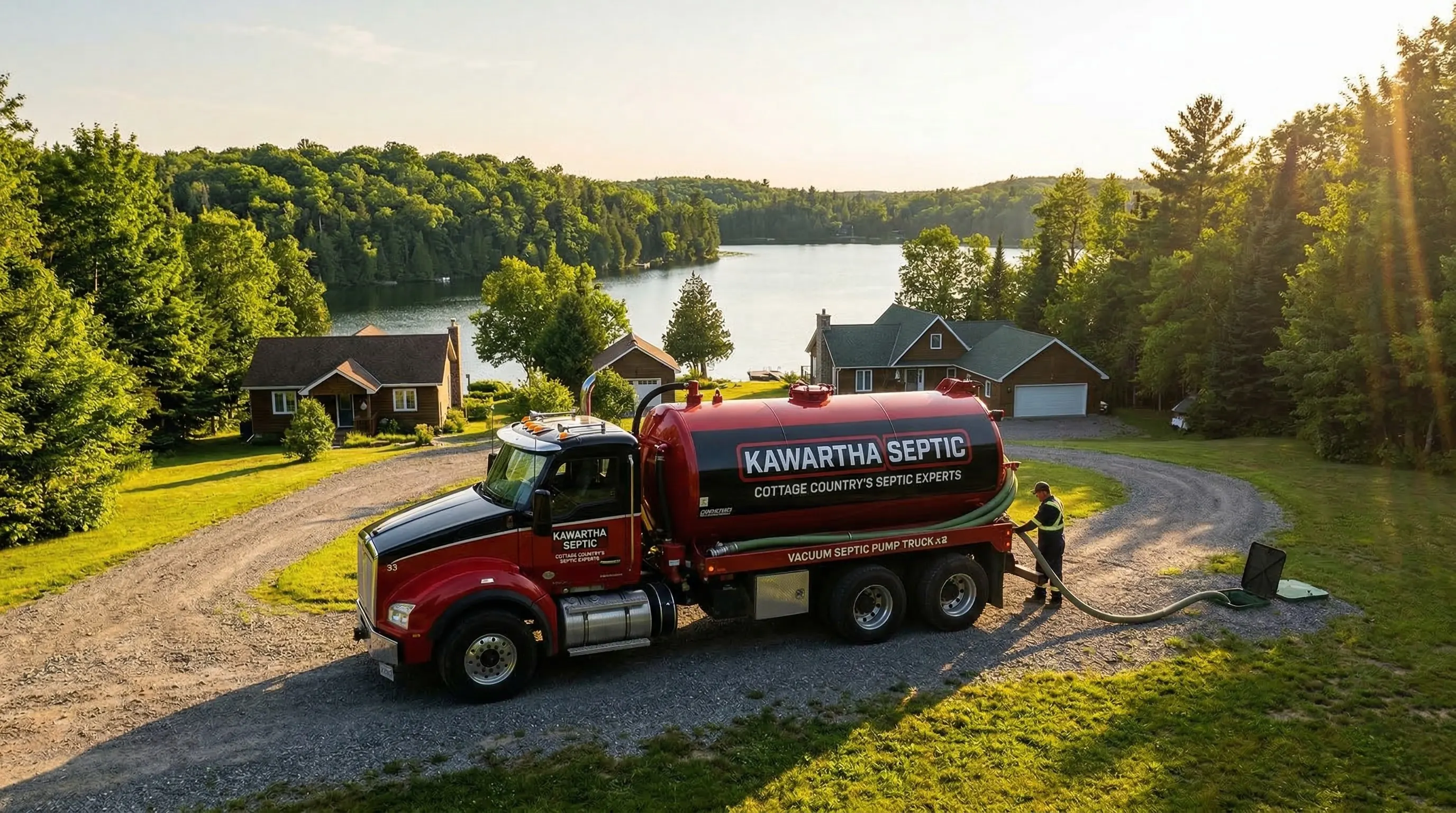
In Ontario the buyer usually pays for the septic inspection, because it is the buyer’s condition in the offer and the buyer’s due diligence. A typical Kawartha Lakes buyer pays $300 to $450 for a full inspection. The seller pays only when the seller orders one, usually before listing, or when the two sides agree to split or shift the cost.
That is custom, not law. Who pays is whatever the agreement of purchase and sale says, and the wording of any condition or cost-sharing clause is a question for your lawyer, not for us.
The more useful questions sit around the edges: the pump-out an inspection needs, whether a seller should pay for a report first, and who pays to fix what the report finds. That last one is where the real money moves.
The Short Version, Line by Line
| Cost | Who usually pays | Typical amount |
|---|---|---|
| Buyer’s full inspection (pump and assess) | Buyer | $300 to $500; most buyers here pay $300 to $450 |
| Pre-listing inspection | Seller | $150 to $500 depending on type |
| Inspection added to a seller’s routine pump-out | Seller | $75 to $150 on top of the pump-out |
| Digging fee where the lid has no riser | Whoever booked the visit, unless the deal says otherwise | $100 to $200 |
| Camera add-on if the inspector wants a look at the lines | Buyer, usually | $150 to $300 |
| City septic records search (Kawartha Lakes) | Whoever requests it | $50 per search |
| City building and septic compliance letter | Whoever requests it, often through an agent or lawyer | $225 |
| Repairs the inspection turns up | Negotiated | Depends on the finding (see below) |
The records search fee and the compliance letter are set by the City of Kawartha Lakes, and the City’s Building and Septic Division page explains how to request both. Other municipalities charge their own rates, so check with yours if the property sits outside the City. For what each inspection level actually covers, see our septic inspection cost guide.
Why the Buyer Usually Pays
The inspection protects the buyer, so the buyer pays for it, same as a home inspection. The Real Estate Council of Ontario notes that a home inspection is one of the most common conditions in an offer, and a septic condition works the same way on rural and cottage property: the buyer gets a set window to have the system looked at, and can renegotiate or walk away if the result is not satisfactory.
Paying for it also means the buyer picks the inspector and gets a report written for them. A report the seller commissioned reflects someone else’s choice of scope, timing and company. RECO makes a related point about the seller’s disclosure statement: it reflects only what the seller personally knows. A seller can be completely honest and still not know the leaching bed is saturated.
If you are buying, our guide to a septic inspection before buying a house in Ontario covers what the inspection itself looks at. This post is about the money around it.
Who Pays for the Pump-Out an Inspection Needs
A full inspection means the tank gets pumped so the inspector can see the walls, the baffles and the inlet and outlet. That pumping is part of the price. The $300 to $500 range for a full inspection already includes it, so a buyer ordering a full inspection is paying for the pump-out as well.
There is a small wrinkle. The buyer pays, but the seller’s tank ends up empty, which is maintenance the seller would otherwise have paid for. Some buyers point that out and ask the seller to cover part of the visit, and some sellers offer it to keep the deal friendly. Neither is standard.
Two practical points both sides should settle before the visit:
- Access. The buyer needs the seller’s permission to open the lid and, if there is no riser, to dig. A buried lid adds a digging fee of $100 to $200. A seller who installs a riser before listing ($200 to $500) removes that fee for every future visit and makes the system easier to inspect.
- Recent pumping. If the seller pumped the tank a few days before the inspection, the inspector loses the normal liquid level, which is one of the best clues to how the tank and bed are behaving. Our post on whether to pump the septic before selling explains the timing. Pump weeks ahead, or book the pump-out and the inspection as one visit.
When a Seller Should Pay for a Pre-Listing Inspection
A pre-listing inspection costs the seller money up front, and the buyer will probably order their own anyway. The reason to pay for it is timing: it moves the surprise onto your schedule instead of theirs. A problem found three weeks before listing is a repair or a pricing decision. The same problem found by the buyer’s inspector halfway through a conditional period is a renegotiation under a deadline, with a closing date already booked and the buyer’s agent holding most of the cards.
A pre-listing inspection makes the most sense when:
- the system is old, or you do not know how old it is
- you have no pumping receipts or permit records
- the property is a cottage or waterfront lot, where buyers are more septic-aware
- you are an executor selling an estate property you never lived in
- you have already seen warning signs such as slow drains, wet ground over the bed, or odour outside
For a seller with a routine maintenance visit due anyway, the cheapest route is to add the inspection to the pump-out for $75 to $150 on top of the pump-out price. A routine pump-out on a 1,000 to 1,500 gallon tank runs $300 to $600 in the City of Kawartha Lakes.
The catch: what you learn, you may have to disclose
A pre-listing report you have read is information you now hold. If it finds a defect, expect to disclose it. How that interacts with your listing documents and the agreement is a question for your lawyer and your agent, and it is better asked before the inspection than after. Our guide to selling a house with a failed septic in Ontario covers disclosure and the four ways sellers handle a bad result.
The flip side is that a clean pre-listing report, handed over with the pumping receipts and any permit records, can make the septic a short conversation, even if the buyer still commissions their own.
Who Pays When the Inspection Finds Something
An inspection bill of a few hundred dollars is small next to the repairs it can uncover, and the repair is never automatically the seller’s problem or the buyer’s. It is negotiated.
Say the buyer’s report flags a deteriorated outlet baffle. That is a $200 to $500 fix. Most sellers would rather fix it or knock the amount off than lose a buyer over it. Now say the report finds the leaching bed has failed. A bed replacement runs $10,000 to $25,000, and a full system replacement runs $15,000 to $35,000 in Ontario, with most jobs landing between $15,000 and $30,000. That is a different conversation.
| Finding | Typical cost to fix |
|---|---|
| Effluent filter replacement | $50 to $150 |
| Tank lid replacement | $100 to $300 |
| Baffle replacement | $200 to $500 |
| Riser installation | $200 to $500 |
| Effluent or lift pump replacement | $600 to $1,500 |
| Leaching bed rehabilitation | $3,000 to $10,000 |
| Tank-only replacement (bed still sound) | $5,000 to $10,000 |
| Leaching bed replacement | $10,000 to $25,000 |
| Full system replacement | $15,000 to $35,000 |
Bigger jobs need a permit before anyone digs. In the City of Kawartha Lakes the permit for a tank replacement or bed repair is $461, and a new standard Class 4 system is $975. Anything past a small repair is quoted after a site visit, not from a table.
The usual ways the cost gets shared:
- Seller fixes it before closing. The buyer has to trust the seller’s choice of contractor and scope, so buyers often ask for the invoice and any permit paperwork.
- Price reduction or credit. The seller pays through the price and the buyer arranges the work after closing. Buyers tend to ask for more than the quote, because they are pricing in the hassle.
- Holdback. Part of the purchase money is held by the lawyers until the work is done. The terms belong in the agreement, drafted by lawyers.
- Buyer walks. Possible if the condition allows it and the numbers do not work.
A written quote changes all of these. A buyer guessing at “a new septic” will assume the worst. A seller holding an itemized quote for a baffle and a filter can keep the discount to the size of the actual job. Our post on how a failing septic can derail a cottage sale goes further into how lakefront buyers react.
Timing Inside the Conditional Period
However many days your condition gives you, the septic inspection is often the item that runs short, because it depends on a truck, a crew and a lid someone can find.
For buyers, book the inspection the day the offer is accepted, not the day after the home inspection. Tell us the condition date when you call. If the report recommends a camera run or a repair quote, you want days left on the clock to get it. Ask the seller’s agent early for pumping receipts and the location of the tank lid, and request the City records at the same time.
For sellers, a pre-listing inspection takes the septic off the buyer’s critical path.
Winter makes all of this harder. Snow and frozen ground limit how much of the bed an inspector can assess and hide the lid. If a sale is likely to land in winter, a fall inspection by the seller is cheap insurance.
And one rule regardless of who is paying: nobody should lift a lid and lean over an open tank to have a look. Leave the opening, and the inside of the tank, to the crew.
A Note for Realtors and Lawyers
On payment, the answer for agents is the same: the client who wants the report normally pays for it. What an agent can do is make it faster. Get the tank location, the pumping receipts and the permit history from the seller at listing, request the City’s compliance letter early, and put the condition date in the first call to us. Our real estate septic inspection page explains what the written report covers, how to read a septic inspection report is worth passing to a client who gets one back, and finding septic records in Kawartha Lakes walks through the City’s search.
Frequently Asked Questions
Does the buyer or the seller pay for a septic inspection in Ontario?
The buyer usually pays, because the inspection is a condition in the buyer’s offer and protects the buyer. The seller pays when the seller orders a pre-listing inspection. Anything else, such as splitting the cost, is a matter of negotiation and should be written into the agreement by the lawyers.
How much does a septic inspection cost for a house sale?
A full inspection, where the tank is pumped and assessed, costs $300 to $500, and a typical Kawartha Lakes buyer pays $300 to $450. A basic visual inspection runs $150 to $250, and a camera add-on is $150 to $300 more. A buried lid with no riser can add a digging fee of $100 to $200.
Is a pre-listing septic inspection worth it for a seller?
It is worth it when the system is old, the records are missing, or the property is a cottage or waterfront lot. It lets the seller find and price problems before a buyer does, instead of renegotiating under a condition deadline. The seller should expect to disclose what the report finds, so talk to a lawyer about that before booking.
Who pays for the pump-out during a buyer’s septic inspection?
The pump-out is part of a full inspection, so the buyer who orders the inspection normally pays for it. Because the seller ends up with an emptied tank, some buyers ask the seller to share the cost, but that is a negotiation point rather than a custom. The buyer also needs the seller’s permission to open the tank and dig if there is no riser.
Who pays to fix septic problems found in the inspection?
Nobody is automatically responsible; it is negotiated. The usual outcomes are a seller repair before closing, a price reduction or credit, a holdback held by the lawyers, or the buyer walking away if the condition allows it. A written quote for the actual repair keeps the discount close to the real cost.
Book the Inspection Around Your Condition Date
Buying or selling, call (705) 702-5526 or book an inspection and give us the property location and your condition date. We call back within 24 hours during business hours, and you get a written report on the tank and the bed.
There is no travel surcharge anywhere in the City of Kawartha Lakes. For properties in Peterborough County, Durham, Belleville and Hastings, or Haliburton, the price is quoted up front before anything is booked.