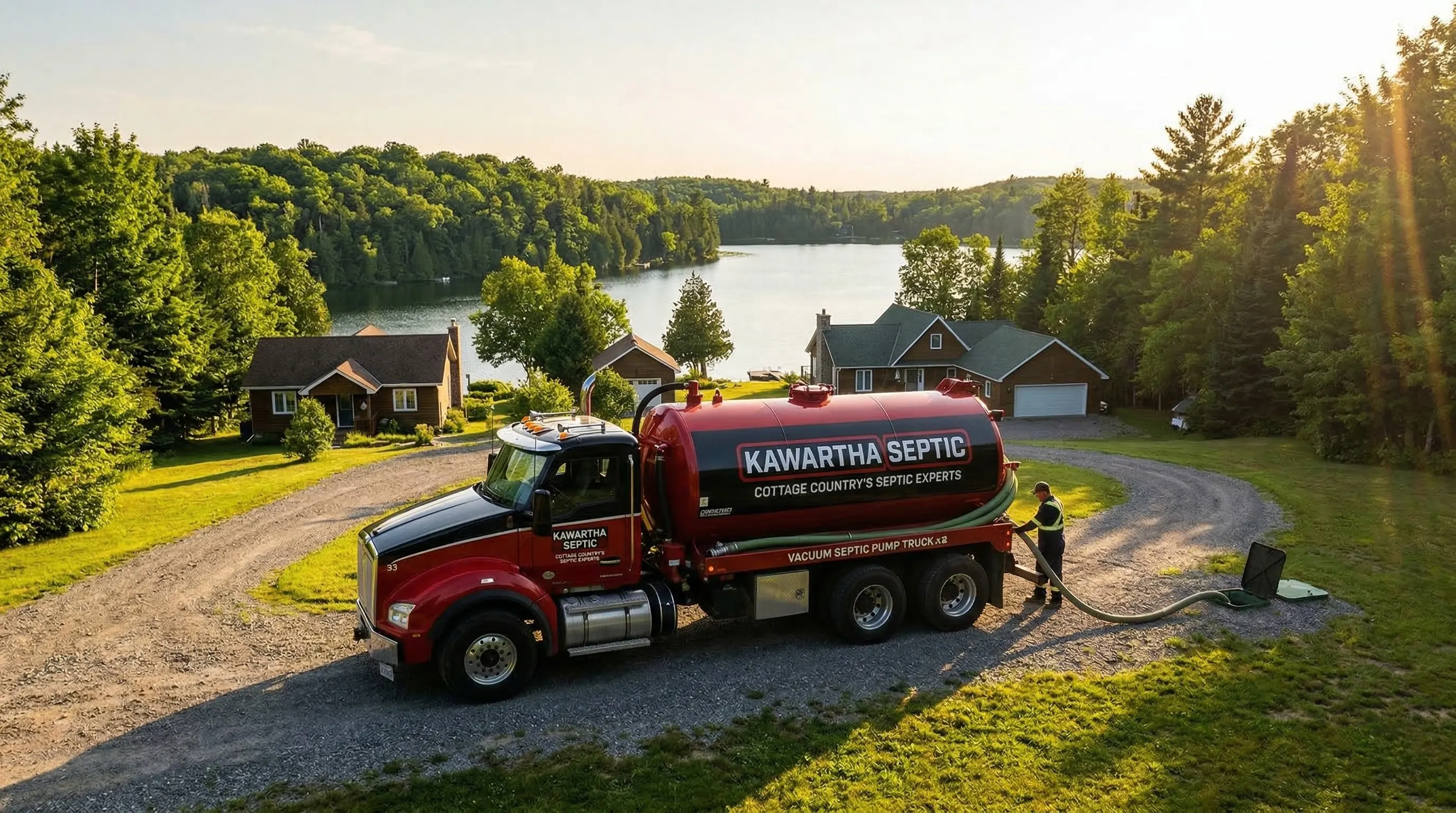
Peterborough sits at the southern edge of cottage country, and that geography decides almost everything about septic systems here. Head south and west and you are on farmland and clay. Head north and you are into lake properties, granite, and shallow soil within twenty minutes. The city itself is largely on municipal sewer — but the county around it is not, and that is where the tanks are.
Kawartha Septic covers Peterborough and Peterborough County: the townships, the concession roads, and the lake properties north and east of the city. Peterborough is part of our service area, and calls from the county are routine rather than exceptions.
This page covers what we do here, what it costs, how often a system in this county actually needs pumping, and the permitting differences that catch people who assume Peterborough works the same way as the City of Kawartha Lakes. It does not.
Book A Pump or call (705) 702-5526 to get on the schedule.
Why Peterborough County Properties Need Regular Service
The City Is On Sewer. The County Is Not.
This is the single most common source of confusion. Someone moves from a Peterborough neighbourhood to a property ten minutes outside it and carries over the assumption that wastewater is somebody else’s problem. It is not. A rural property runs a private sewage system that is legally the owner’s responsibility to maintain, and neglect shows up as a five-figure replacement rather than a rising utility bill.
Two Different Kinds of Ground
The county is split down the middle geologically, and the split matters more than the postal code.
South and west — toward Cavan, Millbrook, Keene, and the Otonabee farmland — you are generally on deeper soil and clay. Clay drains slowly, which shows up as a leaching bed that struggles in a wet spring and a system that punishes hydraulic overload harder than sandy ground does.
North and east — toward Buckhorn, Apsley, Stony Lake and the edge of the Canadian Shield — soil depth runs out fast. Granite sits close to the surface, water tables run high near the lakes, and a conventional tile bed frequently does not fit. That is raised mound and tertiary treatment territory, and it is why replacement quotes in the north of the county land well above the ones in the south.
Cottage Loading Patterns
A large share of county properties are seasonal or recently converted. A cottage on Stony or Chemong runs empty for seven months, then hosts twelve people over a long weekend. That pattern is harder on a system than steady year-round use, because the tank never reaches a stable working state — solids get stirred and pushed toward the bed during exactly the periods the system is most loaded. Our guide to seasonal septic use covers what that does over time.
Our Peterborough Septic Services
- Septic tank pumping — routine pump-outs across the city’s rural fringe and throughout the county
- Septic inspections — condition assessments, and pre-purchase inspections for county property closings
- Septic tank repair — baffles, lids, risers, effluent filters, and pumps
- Drain field repair — bed diagnosis, and the honest rehabilitation-versus-replacement conversation
- Septic system installation and replacement — new builds, failed systems, and cottages converting to full-time use
- Holding tank service — for the shoreline properties where no bed of any kind fits
- Emergency service — backups, alarms, and sewage smell inside the house
How Much Does Septic Pumping Cost in Peterborough?
A standard residential pump-out for a 1,000 to 1,500 gallon tank runs $300 to $600. Most homes and cottages in this county fall in that range.
What moves the number is not distance — it is what the truck meets when it arrives:
| Factor | Effect |
|---|---|
| Tank size | 750 gallon at the low end, 2,000+ gallon at the high end |
| Access | A long, steep, or gated driveway the truck cannot get close to |
| No riser | Digging to find and expose the lid adds $100–$200 |
| Time since last pump | Five years or more means more compacted solids |
| Bundled inspection | Adds $75–$150 while the tank is already open |
Every one of those is quoted up front, before the truck is booked. The price changes only if the scope changes, and we tell you before any extra work happens rather than after. Our cost calculator returns an itemized estimate in about a minute.
How Often Should You Pump in Peterborough County?
Household size drives this more than the calendar does.
| Property | Use | Pump every |
|---|---|---|
| Year-round home | 1–2 people | 4–5 years |
| Year-round home | 3–4 people | 3–4 years |
| Year-round home | 5+ people | 2–3 years |
| Seasonal cottage | Weekends only | 4–5 years |
| Seasonal cottage | Heavy summer use | 2–3 years |
| Rental cottage | High guest turnover | 1–2 years |
| Rural / farm | Variable | 2–4 years |
The shorthand is every 3 to 5 years for most households — but the cottage rows are the ones people get wrong. A property that sits empty most of the year feels like it should need less service, and a rental cottage on Stony Lake with a different family every week needs it twice as often as the house you live in. How often to pump a septic tank works through the reasoning.
Septic Permits Work Differently Here
This is the part worth reading carefully if you have dealt with septic work in the City of Kawartha Lakes before, because the process is not the same one street over the county line.
In the City of Kawartha Lakes, sewage system permits come from the City’s own Building and Septic Division. Peterborough County townships administer Part 8 of the Ontario Building Code through their own building departments, and their fees are set by their own by-laws — so the City of Kawartha Lakes figures published elsewhere on this site do not transfer. Confirm the fee with your township before you budget.
Two things that are the same everywhere in Ontario:
- A permit is required for any new system, replacement, or major repair. The design behind the application has to be prepared by a licensed sewage system designer. Our septic permit guide walks through the sequence.
- The health unit no longer handles onsite sewage systems. Peterborough Public Health does not administer septic permits, and neither does Lakelands Public Health to the north. Septic goes to the municipality. Health units still handle well-water testing.
Properties near water may also need approval from the relevant conservation authority — Otonabee Conservation covers much of the county, and its review runs alongside the municipal application rather than after it. Building that into the timeline from the start beats discovering it at the permit desk.
Cottage and Waterfront Properties
The lakes north of Peterborough — Chemong, Buckhorn, Pigeon, Stony, Clear, and the Kawartha chain running west — bring the same set of constraints together: small lots platted long before modern setbacks, wells and shorelines that box a leaching bed into one possible location, and spring water tables sitting close to grade.
Under the Building Code a leaching bed must sit 15 metres from a drilled well with a watertight casing at least 6 metres deep, and 30 metres from a dug well, plus 15 metres from a lake or watercourse. On a narrow shoreline lot those distances routinely leave no compliant location for a conventional bed, which is why raised systems and tertiary units are so common on these lakes. Waterfront septic rules in Ontario covers the setbacks in detail.
The other frequent job here is the three-season cottage that has quietly become a house. A system designed for July weekends does not survive a family living on it year-round — cottage to full-time capacity explains what changes and why it usually forces a redesign rather than a repair.
Serving Peterborough and the County
Peterborough and the surrounding townships and villages, including Buckhorn, Lakefield, Bridgenorth, Ennismore, Douro, Warsaw, Keene, Norwood, Havelock, Apsley and the Jack’s Lake area, Trent Lakes, and the lake properties in between.
Access matters more than distance out here. Private roads, seasonal roads, steep cottage driveways, and water-access properties all change what is possible — tell us what the approach looks like when you call and we will tell you honestly whether the truck can reach it. Our guide to private road and driveway access covers the common problems.
Peterborough Septic FAQ
Do you service Peterborough and Peterborough County? Yes. Peterborough and the surrounding county are part of our service area, along with the townships and lakes around it — Buckhorn, Lakefield, Bridgenorth, Ennismore, Apsley, and Trent Lakes. Call (705) 702-5526 and describe the property and we will tell you what the realistic path looks like.
How much does septic pumping cost in Peterborough? A standard residential pump-out for a 1,000 to 1,500 gallon tank typically runs $300 to $600. Tank size, access, and how long it has been since the last pump set the final price, and it is quoted up front before the truck is booked, never added afterward.
How often should a Peterborough County property be pumped? Every 3 to 5 years for most households, with household size mattering more than the calendar. Seasonal cottages with heavy summer use are on a 2 to 3 year cycle despite being empty much of the year.
Do you install and replace septic systems in Peterborough? Yes. That covers site assessment, design and permit coordination with a licensed sewage system designer, excavation, and the final inspection. A full replacement runs $15,000 to $35,000 in Ontario, with most jobs landing between $15,000 and $30,000, quoted in writing from a site visit. We diagnose before we replace — if a repair solves it, we say so.
Who issues septic permits in Peterborough County? Peterborough County townships administer Part 8 of the Ontario Building Code through their own building departments, and permit fees differ from the City of Kawartha Lakes figures published elsewhere on this site. Confirm with your township before budgeting. The local health unit no longer handles onsite sewage systems.
Do you cover cottage properties on the lakes near Peterborough? Yes, including seasonal and water-adjacent properties around Buckhorn, Chemong, Pigeon, Stony, and Clear Lake. Cottage systems fail differently from year-round ones — shock loading over long weekends, seven months idle, and shoreline setbacks that constrain where a bed can go at replacement time.
Book Your Peterborough Septic Service
Call (705) 702-5526 or book online. Tell us where the property is, what the system is doing, and what the driveway looks like — that is usually enough to say what it needs and what it will cost before anyone commits to anything.
If sewage is backing up, an alarm is sounding, or there is septic smell inside the house, that is emergency service — call rather than book online, and we will get to you same day or next morning.
We also serve the City of Kawartha Lakes to the west, including Bobcaygeon, Fenelon Falls, Lindsay, and Coboconk.